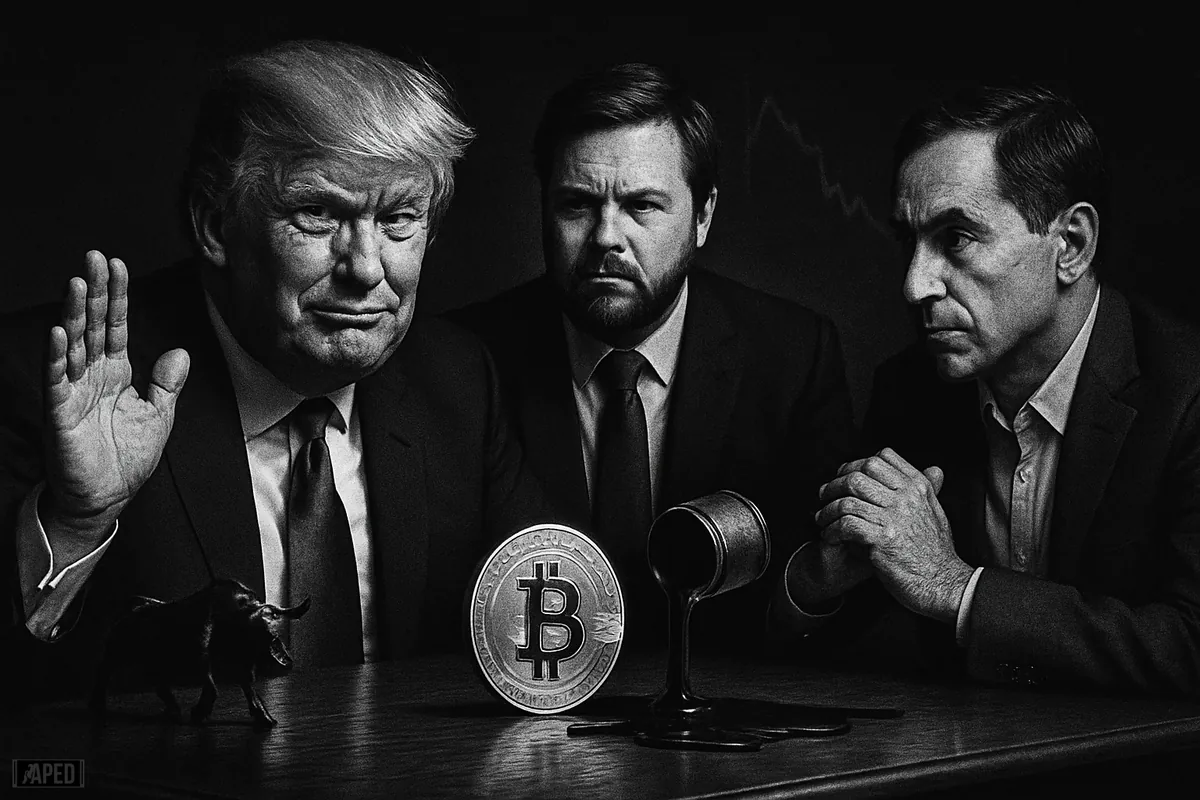
Bitcoin$80,201.51 spent April 25 caught between macro relief and structural risk. Early optimism around lower geopolitical tension and aggressive whale accumulation kept the bid alive, but security failures, hiring fraud, and bond-market stress were a reminder that crypto still does not get a clean tape for long.
Enjoy articles without ads?
Register for free and get unlimited access to all articles.
April 24 had already set the tone. Bitcoin$80,201.51 saw profit-taking above $75,000, then found steadier demand as traders rotated into altcoins and infrastructure names rather than fully de-risking. That mattered because it framed the rest of Friday's session as a continuation trade, not a fresh breakout.
By 10:02 AM UTC, the bullish case sharpened. Whale wallets were reported to have added roughly 270,000 BTC over 30 days, equivalent to around 20 times new post-halving supply. That sort of absorption tightens float fast, and it helps explain why dips have been getting bought even when momentum looks a touch stretched. The $90,000 target in that setup is less about bravado and more about simple scarcity maths, assuming the bigger wallets keep soaking up coins instead of distributing into strength. [1]
The supportive flow was not just on-chain. At 12:01 PM UTC, markets reacted to Donald Trump's upbeat comments on a potential US-Iran deal. Crypto and equities rose while oil fell, a classic risk-on, lower-war-premium response. Later, at 4:31 PM UTC, Bitcoin was reported hovering near $75,700 on the same theme, with traders still pricing in reduced geopolitical stress but not fully trusting the headline cycle. Fair enough. Macro optimism built on political soundbites can flip into a bit of a mess very quickly. [2]
That tension was visible in the day's biggest macro warning. At 11:02 AM UTC, former Treasury Secretary Henry Paulson flagged the risk of a US Treasury market crash and called for an emergency backup plan. For crypto, that cuts two ways. If the bond market genuinely breaks, liquidity conditions across risk assets could get ugly. But the same story also reinforces Bitcoin's appeal as a non-sovereign asset when faith in the plumbing starts looking dodgy. Friday's tape leaned toward the latter interpretation, though that is hardly a settled trade. [3]
Bitcoin's supply story got another small tailwind from the mining side. At 7:31 AM UTC, networkdifficulty was projected to fall about 3% on Friday after slower block production. That should ease pressure on miners who have been dealing with tighter economics since the halving. [4]
A difficulty drop does not magically fix miner margins, but it does reduce near-term operational stress. If miners need to sell fewer coins to stay afloat, that complements the whale accumulation story rather neatly. Less forced supply, more strategic demand, and you can see why the market keeps talking itself into higher levels.
Ethereum$2,325.87 had a more mixed day. At 6:01 AM UTC, Josh Stark's departure from the Ethereum Foundation landed as the clearest high-profile exit since the 2025 reshuffle. On its own, one senior figure leaving after five years is not a crisis. But timing matters, and the Foundation remains under close scrutiny over leadership, execution, and how it balances research culture with ecosystem demands.
The more concrete Ethereum-linked development came later. At 3:31 PM UTC, an Ethereum Foundation-backed security initiative said it had identified around 100 suspected DPRK-linked developers using fake identities to infiltrate crypto firms. That is not merely a headline risk. It is an operational warning for protocols, DAOs, and startups still hiring remote engineering talent at speed. [5]
The significance here is practical. North Korean infiltration has long been associated with laundering and exploit pipelines, but this report points to a broader employment attack surface. Teams that still treat hiring as a vibes-based Telegram process are asking for trouble. Proper identity verification, repository audits, payment tracing, and access controls are no longer optional overhead.
Security trouble was not confined to hiring. At 1:31 PM UTC, Hyperbridge revised the damage from its April 13 Polkadot$1.232 bridge exploit to $2.5 million, up sharply from an earlier $237,000 estimate. The revised number reflected wider losses across four EVM chains and pools, which is exactly why bridge incidents remain such nasty trades for users. Initial figures are often incomplete, and the real damage tends to spread across wrapped assets, fragmented liquidity, and delayed accounting. [6]
That revision is bad news for Polkadot-adjacent sentiment even if the absolute loss is modest by crypto standards. Markets care about confidence, and cross-chain infrastructure still has a habit of looking robust until one weak assumption gets hit. Bridges are where complexity goes to hide, right up until it doesn't.
Polymarket, by contrast, delivered a cleaner story. At 3:01 AM UTC, the platform resolved three Israel-Hezbollah ceasefire markets to Yes, settling more than $5.3 million in bets. On the surface this was just market resolution. Underneath, it showed prediction markets doing what they claim to do: compressing geopolitical uncertainty into tradable outcomes and then closing the loop. The broader market also read the resolution as one more signal of reduced near-term Middle East risk.
Adoption and labour reality checks
Denmark offered a sobering reminder that crypto adoption is not universally marching upward. At 2:31 PM UTC, local ownership was reported stuck at 4%, well below markets like the UK, with harsh tax treatment and limited banking support acting as clear bottlenecks. This is the boring stuff that matters. Retail adoption does not fail because people have not heard of Bitcoin. It fails when banks make access awkward and tax policy makes every transaction feel punitive.
A later white paper from Gate on crypto hiring trends, published at 5:31 PM UTC, added another reality check. The sector's labour market appears more selective and less euphoric than in prior cycles. Even without the full mania-era wage inflation, firms are still hiring around compliance, security, and infrastructure rather than broad speculative expansion. That fits the tape. Capital is flowing, but operators are being far less cavalier about headcount. [7]
Shiba Inu$0.00000613 sat in familiar territory at 9:02 AM UTC. The ecosystem is still building out Shibarium and broader utility, but SHIB price remains under pressure. Development updates are useful, yet they do not override weak demand, soft tokenomics, or a market that has become more ruthless about narratives that do not translate into actual usage and sticky liquidity. [8]
That is the lesson for meme-adjacent ecosystems more broadly. Community can keep a token alive, but it does not guarantee a rerating. Traders want volume, fees, users, and credible catalysts, not just another roadmap thread on CT, meaning Crypto Twitter.
Friday's flow was constructive overall. Bitcoin had whale support, miners caught a small break, and macro headlines briefly lowered the global risk premium. That is a decent cocktail for upside, and it explains why the market kept flirting with stronger levels instead of rolling over.
Still, the invalidation case is straightforward. If geopolitical optimism fades, if bond-market stress starts draining liquidity rather than boosting the anti-fiat trade, or if whales switch from accumulation to distribution, the bullish structure gets a lot less convincing. Add in bridge exploits and state-linked infiltration risk, and the day's message was clear enough: the bid is real, but so are the cracks underneath it.
Your reviews help us improve the quality of both current and future articles. All reviews are public and visible to other readers. We use both ratings and comments to improve future articles and to revise any articles that do not meet our standards.
 See more like this on Google