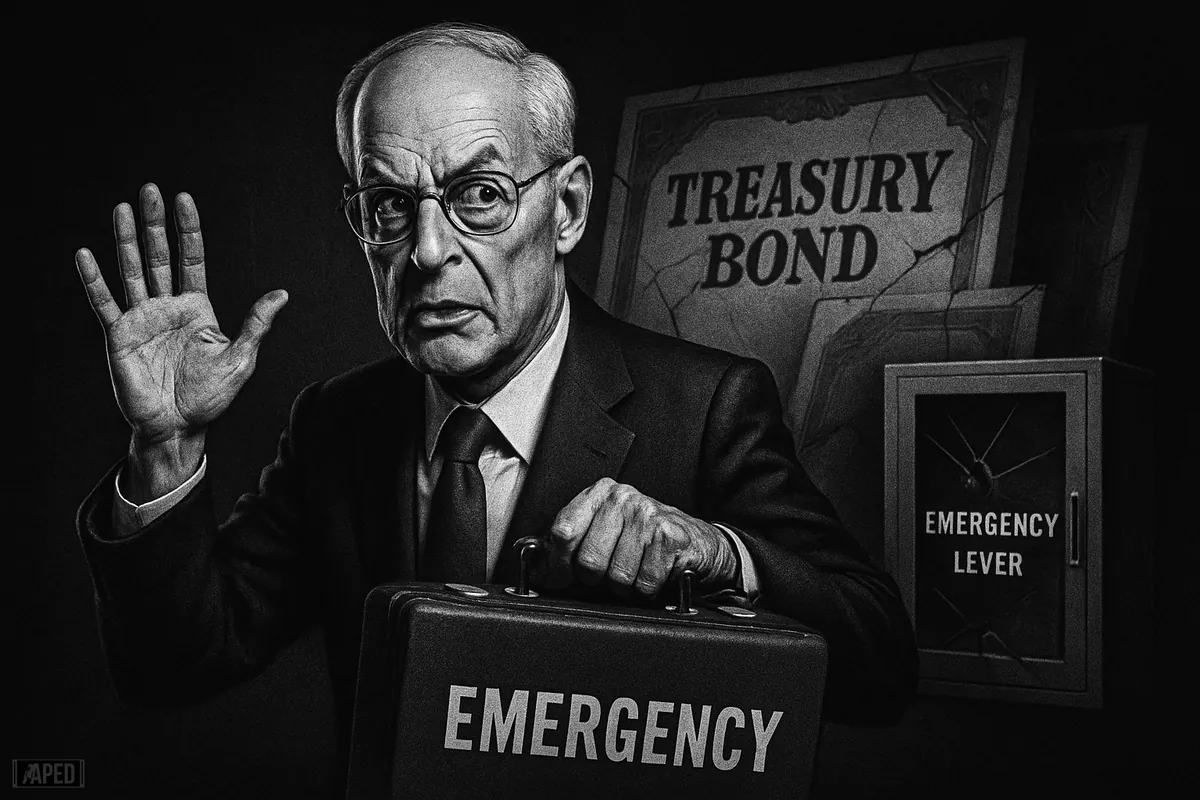
The Treasury market is supposed to be the boring part of finance. The designated adult in the room. So when a former US Treasury secretary starts talking about a possible crash and says policymakers need a "break the glass" plan ready to go, that lands less like routine macro chatter and more like the fire alarm getting tested for real.
Henry Paulson, who led the Treasury during the 2008 financial crisis, said this week that US authorities should prepare an emergency, targeted, short-term response for a potential future breakdown in demand for US Treasurys. Speaking to Bloomberg on Thursday, Paulson warned that nobody can time the moment the market "hits the wall," but argued the fallout could be severe when it happens. [1]
Enjoy articles without ads?
Register for free and get unlimited access to all articles.
Why this warning matters
Paulson is not talking about a normal sell-off or a few rough auction cycles. The issue is more structural: what happens if investors stop absorbing the massive amount of US government debt smoothly enough to keep the market functioning without stress.
That matters because Treasurys are the global system's base layer. They are used as collateral, pricing benchmarks, liquidity reserves, and the default "safe asset" across banks, funds, and sovereign portfolios. If demand for them cracks hard, the damage would not stay contained inside bond desks. It would spill into funding markets, equities, credit, and likely crypto too. [2]
His language is notable for another reason. A former top official calling for a contingency plan suggests concern is moving beyond abstract debt sustainability debates and into market plumbing. In other words, this is not just about whether US borrowing is too high over the long run. It is about whether the system can handle a disorderly repricing if buyers step back suddenly.
The core of Paulson's message is preparedness. He wants an emergency response framework "on the shelf," meaning policymakers should design the tool before stress arrives, not while markets are already dislocating.
A targeted, short-term intervention
Based on his comments, the idea is not a standing bailout or an open-ended support program. It is a temporary mechanism that could be deployed if Treasury market dysfunction became acute. That could mean steps to stabilize liquidity, restore market confidence, or prevent a broader seizure in financial conditions.
The exact design was not detailed in the source reporting, but the phrase "break the glass" is doing a lot of work here. It implies something reserved for a genuine emergency, not a policy convenience. [3]
Why now
The US government continues to issue large volumes of debt, while rates remain high enough to make financing more expensive and long-duration bonds more sensitive to shifts in sentiment. Markets have also become more fragile in moments of stress, especially when leveraged players, dealers, and liquidity providers all pull back at once.
Paulson's warning reflects a simple fear: if confidence in the Treasury market weakens at the same time issuance remains heavy, volatility could feed on itself. [4]
The deeper stress point in the Treasury market
There is a difference between the US being able to pay its debts and the market being able to absorb those debts smoothly. Paulson's concern sits in that gap.
Treasurys still benefit from deep institutional demand, reserve currency status, and the sheer lack of a true alternative at comparable scale. But that does not make the market invulnerable. Auction softness, rising yields, and thinning liquidity can reinforce each other. If buyers demand materially higher returns to hold more debt, prices fall and borrowing costs rise, which can then worsen fiscal concerns.
That loop is what makes the phrase "vicious" stick. Once confidence starts slipping in the world's core collateral market, policymakers may have very little time to react.
This is not a fringe concern anymore
Macro watchers have spent the last few years arguing over whether the Treasury market's biggest problem is debt supply, foreign demand, dealer balance sheet limits, or the fading assumption that bonds always rally in stress. Paulson's comments pull those threads into one message: the system may need a prepared emergency backstop.
On CT, short for Crypto Twitter, the reaction was predictable but not trivial. Some users framed it as another sign that fiat plumbing is buckling and Bitcoin$80,326.13's "digital gold" pitch is back on the menu. That is a little too neat. Treasury stress can help the Bitcoin$80,326.13 narrative over time, but in an actual market accident, correlations often go messy before any safe-haven thesis gets cleanly priced in. [5]
Crypto traders tend to read every macro headline through one of two lenses: bullish liquidity pivot or bearish risk-off shock. Treasury market stress can support both narratives, depending on the timeline.
Short-term risk
If the Treasury market experiences real dysfunction, the first market move is unlikely to be a calm, orderly migration into speculative assets. More often, investors de-risk, funding costs rise, and anything with volatility gets sold to raise cash. That can hit Bitcoin, Ethereum$2,326.40, and altcoins alongside equities.
Stablecoins would also come into focus fast. Many major issuers hold short-dated Treasurys or Treasury-linked assets as reserves, which is usually a strength. But a disorderly rates move or liquidity disruption would trigger fresh scrutiny around reserve management, duration exposure, and redemption capacity.
Longer-term narrative support for Bitcoin
The bigger implication is philosophical and strategic. Bitcoin$80,326.13's appeal strengthens when trust in sovereign debt as the unquestioned safe asset starts to wobble. That does not mean Treasurys are suddenly obsolete. It means the "there is no alternative" mindset gets a little weaker each time a mainstream policymaker openly discusses contingency planning for the bond market itself.
For institutions already treating Bitcoin as a hedge against fiscal drift, Paulson's comments add rhetorical fuel. For everyone else, they are a reminder that macro fragility does not only live in banks or regional currencies. It can show up in the deepest market on earth.
Why policymakers may be forced to act faster next time
One lesson from recent years is that market structure matters as much as headline economics. Treasury volatility can be amplified by leverage, basis trades, dealer constraints, and fast-moving positioning across hedge funds and asset managers. That makes "wait and see" a risky posture.
A ready-made intervention plan could reduce panic simply by existing. Markets do not always need a rescue deployed. Sometimes they need confidence that one can be deployed credibly and quickly.
That said, any backstop carries its own hazards. If participants believe the government will always step in, risk-taking can creep higher. The policy challenge is building a tool strong enough to stop contagion without encouraging complacency.
The Bottom Line
Paulson's warning is not a call to panic-buy bunkers or Bitcoin bags. It is a sober signal that stress in the US Treasury market is now serious enough for former senior officials to talk openly about emergency planning. [6]
For crypto investors, the practical takeaway is simple: watch the bond market like it actually matters, because it does. If Treasury demand weakens sharply, the first effect could be broad market pain. The second could be a stronger case for non-sovereign stores of value. Timing that switch is the hard part, and markets are rarely polite about it.
Your reviews help us improve the quality of both current and future articles. All reviews are public and visible to other readers. We use both ratings and comments to improve future articles and to revise any articles that do not meet our standards.
 See more like this on Google