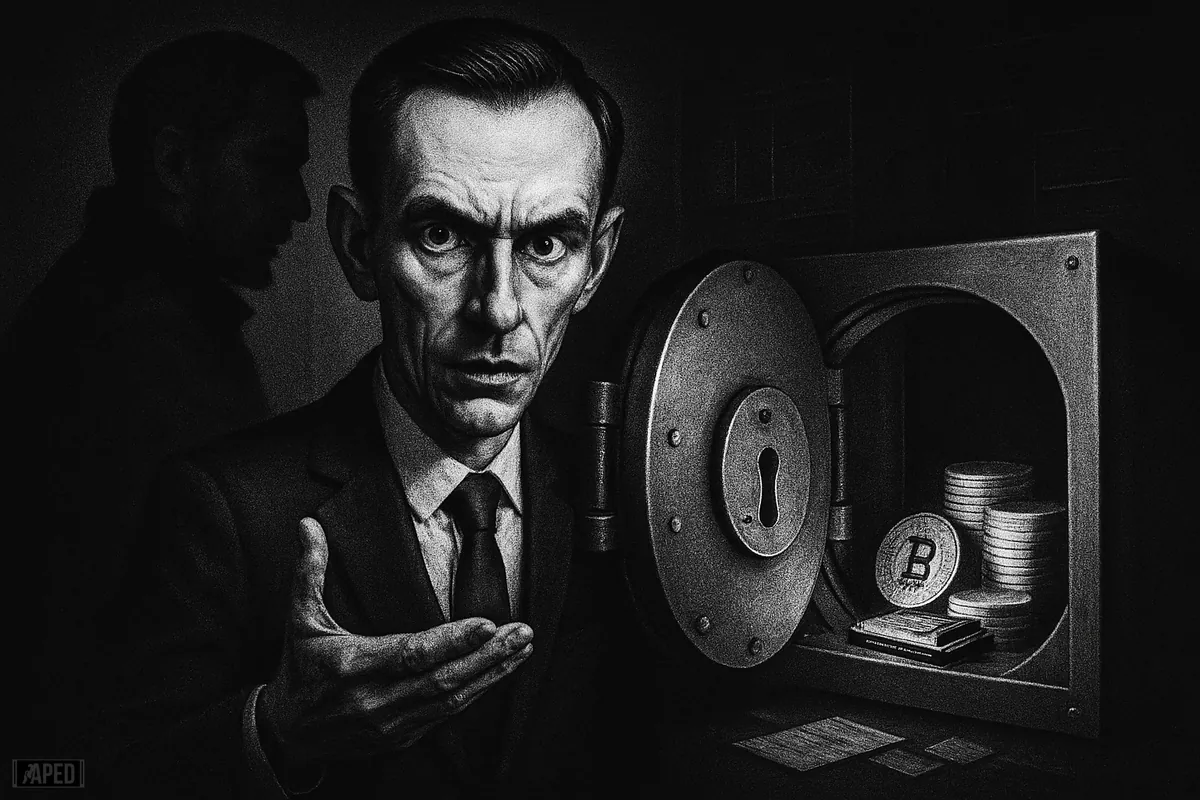
Twitter got another proof of reserves moment, except this one came with a plot twist: the exchange says the coins are real, public, and visible onchain, but also effectively out of reach.
Zonda CEO Przemysław Kral has publicly pointed to a Bitcoin$80,657.30wallet holding about 4,503 BTC, worth roughly $334 million at the time of the statement, as he pushed back against allegations that the Poland-linked crypto exchange misused customer funds. The reveal came via X and a video statement, where Kral framed the controversy as a politically charged attack on the company. His core claim was simple, if unusual: the wallet exists, but Zonda cannot access it because former CEO and founder Sylwester Suszek allegedly did not hand over the private key. [1]
Enjoy articles without ads?
Register for free and get unlimited access to all articles.
The wallet reveal, and why it raised more questions
On paper, showing a public wallet is a clean CT move. It gives the crowd something verifiable, and onchain receipts tend to travel faster than press releases. But the wallet disclosure did not settle the argument. It changed the shape of it.
Kral said the address contains thousands of Bitcoin$80,657.30 connected to the company's history, and he directly called on Suszek to provide the missing key. That turns the dispute from a standard solvency concern into something stranger: a reserve claim tied to an asset that management says it cannot actually use. [2]
That distinction matters. A visible wallet is not the same thing as accessible liquidity. For customers worried about slow withdrawals, the relevant question is less "do the coins exist somewhere?" and more "can the exchange move funds when users ask for them?"
Onchain history does not look like an active exchange treasury
The wallet's transaction pattern has become part of the story. Reports tied to the disclosed address suggest that nearly all of the balance, around 4,434 BTC, arrived back in March 2016. Since then, activity appears limited mostly to small dust transfers, meaning tiny token movements that often say little about operational treasury use. [3]
That history looks odd for an exchange handling large customer flows. A live exchange treasury usually shows more frequent movement, rebalancing, and operational churn. A wallet sitting mostly still for years may still be significant, but it does not obviously function like a hot or warm reserve tied to daily withdrawal demands.
That does not prove wrongdoing by itself. It does, however, weaken the idea that the wallet alone resolves present-day solvency concerns.
The fund misuse allegations at the center of the dispute
The more serious issue is not just wallet custody. It is whether customer funds were used in ways Zonda said they would not be.
A treasury advisory firm, Kancelaria Skarbiec, has pointed to discrepancies between Zonda-linked financial disclosures and the exchange's customer-facing terms. According to cited financial statements for BB Trade Estonia OÜ, the entity said to operate Zonda Crypto, customer funds were "further invested" in both short and long-term activities. [4]
That wording clashes with the exchange's stated position in its terms and conditions, which says customer assets are held to execute orders and are not invested, lent, or used for the platform's own benefit. If both descriptions are accurate, they describe very different business models. If one is inaccurate, the credibility problem gets bigger.
Additional reporting around the same disclosures points to around €75 million in loans extended by BB Trade, with some allegedly issued without collateral. That detail has sharpened concern because unsecured lending using customer-linked funds would be one of the clearest examples of a red-line treasury practice. [5]
At this stage, the public record as presented in the reporting raises questions rather than delivering a final legal conclusion. Still, this is the part of the story that likely matters most to users. Slow withdrawals are one thing. The possibility that client funds were deployed into loans or investments without clear consent is another, and much harder for an exchange to explain away with a wallet screenshot.
Why Kral says politics is part of the story
Kral has argued that the controversy is not purely financial and that Zonda is being targeted in a broader political campaign. That defense lands in a national context where crypto oversight has become a louder issue in Poland.
Deputy Prime Minister and Minister of Digital Affairs Krzysztof Gawkowski has publicly pushed for tighter supervision of crypto exchanges and stronger transparency rules. He has also criticized limitations on the Polish Financial Supervision Authority's reach after crypto-related legislation was vetoed. That means Zonda's current troubles are unfolding at the exact moment policymakers are looking for examples to justify tougher guardrails.
The political angle gained extra traction after reports that Kral donated €105,808 to a foundation linked to a former justice minister, along with €70,000 to a member of a conservative political party. Those donations do not prove financial misconduct, but they add heat to an already messy narrative. Once politics, consumer protection, and exchange reserves get mixed together, nobody gets the luxury of a simple story.
What customers and the market are likely watching
For users, community sentiment tends to collapse into one practical metric fast: are withdrawals normal? The source reporting indicates repeated confirmation that withdrawals have slowed, and that alone keeps pressure on management. Exchanges can survive ugly headlines longer than they can survive a confidence spiral around redemptions. [6]
The second thing to watch is whether Zonda provides stronger proof than a single wallet address. A fuller reserves and liabilities breakdown, independent attestation, wallet ownership proofs, and a clear explanation of the relationship between historic wallets and current operating balances would all be more useful than symbolic transparency.
Even if Kral's account is accurate, it leaves Zonda with a governance problem that is hard to spin. A major wallet allegedly tied to the exchange was not handed over after a leadership transition. That suggests serious internal control failures at minimum. If the allegations around investing or lending customer funds gain documentary support, the issue becomes much larger than governance.
Crypto users have seen this movie before, and that is why market reaction in stories like this tends to be harsher than management expects. The industry's post-2022 trust standard is simple: not your keys, not your coins, and not your audit, not your reassurance.
The bottom line
Zonda's CEO has tried to answer misuse claims with onchain visibility, but the reveal may have deepened the central concern instead of closing it. A 4,503 BTC wallet is meaningful. A 4,503 BTC wallet that management says it cannot access is a different kind of signal.
The next catalyst is not another statement on X. It is evidence: faster withdrawals, clearer accounting, and independent verification of what funds belong to whom. Until then, the wallet reveal reads less like a clean exoneration and more like a live stress test for how much trust an exchange can retain when its own receipts come with an asterisk.
Your reviews help us improve the quality of both current and future articles. All reviews are public and visible to other readers. We use both ratings and comments to improve future articles and to revise any articles that do not meet our standards.
 See more like this on Google