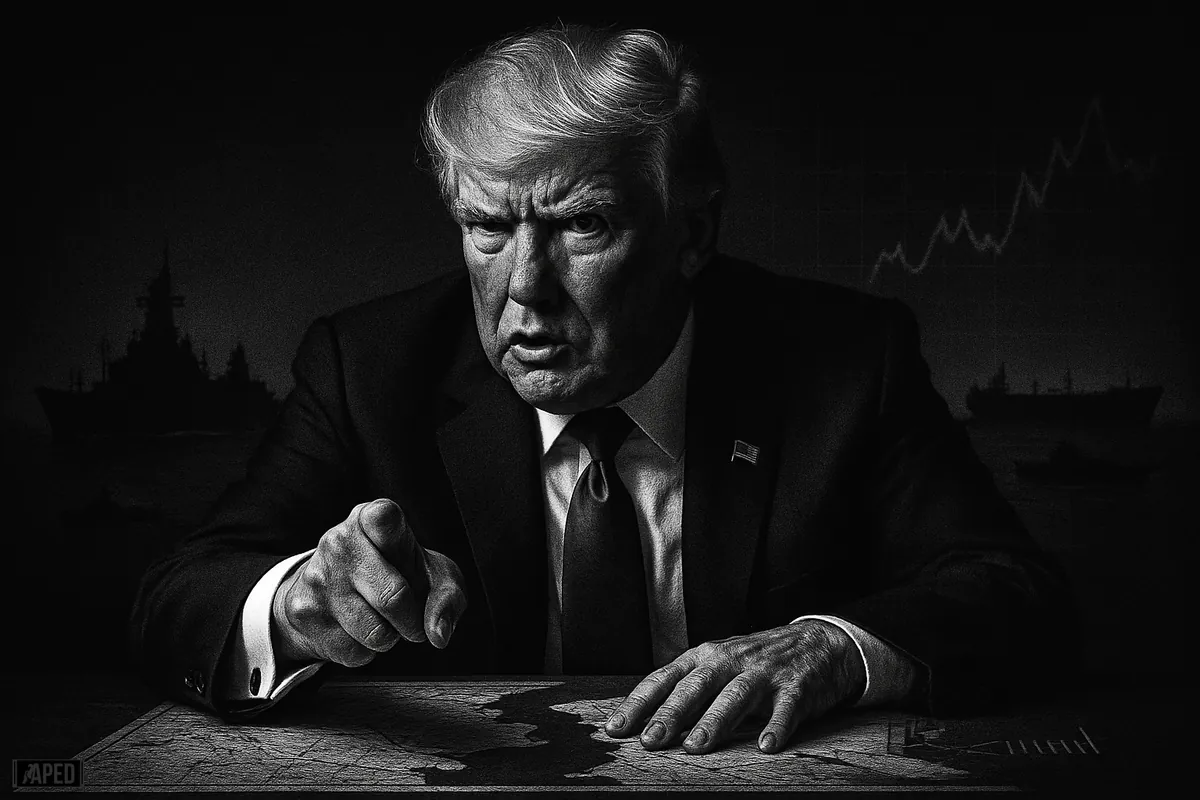
Polymarket's Iran invasion market ripped higher after Donald Trump threatened to target Iranian power infrastructure if Tehran moved to block the Strait of Hormuz. The contract pricing the odds of U.S. forces entering Iran this year surged to roughly 63%, a sharp repricing that shows prediction traders are now assigning better-than-even odds to direct military action. [1][2]
That move matters because Polymarket tends to function like a live geopolitical order book. When traders pile into a contract this quickly, it is usually a response to a new headline plus a scramble to hedge broader macro risk, especially oil, shipping, and defense exposure.
Register for free and get unlimited access to all articles.
Threat rhetoric pushes war odds higher
The catalyst was a fresh Trump warning that framed Iranian power plants as potential U.S. targets if Iran tried to choke off Hormuz, the narrow shipping lane through which a large share of global crude exports passes. Markets did not treat the statement as idle posting. On Polymarket, traders marked up the probability of a U.S. military incursion into Iran well above prior levels, with bids moving fast enough to suggest a rush for exposure rather than a slow grind higher. [3][4]
A 63% implied probability does not mean invasion is likely in the conventional sense. It means traders are willing to pay 63 cents on the dollar for a contract that resolves to yes if U.S. forces enter Iran before the market's deadline. That can reflect conviction, hedging demand, momentum chasing, or thin liquidity amplifying the move.
Why Hormuz changes the market structure
The Strait of Hormuz is the key macro hinge here. Any credible threat to close or disrupt it immediately widens the blast radius beyond regional politics. Tanker traffic, energy prices, insurance costs, and broader risk sentiment all get repriced at once.
That is why a threat tied specifically to Hormuz can move prediction markets harder than generic war rhetoric. Traders are not just betting on headlines. They are pricing a chain reaction: blockade fears, U.S. retaliation, escalation risk, and the odds that a limited strike becomes something legally or operationally classed as "entering Iran."
Prediction markets are useful because they compress news flow into a single tradable number, but they are not crystal balls. They are especially tricky on military contracts, where wording does a lot of work.
If a market asks whether U.S. forces will "enter Iran," traders need to think about what counts. Ground troops crossing the border is obvious. Less obvious are special operations, air crews involved in strikes, naval actions with no physical entry, or cyber and infrastructure attacks that stop short of boots on the ground. Those edge cases can create violent swings as traders game the resolution criteria. [5]
High odds do not equal high confidence
When a contract jumps into the 60% range on a headline, that often says as much about urgency as certainty. Geopolitical markets can be thin, and a relatively small amount of capital can gap price if the ask side disappears. A few whales, or even a cluster of fast-money accounts, can force a repricing that looks more definitive than it really is.
That does not make the signal useless. It means the number should be read alongside volume, spread, and context. If the bid holds after the initial spike, it suggests deeper conviction. If it fades quickly, the move may have been a headline squeeze.
Why crypto traders care
This is not just a politics trade. Crypto desks watch these markets because geopolitical stress tends to spill into Bitcoin, stablecoins, and on-chain risk appetite.
A Hormuz escalation would likely hit global liquidity expectations through higher oil and shipping costs. That can push traders toward dollars and short-duration safety, at least initially. In crypto terms, that usually means stronger stablecoin demand, weaker altcoin beta, and choppier conditions for leveraged longs. Bitcoin can sometimes catch a bid as a non-sovereign asset, but the first move during war scares is often simple de-risking.
Prediction markets like Polymarket also matter as crypto-native venues themselves. Big geopolitical events test whether on-chain markets can absorb real-world uncertainty without freezing up or becoming too easy to manipulate. If volume spikes and prices continue to update cleanly, that reinforces the case for crypto rails in event trading. If spreads blow out or resolution disputes dominate the conversation, skeptics get fresh ammo.
The key risk in reading this signal
The main risk is confusing a threat with a settled policy path. Trump's statement clearly pushed traders to buy war risk, but military escalation depends on many variables that no prediction market fully captures: Iranian response, U.S. allied coordination, congressional and legal constraints, and whether deterrence works without actual strikes. [6]
There is also headline reflexivity. Once a market spikes, the spike itself becomes news, which can attract more buyers who are trading narrative momentum rather than underlying probability. That loop can keep prices elevated longer than the facts justify.
The Bottom Line
Polymarket's jump to about 63% on U.S. forces entering Iran this year is a clean read on how seriously traders took Trump's threat around Iranian power infrastructure and a possible Hormuz blockade. It is a strong signal that geopolitical risk has been repriced, not proof that invasion is locked in. [7]
For traders, the level matters less than whether it sticks. If odds stay elevated after the initial headline cycle, that points to real conviction. If they retrace hard, it was likely a liquidity-driven panic bid. Either way, this is now a market to watch closely because the invalidation is simple: de-escalation around Hormuz, softer U.S. rhetoric, or contract language that makes the "invasion" thesis harder to resolve as yes.
Your reviews help us improve the quality of both current and future articles. All reviews are public and visible to other readers. We use both ratings and comments to improve future articles and to revise any articles that do not meet our standards.
 See more like this on Google