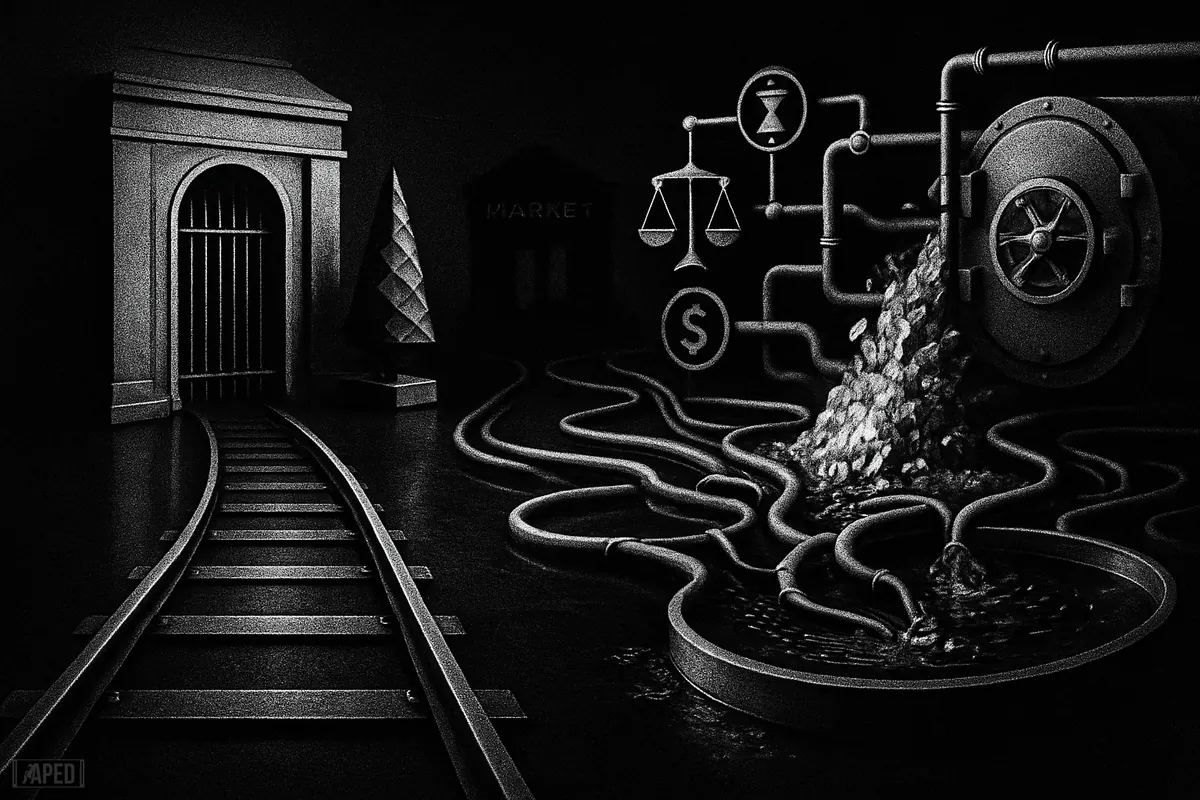
The on-chainmarket is no longer one big, messy casino with a Bloomberg terminal taped to the side. It is splitting into two distinct tracks, and the gap says quite a lot about who crypto is for in 2026, and who gets to touch the good liquidity. [1]
One lane is being built for institutions that want blockchain rails without public-chain chaos. The other remains public DeFi, where liquidity, composability, and round-the-clock price discovery still live. The interesting bit is not that these worlds are diverging. It is that they now need each other.
Enjoy articles without ads?
Register for free and get unlimited access to all articles.
Two systems, two priorities
Large financial firms are pushing deeper on-chain, but mostly inside controlled environments. That means permissioned systems for repo, treasury management, cash movement, and settlement, with identity checks, access controls, and compliance baked in from the start. The pitch is familiar: blockchain efficiency, TradFi guardrails. [2]
Public DeFi, meanwhile, is still doing what it does best. Open liquidity pools, perpetual trading, lending markets, stablecoin rails, and programmable settlement remain concentrated on public networks because that is where users, capital, and applications already are. Institutions may dislike the mess, but they still want the depth.
That is creating a market structure with different users, tools, and risk tolerances on each side. Permissioned networks optimise for governance and oversight. Public chains optimise for liquidity and speed. Neither side fully replaces the other.
The old framing treated private institutional chains and public DeFi as mutually exclusive. That view is ageing badly. The current trend is toward controlled gateways that let regulated participants access public-chain liquidity without opening the doors completely. [3]
This matters because institutional adoption is no longer about whether banks will use blockchain. They already are, selectively. The live question is how they connect those internal systems to external liquidity venues without blowing up compliance policy. The answer, increasingly, is segmented architecture: gated environments on one side, public execution or settlement access on the other. [4]
Avalanche$9.279's Evergreen stack is one of the better-known examples of this design. Its enterprise-facing work, including Spruce-related tokenization pilots, has focused on bespoke blockchain environments for institutions. Avalanche Warp Messaging adds a way for separate Avalanche-based chains to communicate, which is exactly the sort of plumbing needed if capital is going to move between private and public contexts.
ZKsync$0.01662 is chasing a similar route through enterprise-oriented systems linked back to Ethereum$2,335.15. The point is not the branding. It is the direction of travel. Institutions want crypto rails, but only with selective exposure, known counterparties, and a veto button.
Tokenized treasuries are winning the "safe" trade
If there is a benchmarkasset for compliant on-chain capital in 2026, it is tokenized Treasuries. They give institutions a low-risk yield instrument that sits comfortably inside regulated workflows, and they solve a practical problem: what to do with idle on-chain cash without diving straight into DeFi risk. [5]
That makes them one of the clearest beneficiaries of the split economy. On one track, tokenized T-bills are becoming the reserve asset of serious, compliance-first capital. They are useful collateral, cash management tools, and a parking place for firms that want blockchain efficiency but do not want to explain memecoin beta to the investment committee.
But the trade is not universal. Public DeFi users, especially those still hunting higher returns, are less interested in parking funds in low-yield government paper unless it can be used productively on-chain. The product only really sings when it plugs into lending, collateral, and settlement flows. Without that, it risks becoming an institutional wrapper with limited retail relevance.
The user split is just as important as the infrastructure split. Retail flows are increasingly coming through fintech wrappers and app-based products that make crypto look less like native DeFi and more like digital savings or passive accumulation. The emphasis is on access, convenience, and regulated user experience.
That is a different cohort from early-cycle crypto natives, many of whom have shifted from aggressive speculation to capital preservation. A lot of the old guard are still on public rails, but the mood has changed. Less "ape first, ask later", more "where is the exit liquidity and who controls the bridge".
This creates a strange market dynamic. New users may technically be entering the on-chain economy, but not necessarily through the permissionless stack that defined earlier cycles. They are touching blockchain through packaged front ends, custodial rails, and regulated products, while native DeFi remains the playground for users willing to manage more risk directly.
Cross-border settlement is still a legal problem disguised as a tech problem
For all the talk of blockchain solving global payments, cross-border settlement still depends less on throughput and more on whether compliance frameworks can line up across jurisdictions. That is where plenty of otherwise polished institutional projects hit the wall. [6]
A permissioned network can move value neatly between approved participants, but the moment assets cross borders, legal treatment, reporting standards, licensing, and counterparty rules become messy. Public chains can handle the transfer. Regulators and institutions still need to agree what the transfer means.
That keeps the split alive. Domestic or tightly scoped institutional use cases can work well inside permissioned environments. Global, always-on liquidity still leans public. The connective tissue is improving, but the policy layer remains the bit most likely to slow things down.
Market plumbing will matter more than narratives
For traders, this bifurcation changes where to look for real signals. The story is not just "institutional adoption" anymore. It is whether capital can actually move between gated and public systems in size, with acceptable settlement risk and enough secondary liquidity.
That means watching stablecoin issuance and redemption patterns, wallet clustering around tokenized treasury products, bridge volumes between enterprise-friendly subnets or rollups and public chains, and the growth of compliant liquidity venues. Open interest and funding rates still matter for public markets, particularly when tokenized real-world asset narratives start dragging beta higher across infrastructure names. But the more durable signal is where sticky capital parks itself when volatility rises.
If permissioned venues keep absorbing treasury and cash-management flows while public DeFi retains trading and leverage, then crypto's market structure starts to look less like one ecosystem and more like two interdependent balance sheets.
There are several ways this setup can go wrong. First, liquidity fragmentation. If too much capital gets siloed in private environments, public markets lose depth, spreads widen, and the whole "connect to DeFi when needed" promise starts looking thin.
Second, bridge and interoperability risk remains very real. The tubing, to borrow the industry metaphor, is where systems usually leak. Every extra messaging layer, wrapped representation, or permissioned access point adds operational and security risk. [7]
Third, plenty of tokenization activity is still more pilot than product. There is a habit in crypto and finance alike of announcing infrastructure as if that alone creates demand. It does not. If users do not need the instrument, or cannot use it across venues, it stays a press release with good branding.
Finally, some of this remains pure vibes. Slapping "institutional" on a chain or a token does not make the market deep, compliant, or useful.
Tokenized Treasury growth: not just issuance, but secondary market turnover and DeFi collateral usage
Enterprise-to-public chain flows: especially across Avalanche, Ethereum-linked rollups, and compliant bridge routes
Stablecoin settlement rails: issuance mix, redemption pressure, and cross-jurisdiction adoption
Liquidity concentration: whether public DeFi keeps the deepest books or starts losing meaningful depth to gated venues
Regulatory alignment: cross-border rulemaking will decide how much of this remains domestic pilot activity
On-chain risk metrics: bridge volumes, wallet concentration, collateral rehypothecation, and leverage build-up in RWA-linked markets
The split is real. The real trade now is not choosing one side, but figuring out where the two tracks actually meet, and whether the junction has enough liquidity to survive first contact.
Your reviews help us improve the quality of both current and future articles. All reviews are public and visible to other readers. We use both ratings and comments to improve future articles and to revise any articles that do not meet our standards.
 See more like this on Google