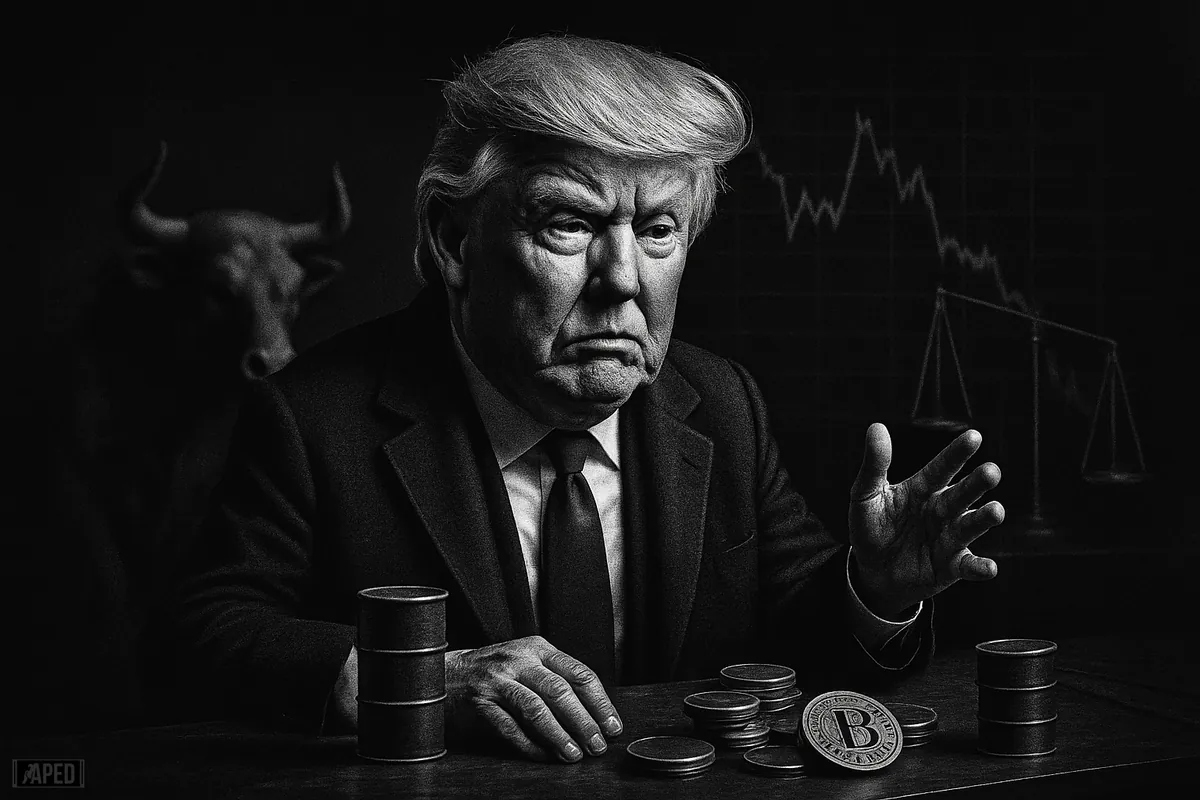
Markets love a clean story, even when the tape looks less convinced than the headlines. Wednesday's version was simple enough: oil eased after fresh comments from President Donald Trump suggesting the war in Iran could end within "two to three weeks," and crypto caught a bid. The catch, because of course there is one, is that derivatives data did not exactly scream conviction. [1]
Bitcoin$80,326.14 traded near $68,500 in early Wednesday action, up roughly 0.4% since midnight UTC and about 3.1% over the past 24 hours. Ethereum$2,327.25 changed hands around $2,130, extending a recovery after briefly dipping below $2,000 last week. Broader market performance was positive as well, with altcoins participating and some smaller names outperforming sharply. [2]
That price action lines up with a broader relief move across risk assets as crude briefly slipped below $100 per barrel. Lower oil matters because it can ease some immediate inflation and geopolitical pressure, which in turn tends to support speculative assets. Crypto did what crypto usually does when macro stress backs off a little: it bounced quickly, then asked traders to decide whether they actually meant it.
Enjoy articles without ads?
Register for free and get unlimited access to all articles.
The move was real, the conviction was not
The key market signal was not spot price direction. It was the gap between rising trading activity and muted positioning in futures.
According to the source data, futures volumes increased while open interest stayed broadly flat. That distinction matters. Volume tells you people are trading. Open interest, or OI, tells you whether they are adding fresh positions that remain open. When prices rise on stronger volume but OI does not build, the rally is often being driven by spot buying, position rotation, or short covering rather than new leveraged longs entering with force. [3]
That does not make the move fake. It does make it more fragile.
A rally powered by short covering can run fast, especially after a weak patch, but it tends to lose momentum if fresh capital does not follow. Traders covering bearish bets can push prices up for a while. They cannot sustain a trend indefinitely on their own. For that, the market usually wants to see open interest expand alongside price, ideally with funding and basis metrics staying orderly rather than euphoric.
Bitcoin and ether recovered, but not in the same way
Bitcoin's rebound back toward $68,500 looks constructive on the surface, particularly after recent macro nerves tied to energy markets and Middle East tensions. BTC has held up better than many traders feared during the latest oil spike, which suggests there is still underlying demand on dips.
Ether's recovery to $2,130 is more complicated. The move off sub-$2,000 levels is notable, but ETH remains more vulnerable to leverage-driven swings than BTC, especially when traders crowd into derivatives without a broader macro tailwind. Research tied to the market move flagged elevated leverage in ETH, a setup that can amplify gains on the way up but also sharpen reversals if sentiment turns. [4]
That is the recurring pattern here: prices improved, but the structure underneath the move remains selective and a bit thin.
Altcoins outperformed, which is not always a good sign
The broader market participated in the rebound, and some altcoins posted outsized gains. CoinDesk's snapshot showed tokens such as Algorand$0.08382 among the leaders. That kind of rotation can indicate improving risk appetite, but it can also reflect a lower-quality bounce where traders chase beta, meaning the more volatile corners of the market, before core positioning has fully stabilized. [5]
When altcoins rip while derivatives in majors remain hesitant, the message is mixed. It can mean traders are expressing short-term optimism in cash markets. It can also mean speculative capital is reaching for quick upside while avoiding heavier leveraged commitment in BTC and ETH futures. Sure, sometimes that works. It is just not the same thing as a broad, durable trend reset.
Oil is still the macro hinge
The day's catalyst was not crypto-specific. It was oil.
Trump's comments about a possible end to the Iran war in "two to three weeks" helped push crude lower, at least temporarily, and that fed directly into crypto's rebound. The relationship is straightforward: when oil surges, markets worry about inflation persistence, central bank constraints, and broader geopolitical spillover. When oil cools, even briefly, those fears ease and risk assets get room to breathe. [6]
The problem is that this is a headline-sensitive setup. If crude resumes climbing, the relief bid in crypto could fade just as quickly as it appeared. Markets can price in hope for a few hours. They usually need harder evidence to keep doing it for days.
That is especially relevant because crypto has been trading as a macro-sensitive asset more often than the "digital gold" crowd would prefer to admit. BTC may still outperform in stress episodes over longer periods, but intraday and weekly flows continue to respond to the same cross-asset triggers affecting equities, bonds, and commodities.
Why flat open interest matters more than a green screen
There is a temptation to read any synchronized move higher across bitcoin, ether, and altcoins as broad bullish confirmation. The derivatives backdrop argues for more restraint.
Flat OI with stronger volume suggests traders are active, but not necessarily committed. Some of that flow likely reflects shorts closing into a rebound after recent weakness. Some likely came from spot desks and cash buyers stepping in as prices stabilized. What it does not obviously show is aggressive new leverage being deployed to press the rally further.
That is an important difference for short-term market structure. Strong trends often feed on themselves because rising price attracts fresh positioning, which then reinforces momentum. Without that OI expansion, price can drift higher, but it is more vulnerable to reversal on the next adverse macro headline.
Research tied to the move also pointed to elevated leverage in ETH and Zcash$355.81, adding another layer of risk. If market sentiment sours, more crowded leveraged positions can unwind quickly. Thin conviction rallies are fine until they are asked to survive actual stress.
What to watch next
Three signals matter from here.
First, oil. If crude stays below recent highs and the market believes geopolitical risk is cooling rather than merely pausing, crypto has room to extend the rebound. If oil snaps higher again, this relief move will look less sturdy.
Second, open interest in BTC and ETH futures. A continued price rise with still-flat OI would suggest the market is levitating on spot demand and short covering. A healthier bullish setup would be rising prices accompanied by measured OI growth, not a sudden leverage binge, but clear evidence that fresh positions are being added.
Third, whether ether's leverage normalizes or stretches further. ETH often acts like a useful stress gauge for crypto risk appetite. If it climbs while leverage remains elevated and funding gets overheated, pullback risk rises. If it can hold gains without derivatives excess building too fast, the rebound starts to look more credible.
For now, crypto got its bounce, oil gave it some oxygen, and derivatives traders responded with a shrug. That is not bearish by itself. It is just not the sort of all-in confirmation bulls usually claim five minutes after a green candle.
Your reviews help us improve the quality of both current and future articles. All reviews are public and visible to other readers. We use both ratings and comments to improve future articles and to revise any articles that do not meet our standards.
 See more like this on Google