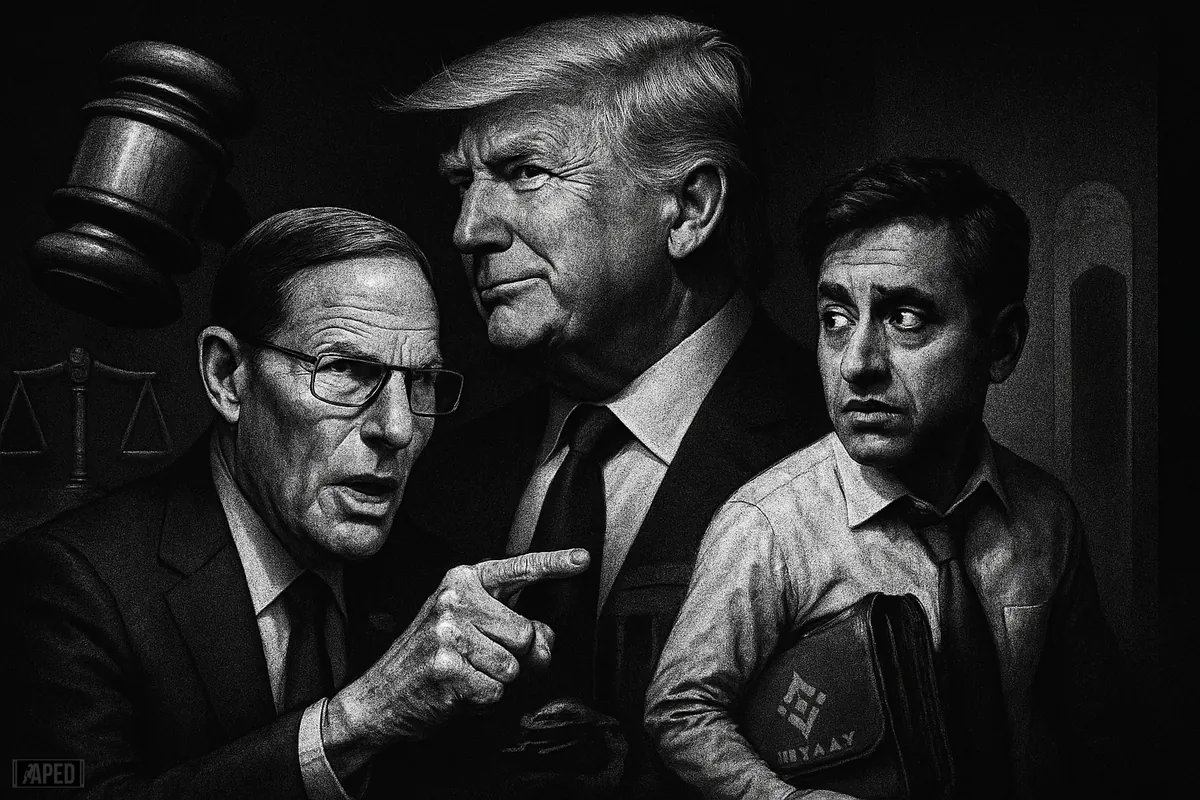
The optics are rough, even by Washington standards. A top SEC enforcement official is heading for the door just as senators demand to know whether crypto firms tied to Donald Trump's orbit have been getting unusually soft treatment.
Senator Richard Blumenthal has pressed the Securities and Exchange Commission for answers over what he framed as potential preferential handling of Trump-linked crypto players, putting the agency's enforcement posture under a fresh political spotlight. The questions land at an awkward moment: Sanjay Wadhwa, the SEC's acting enforcement director and one of the agency's most senior policing officials, is set to exit, leaving a vacuum just as the regulator is being asked to explain who gets pursued, who gets a pass, and why. [1][2]
Enjoy articles without ads?
Register for free and get unlimited access to all articles.
Why the SEC is being pressed now
Blumenthal's inquiry centres on whether the SEC altered, delayed, or declined enforcement activity involving firms and projects associated with Trump allies or financial backers. The concern is not just partisan theatre. It goes to the core of market credibility: if enforcement is seen as negotiable for politically connected operators, every settlement, Wells notice, and case closure starts to look a bit suspect. [3]
The senator's questions also reflect a broader shift in the US crypto policy fight. Over the past year, the industry has gone from complaining that the SEC was regulating by lawsuit to lobbying for a friendlier framework from Congress and, potentially, from a future administration. Trump's embrace of crypto, once improbable, has turned some of his donors and associates into visible players in the sector. That overlap is now drawing scrutiny from lawmakers who want to know whether politics is leaking into securities oversight. [4]
Wadhwa has been a central figure in the SEC's recent enforcement machine, particularly across complex financial misconduct and crypto-adjacent cases. His departure does not automatically mean the agency will change course. But timing matters, and in markets, timing is often the whole trade.
A leadership transition inside enforcement can slow decision-making, reshuffle priorities, and create room for more cautious case selection. For crypto firms already betting that the SEC's aggressive posture is ebbing, that is a notable signal. For critics, it raises the opposite risk: that sensitive matters could be quietly deprioritised when accountability is most needed.
There is also the practical point. Enforcement is not just about filing splashy complaints. It is about subpoenas, testimony, document review, settlement leverage, and the willingness to push borderline cases. When the person overseeing that machinery exits under political scrutiny, market participants notice. [5]
What the political angle means for crypto
Crypto has always had a regulation problem, but this one is more specific. The issue is no longer merely whether tokens are securities or whether staking products need registration. It is whether access and political proximity can shape the regulator's appetite.
That matters because the market has already been trading on policy vibes. Tokens tied to US regulatory narratives, exchange listings, ETF expectations, and election rhetoric have repeatedly repriced on headlines alone. If traders start to believe that certain well-connected entities face lower enforcement risk, capital could flow accordingly, regardless of underlying fundamentals. That is not healthy price discovery. It is a contacts trade.
For firms operating in the US, the bigger risk is uneven compliance pressure. A smaller issuer with no political insulation may conclude it is being held to a harsher standard than a better-connected rival. That can chill legitimate activity while rewarding the sort of headline-chasing behaviour the SEC is supposed to deter.
So far, the public reporting points to questions, not proof. Blumenthal has asked the SEC to provide information on its interactions and decision-making related to Trump-connected crypto interests. That includes whether agency staff communicated with such parties, whether any investigations were modified, and whether conflicts or political considerations were disclosed internally. [6]
What is missing, for now, is documentary evidence showing that enforcement decisions were in fact bent to suit Trump allies. That distinction matters. Regulators are allowed to close weak cases, reallocate resources, and exercise prosecutorial discretion. The line gets crossed if those decisions are driven by politics rather than law or evidentiary strength.
That leaves the SEC in a tight spot. If it says little, critics will fill the vacuum. If it discloses too much, it risks exposing active investigative processes or internal deliberations. Either way, the agency is now defending not just its legal judgments but its independence.
Market impact is indirect, but real
There is no clean price chart for "regulatory credibility", and no on-chain dashboard showing whether political influence has entered the SEC's bloodstream. This is not a token-specific flow story with funding spikes or whale wallets rotating size on Binance. It is a narrative risk story, and those have a habit of turning into liquidity events later.
The immediate impact is likely to be felt most by US-facing exchanges, token issuers, and legal teams modelling enforcement exposure. If the market reads the episode as a sign that SEC crypto oversight is fragmenting, risk appetite could rise in the short term, especially in the more speculative corners of the tape. That sort of relief rally can be very real, and very dumb.
Longer term, though, selective enforcement fears tend to increase the discount investors apply to US regulatory assets. If rules look arbitrary, serious capital either demands a premium or goes elsewhere. Neither outcome is especially bullish for a sector still trying to persuade institutions that it has grown up.
The story cuts beyond one senator's letter and one official's departure. It tests whether US crypto policy is becoming just another patronage battlefield, where firms seek political sponsorship instead of regulatory clarity.
That would be a grimly familiar outcome. When compliance costs are high and legal definitions are muddy, influence becomes an asset class of its own. Crypto, with its mix of money, ideology, and online clout, is particularly vulnerable to that dynamic.
For now, the pressure is on the SEC to show that its case choices are evidence-led and consistent, regardless of who is backing whom. If it cannot do that cleanly, calls for outside oversight will only get louder.
What to watch next
Blumenthal's deadline and the SEC's response: whether the agency provides substantive detail or defaults to procedural language.
Wadhwa's replacement: a hardliner, a caretaker, or a more settlement-oriented operator will each signal something different.
Any newly unsealed enforcement actions or dropped probes: especially if they touch politically connected crypto entities.
Congressional follow-through: one letter is noise, hearings or document requests are more serious.
Industry reaction: lobbying groups and major exchanges may use this moment to push for statutory limits on SEC discretion.
Headline-driven market moves: particularly in US-exposed names where regulatory vibes still move faster than fundamentals.
Your reviews help us improve the quality of both current and future articles. All reviews are public and visible to other readers. We use both ratings and comments to improve future articles and to revise any articles that do not meet our standards.
 See more like this on Google