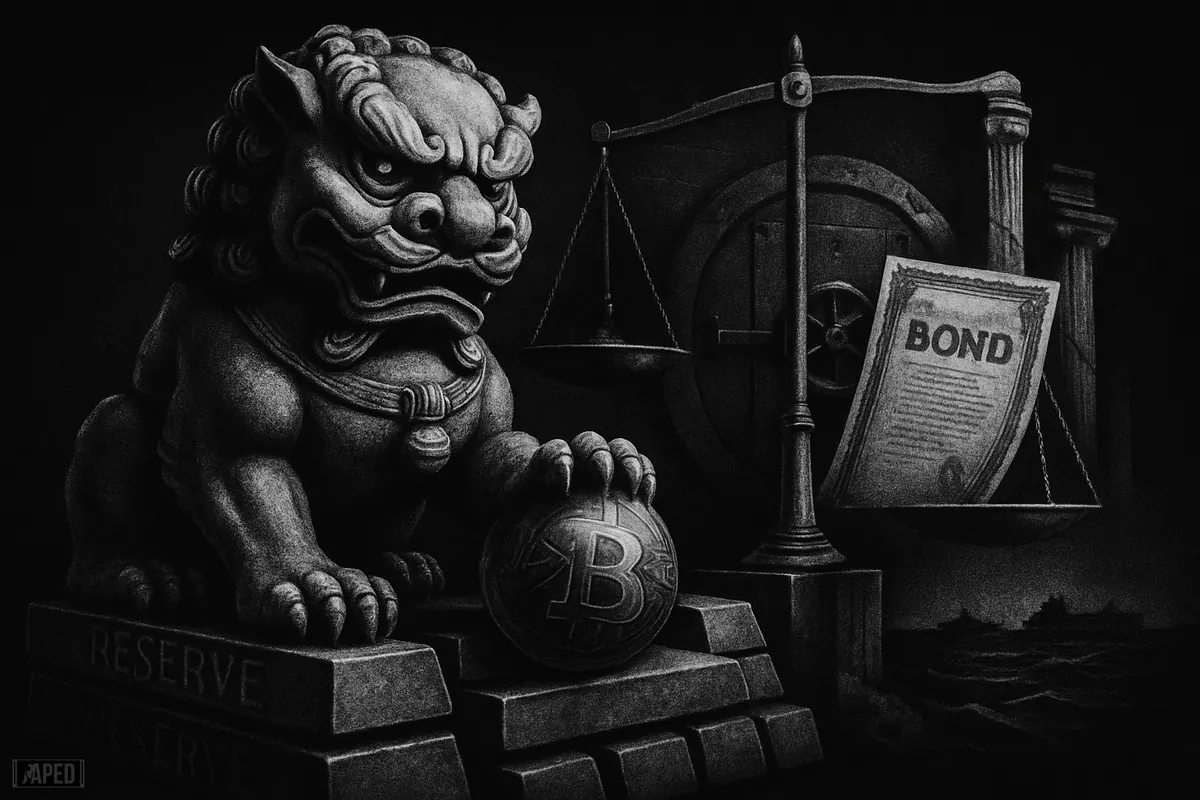
The bitcoin reserve trade has escaped the usual Washington echo chamber and landed in Taipei. That matters, because this is not a vibes-only policy riff, it is a hedge debate aimed squarely at Taiwan's biggest financial concentration risk: the U.S. dollar.
Fresh discussion around a potential Taiwanese Bitcoin$82,077.84 reserve follows a new research push arguing the island should rethink its earlier rejection of the idea. The core claim is simple enough. Taiwan's reserves are heavily tied to the dollar system at a time when U.S. debt, deficit expansion, and monetary loosening remain live macro concerns. Add geopolitical strain in the Taiwan Strait, and bitcoin starts to look less like a speculative toy and more like optionality. [1]
Register for free and get unlimited access to all articles.
Why the idea is back on the table
Taiwan already considered and rejected a Bitcoin$82,077.84 reserve in December 2025. At the time, the objections were fairly orthodox. Bitcoin was judged too volatile, too thinly traded relative to reserve assets like dollars and gold, and operationally awkward for a central bank framework that has to worry about custody, security, and AML compliance.
What changed is not that bitcoin suddenly became boring. It is that Taiwan's macro exposure now looks more concentrated than comfortable. Research cited this week argues that more than 80% of the Central Bank of the Republic of China's reserves sit in U.S. Treasuries, while roughly 85% to 90% of Taiwan's exports are priced in dollars. That leaves the economy highly sensitive to any sustained erosion in dollar purchasing power or credibility. [2][3]
Jacob Langenkamp, a U.S. Department of Defense civil servant and author of the new paper circulating in the debate, frames Bitcoin$82,077.84 as a hedge against both monetary debasement and wartime disruption. The argument is not that BTC replaces core reserve assets tomorrow. It is that even a small allocation could diversify a reserve book that is currently leaning hard on a single system. [1]
That is the sort of thesis policymakers tend to ignore until they cannot. A $157 billion trade surplus gives Taiwan room to consider strategic diversification without looking reckless. Whether it wants to use that room is another matter.
For now, the numbers are almost comically small. Taiwan is estimated to hold 210 BTC, worth roughly $14 million at the prices referenced in the source material. That equates to about 0.001% of bitcoin's total supply, barely enough to count as an opening bid. [4]
Set against other sovereign holdings, the gap is obvious. The U.S. is listed with 328,372 BTC, while China is shown with 190,000 BTC. Those figures mostly reflect seized or state-controlled holdings rather than classic reserve accumulation, but the optics still matter. In the current policy cycle, bitcoin ownership itself has become a geopolitical signal. [5]
Research tied to the debate says 29 countries had some form of bitcoin exposure by January 2026, a trend that accelerated after the U.S. Strategic Bitcoin Reserve executive order. That does not mean a global race is underway in the clean, linear way crypto headlines like to suggest. It does mean the taboo around sovereign BTC exposure is eroding. [5]
The real case for Taiwan is not price upside
The strongest argument for a Taiwanese bitcoin reserve is not that BTC might go up. Central banks do not, or at least should not, run reserve policy like a weekend punter rotating into momentum.
The real case is resilience. Bitcoin is outside the direct control of any single sovereign issuer. It can be self-custodied, moved across borders, and accessed in scenarios where traditional financial channels are impaired. For an economy living under persistent geopolitical pressure, those attributes are not trivial.
There is also a trade structure angle. If Taiwan's export machine invoices overwhelmingly in dollars, and its reserve pile is heavily stacked in Treasuries, then reserve diversification becomes less about replacing the dollar and more about reducing one-way exposure to it. A modest bitcoin allocation would sit in the same bucket as any other non-correlated reserve hedge, except with much higher volatility and a very different liquidity profile.
That last bit is the catch. Bitcoin can hedge tail risks, but it can also become the risk if position sizing is sloppy.
Why officials said no before, and why they still might
The objections from late 2025 have not disappeared. Bitcoin remains volatile by reserve-management standards. A central bank can tolerate mark-to-market swings in a strategic allocation, but political systems tend to have a lower pain threshold than portfolio theory. A 25% drawdown is routine in crypto. It is much less routine in parliamentary oversight hearings.
Liquidity is another sticking point. Yes, bitcoin is one of the deepest crypto markets on earth. No, it is not as liquid or as stable as the U.S. Treasury market, especially under stress. If a reserve asset is meant to provide immediate large-scale usability during crisis conditions, execution quality matters more than a neat macro thesis.
Custody risk also stays front and centre. Self-custody solves one problem and creates three more. Third-party custody introduces counterparty risk. AML and sanctions compliance complicate state usage further, especially for an economy as globally integrated as Taiwan's.
There is a more basic political risk too. Taiwan adopting bitcoin as a reserve diversifier would be read internationally as both a monetary signal and a strategic one. That might be the point. It might also be exactly why officials tread carefully.
Market backdrop: BTC is wobbling, not breaking
Bitcoin was trading around $66,420 at the time referenced in the source, down 3.12% over 24 hours. That is not unusual in isolation, but it does matter when a policy discussion is tied to reserve credibility. Nobody wants to pitch a new sovereign asset strategy on a red day and pretend volatility is a rounding error. [6]
Still, BTC dominance near the high-50% range suggests the broader market continues to treat bitcoin as the main institutional and macro expression in crypto. That does not validate the reserve thesis on its own, but it does reinforce where serious allocators tend to look first when they want crypto exposure without diving headlong into illiquid alt territory.
The on-chain and derivatives picture was not detailed in the source material, so any stronger claim about funding, open interest, or exchange flows would be guesswork. What can be said safely is that reserve managers would care less about retail sentiment and more about market depth, custody standards, and stress-period liquidity. Those are not CT metrics, but they are the ones that actually count here.
Taiwan's renewed debate is also happening against a broader U.S. policy backdrop. American lawmakers have been pushing crypto and mining legislation, including the proposed "Mined in America Act," which aims to support domestic mining and formalize a strategic bitcoin reserve framework.
That matters because Washington's posture can legitimize what once looked fringe. If the U.S. is normalizing state-linked BTC exposure, allies and trade partners get political cover to revisit their own assumptions. Taiwan does not need to mirror the U.S., but it does operate in a security and financial environment where American policy sets the tone more often than not.
What to watch next
A reserve announcement is not imminent, but the conversation has moved from dismissal to strategic review. For traders and policy watchers, the checklist is fairly clear:
Any formal response from Taiwan's central bank or finance ministry
Debate over reserve diversification, especially away from Treasuries
Proposed custody structure, if officials move beyond theory
Position sizing, because 0.1% and 5% are completely different stories
U.S. progress on strategic reserve legislation and mining policy
BTC liquidity conditions during macro stress, not just on green days
If Taiwan does move, expect it to start small, heavily caveated, and politically hedged. Which, to be fair, is usually how serious money enters bitcoin before pretending it was obvious all along.
Your reviews help us improve the quality of both current and future articles. All reviews are public and visible to other readers. We use both ratings and comments to improve future articles and to revise any articles that do not meet our standards.
 See more like this on Google