Iran Bitcoin Toll Plan Reshapes Shipping Economics
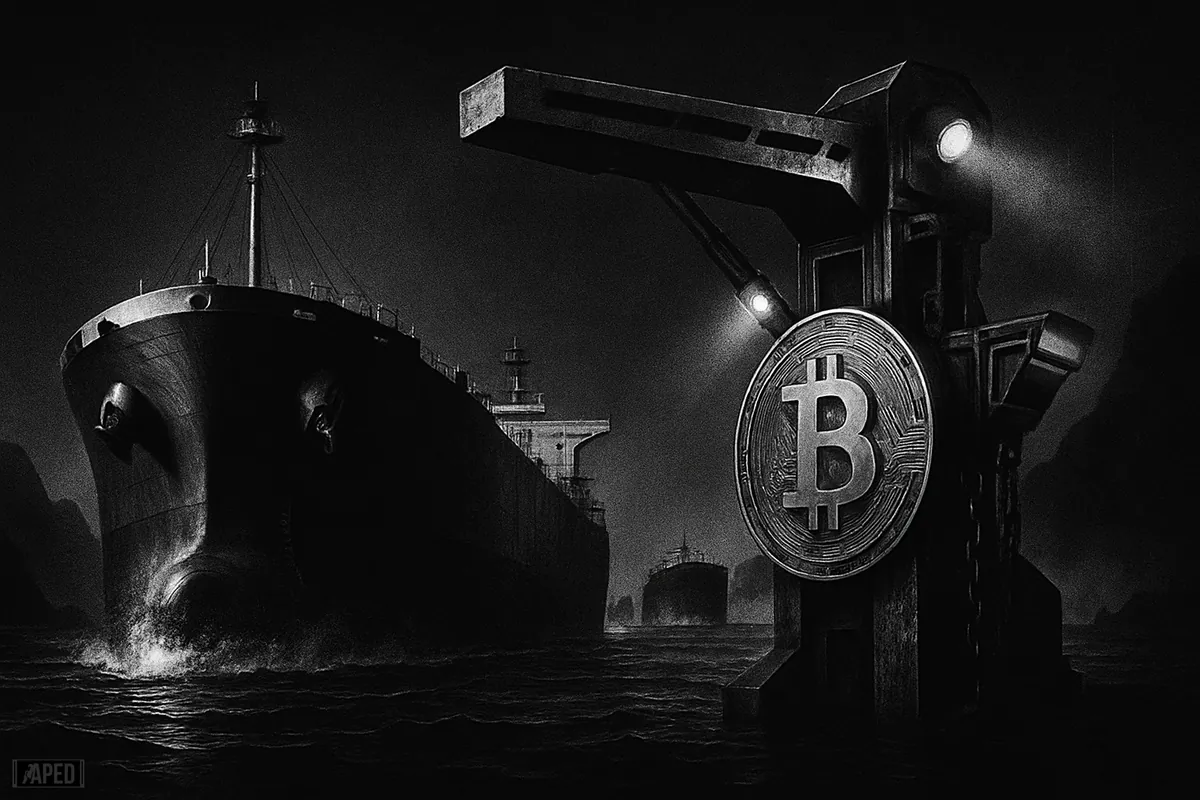
Iran has announced plans to require oil tankers transiting the Strait of Hormuz to pay a $1 per barrel toll in Bitcoin$80,593.08, according to research from Arkham Intelligence. The move includes strict verification and enforcement mechanisms, marking a significant step toward Bitcoin$80,593.08 adoption by a nation-state for critical infrastructure payments and potentially signaling Iran's use of crypto to circumvent international sanctions.
The Strait of Hormuz just got a Bitcoin$80,593.08 lane, and global shipping now has a very weird new problem.
Arkham said earlier today that Iran plans to require oil tankers transiting the Strait of Hormuz to pay a $1 per barrel toll in BTC, with what it described as strict verification and "very severe enforcement." The post linked to Arkham's own research note and framed the move as more than a headline stunt. If implemented as described, this is a geopolitical payment rail built directly on Bitcoin$80,593.08, attached to one of the most important energy chokepoints in the world. [1]
That matters because the Strait of Hormuz is not some niche route for degens with bags. It is one of the core arteries of global oil transport. A toll set per barrel means the cost scales directly with cargo size, which turns Bitcoin from a treasury asset or sanctions workaround into transaction infrastructure for physical commodity flows. Even at a seemingly simple rate of $1 per barrel, the aggregate demand for BTC settlement could become material if the policy applies broadly across tanker traffic.
Register for free and get unlimited access to all articles.
What Arkham said, and why it is different
Arkham's wording points to a system with compliance checks, not a symbolic declaration. "Strict verification" implies Iran is not merely asking for payment to a published address and hoping for the best. It suggests some form of identity, shipment, or transaction matching process tied to vessel transit. "Very severe enforcement" is also doing a lot of work here. In the Hormuz context, enforcement risk is not theoretical. It means ship operators, insurers, cargo owners, and intermediaries would need to price in both the BTC payment itself and the consequences of non-payment. [1]
That instantly raises a stack of operational questions for the crypto market. How is BTC payment verified before passage, at waypoint checkpoints, or after transit? Are payments tied to declared barrel counts, AIS shipping data, cargo manifests, or a wallet allowlist? Does Iran use single-use deposit addresses, multi-signature collection wallets, or intermediary OTC channels to reduce traceability? Arkham did not answer those questions in the source post, but the fact that the story came from an on-chain intelligence firm is notable. This is exactly the kind of setup where wallet clustering, payment routing, and sanctions monitoring become front-page crypto issues instead of compliance back-office work. [1]
Ceasefire headline, sanctions reality
The timing is especially sharp. On April 8, the US-Iran ceasefire resolution on Polymarket had pointed to a temporary cooling in tensions. Arkham's report, if borne out, cuts the other way. It suggests Iran is not stepping back from economic hardening, but instead building a crypto-native mechanism around a strategic maritime chokepoint. That makes the ceasefire context look less like normalization and more like a pause while alternative rails are put in place.
For the crypto community, the biggest implication is sanctions circumvention risk. Iran has long had incentives to reduce dependence on dollar-based rails. A Bitcoin toll on tanker traffic would create a direct sovereign use case for BTC in cross-border settlement under geopolitical pressure. It would also force every participant in the chain, shipowners, commodity traders, brokers, insurers, and exchanges, to think about wallet exposure and taint analysis in a new way. If toll payments begin hitting identifiable addresses, those wallets could become some of the most scrutinized on-chain endpoints in the market.
Market impact is not just narrative
This also lands against a shaky macro backdrop. The Fear and Greed Index was sitting at 14, an extreme fear reading, in adjacent market signals. That does not prove this development caused the anxiety, but it does fit the mood. When Bitcoin$80,593.08 is being discussed simultaneously as a risk asset, a sanctions bypass tool, and now potentially a toll token for oil transit, traders get a lot more to digest than price candles.
There is a second-order effect too. If sovereign or quasi-sovereign actors start demanding BTC for real-world access, Bitcoin's role shifts again. Bulls will call it adoption. Regulators will call it a sanctions and security headache. Both can be true at once. The more BTC intersects with shipping and energy flows, the more likely policymakers are to treat blockchain intelligence, exchange surveillance, and wallet blacklisting as strategic tools rather than financial regulation trivia.
Arkham's report turns Bitcoin's geopolitical utility from theory into a very concrete scenario: pay in BTC, or face enforcement at one of the world's key oil routes. That is not just good content for CT. It is a test case for whether Bitcoin can function as coercive infrastructure, not just neutral settlement tech. [1]
If Iran follows through and wallets tied to the toll system become visible on-chain, expect a rush of monitoring, labeling, and sanctions analysis. If the policy stays vague or enforcement proves uneven, it may end up as leverage theater. Either way, crypto is now tied a little tighter to the plumbing of global trade, and that tends to get real fast.
Your reviews help us improve the quality of both current and future articles. All reviews are public and visible to other readers. We use both ratings and comments to improve future articles and to revise any articles that do not meet our standards.
 See more like this on Google