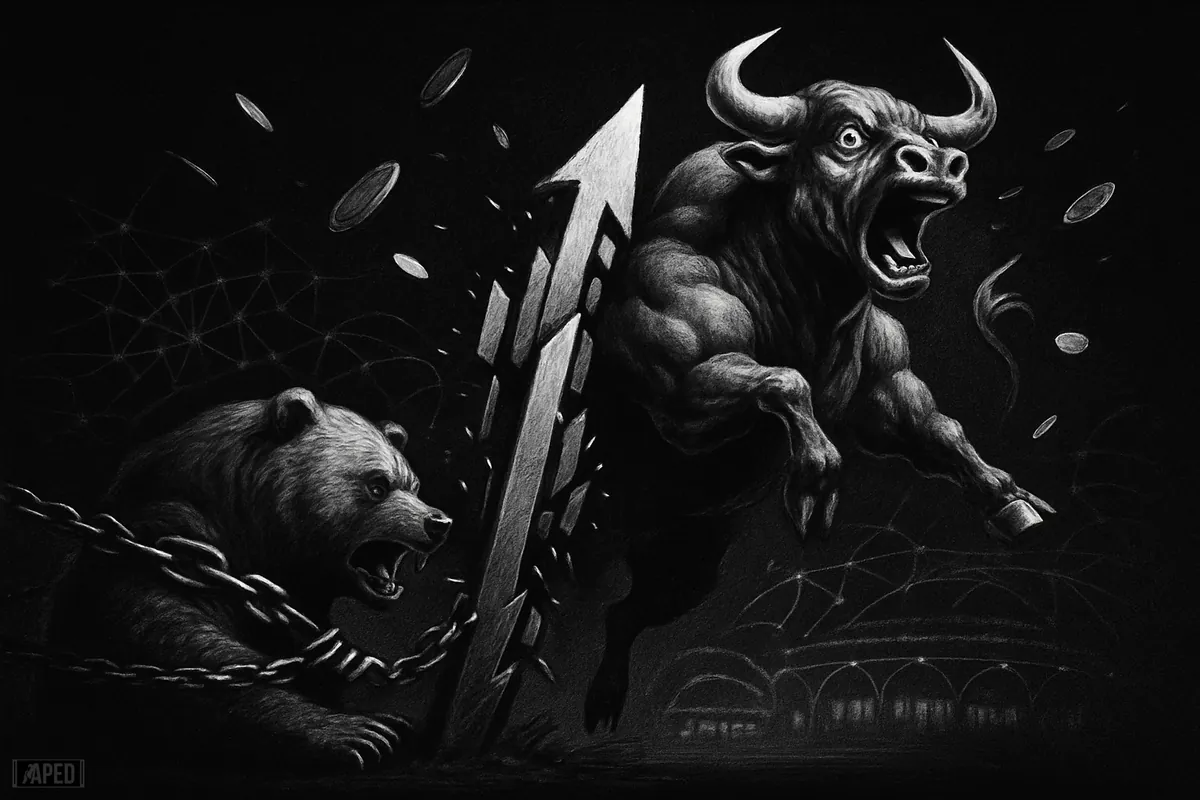
Markets spent April 17 doing what they do best, which is claiming to love risk while punishing anyone who touched the wrong part of the curve. Bitcoin$80,504.81 and DeFi caught a regulatory tailwind, memecoins woke up, and a few institutional rails quietly got built. Elsewhere, leveraged traders in XRP$1.518 got steamrolled, and Bittensor$248.25's liquidity looked less like a market and more like a warning label.
Enjoy articles without ads?
Register for free and get unlimited access to all articles.
Market Moves
XRP leverage cracked first
The day's clearest stress signal arrived early. XRP$1.518futures shed roughly 860 million tokens in open interest overnight after upside momentum failed, pointing to a sharp unwind in leveraged positioning rather than fresh conviction from either side. That kind of drop usually means traders stopped believing the breakout story at the exact moment funding and positioning had become too crowded. [1]
The wipeout mattered beyond XRP itself because it framed the rest of the session's price action. Risk appetite was improving in majors later in the day, but derivatives traders were already being forced into cleaner books. Translation: spot-led strength looked healthier than anything built on borrowed enthusiasm.
Bitcoin pushed back toward breakout territory
By late afternoon, the tone had shifted. Bitcoin$80,504.81 moved back toward a key resistance zone, with renewed chatter that a decisive break above $80,000 could reopen the path to a fresh all-time high later this year. The call itself is not news, obviously. The setup is. After holding firm above $70,000 in the prior session, BTC spent April 17 building on a more constructive macro and regulatory backdrop instead of giving it all back in the next headline cycle, which is real progress by crypto standards.
The bigger point was sentiment. Bitcoin's move did not look like an isolated squeeze. It arrived alongside strength in DeFi names, Ethereum-linked beta, and selected altcoins, suggesting traders were broadening exposure after the morning's derivatives cleanup.
Ether strength spilled into DOGE and high beta names
That broadening showed up clearly in memecoins. Dogecoin$0.09301 moved closer to $0.10 as Ethereum$2,344.12's breakout helped drag speculative corners of the market higher, with DOGE up about 3% and traders focused on reclaiming the $0.094 to $0.095 zone to confirm momentum.
This was not just a DOGE story. It was another example of how ETH-led upside tends to leak into higher beta names once traders believe the move has legs. Sure, that does not make memecoin strength fundamentally profound, but it does tell you something useful about market mood: people were willing to rotate down the quality ladder again.
Hyperliquid kept acting like a market leader
Hyperliquid$59.48's HYPE token hit a four-month high near $45, helped by priority fee upgrades, broader market strength, and a technical setup traders clearly wanted to own. Among altcoins, this was one of the more substantial moves because it combined product-level catalysts with improving risk sentiment instead of relying purely on momentum tourism. [2]
HYPE's rally also fit a wider pattern. Traders were rewarding tokens tied to real trading infrastructure and fee generation while also chasing speculative beta elsewhere. Those two behaviors can coexist for a while. They usually do, right up until they don't.
Regulation and Policy
SEC self-custody update boosted Bitcoin and DeFi
The most important policy development of the day came in the early afternoon, when an SEC update on self-custody concerns was read by the market as a meaningful easing for wallet-based crypto activity. Bitcoin and DeFi tokens reacted positively, as traders interpreted the guidance as creating more room for products and services that sit outside older custody assumptions. [3]
That mattered because custody has been one of the industry's chronic bottlenecks. Any signal that self-hosted wallet models face less regulatory friction immediately helps DeFi interfaces, Bitcoin-native custody narratives, and firms building wallet-connected products. Markets responded accordingly, with the policy update helping explain why gains broadened later in the session instead of staying confined to BTC.
Infrastructure and Institutional Adoption
Broadridge added a new crypto rail in Canada
One of the more durable stories on April 17 came from market plumbing rather than price charts. Broadridge launched a crypto platform in Canada that lets wealth firms trade, custody, and service digital assets alongside traditional holdings in a unified workflow. [4]
For crypto's institutional case, this is the kind of development that tends to matter more in six months than it does in six minutes. Canadian wealth platforms do not need another pitch deck about tokenization. They need operational tools that fit existing compliance, reporting, and portfolio workflows. Broadridge is betting that integrated servicing beats standalone crypto complexity, which feels less glamorous but far more useful.
The timing is notable too. With regulators gradually clarifying where custody, brokerage, and self-directed access can coexist, traditional financial infrastructure firms are moving from "monitoring the space" to actually shipping products. Slowly, then suddenly, then wrapped in enterprise software.
Liquidity Stress and Execution Risk
Bittensor's TAO spread stayed ugly across venues
Three separate reports during the day highlighted the same underlying problem in Bittensor's TAO market: cross-exchange spreads blew out to 28.3%, 28.2%, and 27.7% across April 13 and April 14 readings, pointing to severe fragmentation and poor execution conditions for a top-50 token.
That is not normal noise. A spread that wide means the quoted market is barely functioning as a single market at all. It suggests either liquidity has thinned dramatically, arbitrage is impaired, or venue access and inventory constraints are preventing price alignment. Possibly all three.
For traders, the warning is straightforward. A token can show strong headline performance and still be functionally difficult to trade at scale. TAO's dislocations imply much higher slippage, weaker price discovery, and elevated risk that stop losses or market orders execute far from expectations. "Liquid" is one of crypto's more abused words. This is what the opposite looks like.
Rotation Beyond Crypto
Energy kept stealing attention from the AI trade
A notable macro cross-current came from equities, where energy stocks were reported up roughly 30% in 2026 as the AI trade cooled and investors rotated out of chipmakers and cloud names into power and utilities. For crypto traders, this matters less as a direct driver and more as a reminder that global risk capital is being reallocated toward harder-cash-flow, infrastructure-heavy themes. [5]
That shift can cut two ways. If investors continue favoring tangible demand stories like power generation over long-duration speculation, parts of crypto could struggle for marginal flows. But if the AI unwind reduces pressure on crowded growth trades without triggering a full risk-off move, crypto can still benefit as capital hunts for cleaner momentum setups. April 17 looked more like the second scenario.
Speculative Corner
RAVE DAO showed what thin liquidity can do
Late in the day, RaveDAO$1.30 drew attention after surging from roughly $0.25 to the mid-teens within days, with the move attributed to thin liquidity and momentum dynamics. That is a polite way of saying price went vertical in a market that may not require much capital to move.
These bursts can persist longer than skeptics expect, especially when float is tight and social attention arrives faster than sellers. They can also reverse with equal efficiency. Anyone treating a parabolic micro-liquidity move as proof of sustainable value should probably keep one hand near the exit.
Looking Ahead
April 17 was a good day for the "real adoption plus selective risk" narrative. The SEC's self-custody signal helped legitimize wallet-based activity, Broadridge added another institutional access point, and Bitcoin kept pressing toward a level that could reset market psychology if broken. Those were the constructive pieces.
The caution signs were just as visible. XRP's overnight open interest collapse showed leverage remains brittle, and TAO's fractured pricing was a live example of how quickly liquidity quality can disappear outside the largest names. The market mood improved, but not all liquidity is equal and not every rally deserves applause. Next up, watch whether Bitcoin can actually clear resistance near $80,000, whether ETH-led strength continues to support higher beta sectors, and whether DeFi can hold gains once the policy headline stops doing the heavy lifting.
Your reviews help us improve the quality of both current and future articles. All reviews are public and visible to other readers. We use both ratings and comments to improve future articles and to revise any articles that do not meet our standards.
 See more like this on Google