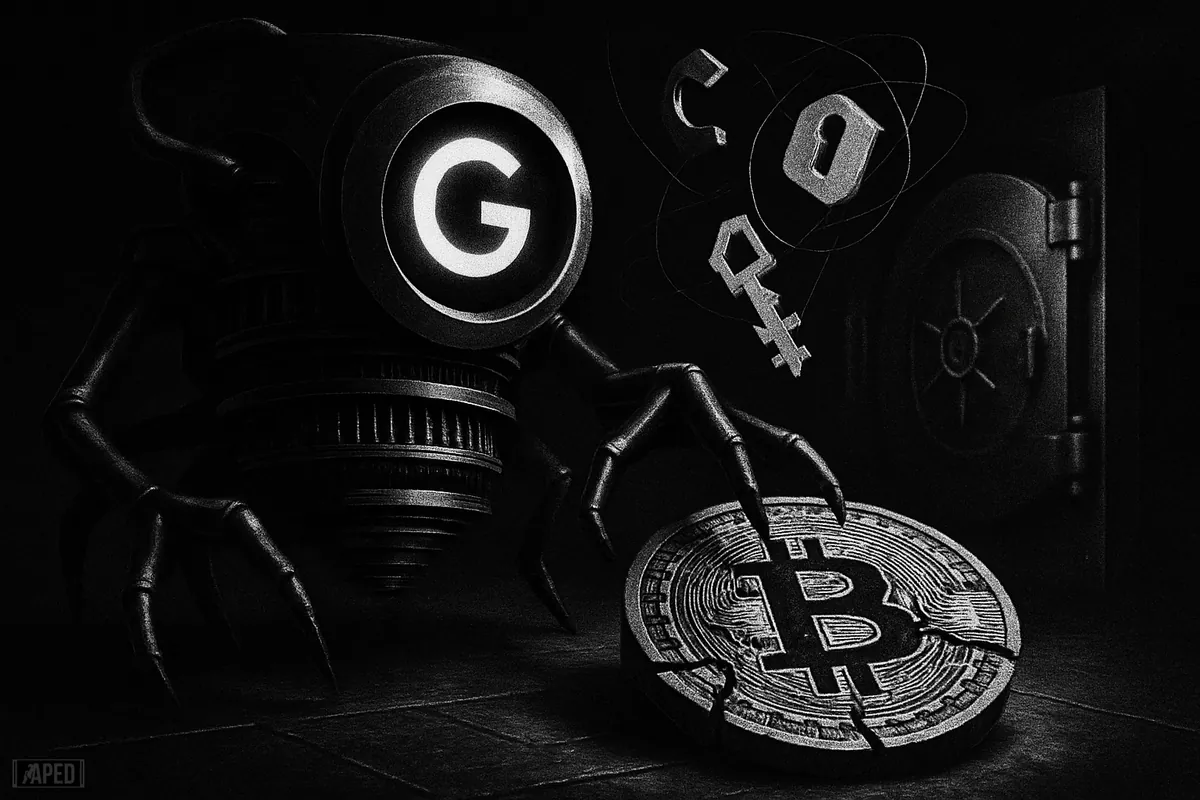
Quantum doom has been one of crypto's favorite campfire stories for years. Now Google has given the plot a more uncomfortable timestamp, which is why the market is paying attention instead of just nodding politely and moving on.
Recent reporting tied the renewed concern to Google research suggesting quantum systems may crack widely used cryptography much faster than earlier assumptions implied. [1] The headline risk for Bitcoin$82,069.06 is not mining. It is signatures. Bitcoin$82,069.06 relies on elliptic curve cryptography to prove that a wallet owner is allowed to spend coins. If a sufficiently capable quantum computer can derive a private key from a public key quickly enough, exposed addresses become targets. [2]
Register for free and get unlimited access to all articles.
What Google's warning actually means
The core issue is a reduction in the estimated resources needed to break RSA style encryption and related public key systems. Bitcoin does not use RSA, but the broader message is the same: quantum attacks against today's cryptography may be less distant than the industry hoped. [3] That does not mean someone can drain the network tomorrow. It does mean the comforting phrase "decades away" looks less solid than it used to.
For Bitcoin, the practical danger is concentrated in coins whose public keys are already visible on-chain. That includes funds sitting in older address formats after they have spent, reused addresses, and dormant wallets that cannot easily rotate to safer schemes. The most cited elephant in the room is Satoshi-era bitcoin. If those keys were ever vulnerable, markets would have a much bigger problem than a scary research paper. [4]
Why signatures matter more than hashpower
Quantum computing is often framed as a threat to Bitcoin mining, because Grover's algorithm could in theory speed up brute force search. That is the less immediate issue. Bitcoin's proof of work can be adjusted. Signature forgery is harder to shrug off.
A successful signature attack would let an attacker spend coins they do not own. That is a direct hit to property rights on the chain, not just network competition. Sure, that tends to get people's attention.
The latest wave of concern has spilled into trading for so-called quantum resistant tokens and post-quantum security plays, with some names seeing sharp short-term jumps. [5] As usual, the market's first instinct was to buy the narrative before checking whether the product actually solves the problem. Not every token with "quantum" in the pitch deck is suddenly critical infrastructure.
Bitcoin itself has not traded like a market facing imminent cryptographic collapse. That is rational enough. A quantum capable attack on Bitcoin still requires hardware and error correction far beyond what is publicly deployed today. But the repricing is happening in expectations, governance debates, and security roadmaps rather than in a straight panic selloff. [6]
The honest answer is not "imminent" or "never." It is whether Bitcoin can coordinate a migration to post-quantum signatures before quantum machines become strong enough to threaten exposed keys. That would likely require wallet upgrades, new address standards, and broad social consensus across developers, miners, exchanges, and custodians.
That process is doable, but not trivial. Crypto has a habit of calling coordination easy right up until coordination is required.
Why it matters
Bitcoin's quantum risk is no longer just a theoretical talking point for conference panels and doomsday threads. Google's research has shifted the conversation toward preparation: which coins are most exposed, how fast wallets can move users to safer schemes, and whether the network can upgrade before the threat window opens. [7]
The next thing to watch is not a magical quantum attack headline. It is Bitcoin's response speed. If developers and major holders start treating post-quantum migration as a real engineering priority, the threat stays manageable. If they keep treating it like a problem for future versions of themselves, the market may eventually decide the warning came right on time.
Your reviews help us improve the quality of both current and future articles. All reviews are public and visible to other readers. We use both ratings and comments to improve future articles and to revise any articles that do not meet our standards.
 See more like this on Google