Background and history
One important caveat for anyone researching the platform is brand-name ambiguity. Many “Tally reviews” on the open web refer to an unrelated product in the forms and survey category, often associated with a different domain. If you are evaluating Web3 governance and token infrastructure, you should verify sources explicitly reference tally.xyz and DAO features, rather than form building.
Key features and services
Tally’s value proposition is easiest to understand as a single workflow that connects token operations and governance participation. Many projects start with governance tools, then expand into distribution and incentives once they need to onboard users at scale. Tally’s messaging strongly suggests it wants to be the integrated system for that lifecycle.
On-chain governance frontend for DAOs
Governance is the anchor product. According to Crunchbase, Tally enables core DAO actions including:
- Delegating voting power
- Creating and passing proposals to spend DAO funds
- Managing protocol decisions
- Upgrading smart contracts
These actions are described as happening on-chain, with Tally providing the interface layer that makes participation easier for token holders and delegates. [1]
Token launch, distribution, and claims
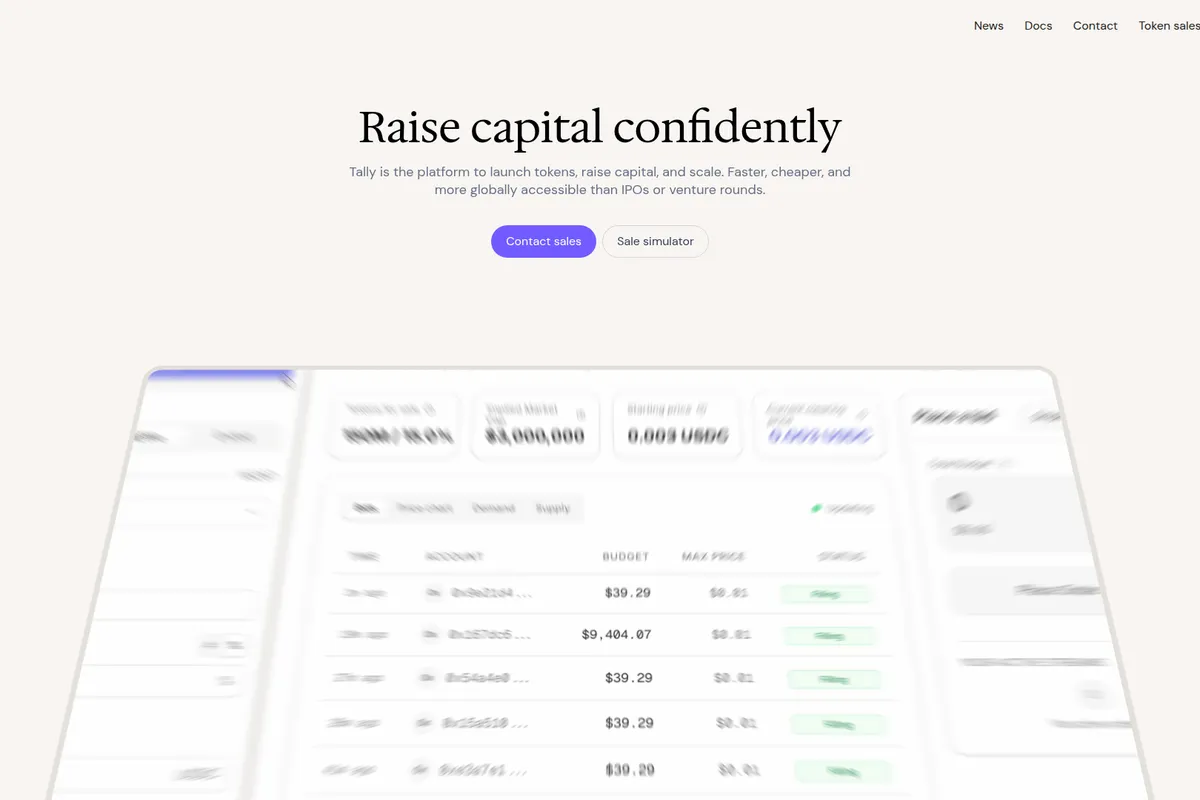
Tally also positions itself as token launch infrastructure. Its blog post “Launch and scale tokens with Tally” describes a consolidated toolkit for running airdrops, token sales, and vesting programs, using audited smart contracts and branded claim interfaces designed to reduce friction for end users. [3]
Several details in that post are especially relevant for teams comparing providers:
- Eligibility design: Tally says eligibility can be set using on-chain activity, snapshots, or allowlists. This is a practical menu that matches how most airdrops and distributions are structured today. [3]
- Scale claims: The post claims claim pages can “scale from hundreds to millions of recipients across any EVM chain,” which speaks to a common pain point: spikes in traffic and transaction orchestration during launches. [3]
- Brand control: The platform emphasizes branded claim pages, and mentions the ability to develop custom claim frontends and domains. That matters because token claims often function like a product onboarding flow, not just a contract interaction. [3]
From the directory side, F6S summarizes the distribution component as scalable claim infrastructure, customizable distribution flows, and EVM support. [2]
Staking, rewards, and incentives
The third pillar is staking and incentives. In “Reward your token holders and drive protocol growth,” Tally describes a “complete, modular staking solution,” combining open-source smart contracts with a ready-to-use interface. The goal is to let teams deploy staking and reward programs without building the infrastructure from scratch, with use cases like returning protocol revenue to token holders and rewarding long-term participation. [4]
A concrete example appears in Tally’s case-study style post about the Obol Collective. Tally says it partnered with Obol earlier in the year to launch the OBOL token and governance system, followed by liquid staking (stOBOL), aiming to combine rewards and governance in a unified interface. The same article describes “Delegate Compensation” as an incentive mechanism designed to reward active, high-quality governance contribution rather than passive holding. [5]
Data transparency and the Tally API
Governance credibility often hinges on transparency. In “Tally wrapped 2025,” Tally explicitly states that proposal statistics, voting records, and governance metrics are publicly available on each organization’s Tally homepage or through the Tally API. For analysts, delegates, and ecosystem researchers, that API claim is meaningful because it suggests Tally is not just a UI, but also a data surface for governance intelligence. [6]
Security and trust
User experience
Because the provided sources are more descriptive than hands-on, this section focuses on what can be inferred from Tally’s stated scope and its emphasis on “integrated” workflows.
For DAO participants, the main UX benefit of a governance frontend is simplification: fewer raw contract interactions and more consistent presentation of proposals, voting power, and execution steps. Crunchbase’s description underscores this by highlighting delegation, proposals, spending decisions, and upgrades, all through Tally as the interface layer. [1]
For token operations teams, the “branded claim interface” language points to an onboarding mindset. Distribution is not only a contract deployment; it is also a user journey, where unclear instructions lead to missed claims, support tickets, and reputational risk. The ability to create branded claim pages and potentially host them on custom domains is a practical feature for marketing and community teams, not just engineers. [3]
On the developer and analytics side, the platform’s stated API and public data access can reduce friction for governance dashboards, delegate tooling, and internal reporting. Tally’s own “Wrapped” post explicitly points users to organization homepages and the Tally API for metrics. [6]
That said, a notable UX challenge sits outside the product: the brand-name confusion with unrelated “Tally” products (forms, surveys, and even loyalty software directories). For procurement and security teams, this can complicate vendor research and lead to mistaken comparisons unless the evaluation criteria is carefully scoped to DAO governance and token infrastructure.
Pricing and fees
In the provided sources, Tally’s pricing is not clearly published. While one directory page is titled “Tally Reviews and Pricing 2026,” the captured information does not include concrete tiers, subscription fees, or a transparent fee schedule for distributions or governance modules. [2]
For teams evaluating total cost, it is useful to separate three categories:
- Platform fees (what Tally charges, if any, for software access and support)
- On-chain costs (gas fees on the selected EVM chain, which vary widely)
- Program costs (token incentives, delegate compensation budgets, and any third-party compliance or legal costs)
A good procurement step is to request an itemized quote and confirm whether pricing is tied to recipients, claims, proposal volume, or required enterprise support.
Comparison with alternatives
A fair comparison starts with the question: “What is Tally replacing?” In practice, Tally can compete against point solutions in governance, token distribution, or staking, as well as other integrated DAO operations stacks.
From the provided sources, CB Insights lists several companies as competitors or adjacent alternatives in the “Tally” context, including KurateDAO, Swae, SundaeSwap Labs, Zeitgeist, and Paymagic Labs, with additional governance-adjacent tooling such as Karma. These alternatives vary widely, ranging from DAO governance analytics (Karma) to prediction-market-based governance concepts (Zeitgeist) and broader coordination or innovation tooling (Swae). [8]
Two cautionary notes are essential here:
- Directory mismatches are common. The same “Tally” name maps to loyalty and marketing software listings on G2, and to forms and lead-capture tooling on other directories. Those are not meaningful substitutes for tally.xyz as a DAO infrastructure product. [9] [10]
- The “best” alternative depends on scope. If your primary need is a governance UI, you will compare differently than if your primary need is claims and vesting at high scale, or a modular staking program with incentives.
Final verdict
Tally is best evaluated as infrastructure for on-chain organizations that want to professionalize governance while also running token operations, distributions, and incentives on EVM networks. The platform’s strongest narrative, supported by both third-party descriptions and first-party posts, is integration: governance, token launch and distribution (including airdrops, sales, and vesting), and modular staking and rewards, with an emphasis on scalable claims and branded participation flows. [1] [3] [4]
The main drawbacks in the current evidence base are commercial and evaluative clarity: pricing is not plainly published in the provided sources, and third-party reviews with concrete benchmarks, reliability metrics, or audited security details are limited in this dataset. Additionally, the brand-name overlap with unrelated “Tally” products can add friction to due diligence.