Background and history
One practical note for researchers is naming ambiguity. Search results for “LayerZero” can surface an unrelated company, LayerZero Power Systems, LLC, which uses LayerZero® as a registered trademark for power distribution products in data centers. That brand’s “What is LayerZero?” page is explicitly about electrical power delivery, not blockchains. [4]
Key features and services
Omnichain interoperability (messaging and value transfer)
Third-party documentation-style education from Ledger Academy provides the most concrete high-level explanation of how LayerZero is intended to work:
- Endpoints are deployed on each supported chain. They send, verify, and receive messages, making each chain a node in a network that can communicate with other endpoints. [2]
- Ultra-Light Nodes (ULNs), implemented via smart contracts, are described as a way to validate cross-chain activity without storing all transaction data on-chain, aiming to reduce cost and complexity relative to “full” light clients. [2]
- Oracles and relayers split duties, with an oracle relaying block headers and a relayer delivering transaction proofs. Ledger emphasizes that these parties should be independent to preserve message validity. Ledger also notes Chainlink and Band Protocol as “official” oracles. [2]
Stargate
LayerZero.network highlights Stargate as “the fully composable liquidity transport protocol at the heart of Omnichain DeFi,” and links directly to stargate.finance. In third-party directories, Stargate is frequently categorized as a DeFi-focused liquidity bridge. [1] [5]
Cardano integration (2026 adoption signal)
A specific adoption datapoint in the provided research set is Crypto.news reporting that Cardano integrated with LayerZero, with Cardano founder Charles Hoskinson quoted as saying Cardano would be “no longer an island,” connecting to “80+ chains including ETH, SOL, and BNB Chain.” The same article states LayerZero would allow Cardano dApps to send messages and assets across dozens of networks, potentially enabling omnichain DeFi patterns such as cross-chain lending and deeper liquidity. [6]
However, that reporting also includes an important caveat for builders and evaluators: it notes that details about the technical implementation timeline and the specific blockchains accessible through the integration were not immediately disclosed. [6]
“Zero” L1 (reported announcement)
The most forward-looking feature discussed in the sources is “Zero,” described in Decrypt’s newsletter item republished by Yahoo Finance as a new Layer-1 blockchain unveiled by LayerZero Labs. The report claims a target of 2 million transactions per second per Zone, and it contextualizes that target as roughly “100,000x Ethereum” and “500x Solana,” which should be read as narrative comparison rather than audited benchmarking. [3]
The same report states Zero is planned to launch in fall 2026, starting with three “zones”: a general-purpose EVM environment, a privacy-focused payments system, and a purpose-built trading venue. [3]
Architecturally, the piece describes a “heterogeneous validation” model with separation between block producers (who execute, build blocks, and generate proofs) and block validators (who verify proofs). It also frames zones as parallel “Atomicity Zones,” similar to concurrent processes on a multi-core CPU. [3]
Security and trust
User experience
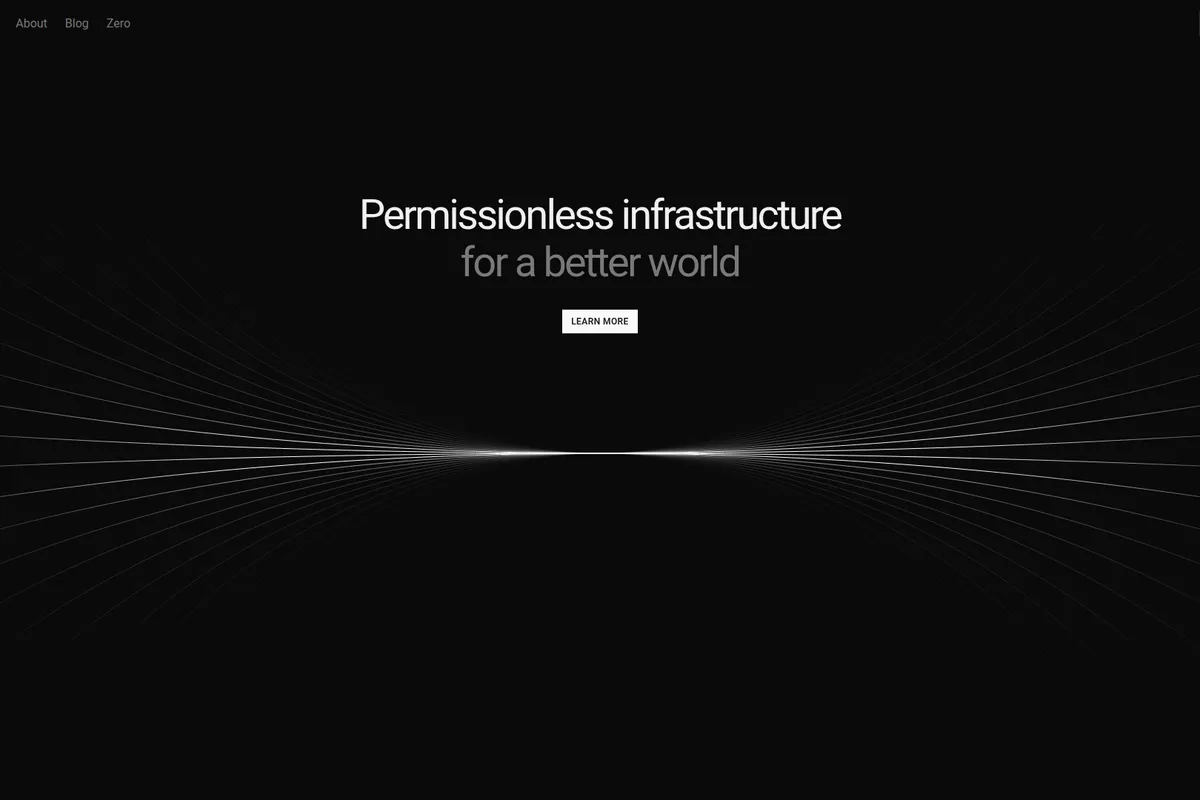
What can be stated from the homepage capture is that the site is organized around three product pillars, Interoperability, Stargate, and Zero, and it leans heavily on mission language, adoption metrics, and a partner logo wall to communicate legitimacy and scale. That makes the site effective as a top-level “what is it” landing page for builders and institutions, but it leaves practical questions open, including how costs are calculated and how production deployments should measure risk and reliability. [1]
Pricing and fees
No explicit pricing table, fee schedule, or enterprise plan details are included in the provided LayerZero.network capture. Similarly, the third-party educational source from Ledger explains architecture but does not provide a cost model. [1] [2]
Token and market context (ZRO)
Some coverage of LayerZero is token-centric rather than protocol-centric. A CoinDCX post dated Feb 11, 2026 discusses ZRO trading around $1.92 to $1.96 and provides technical-analysis style support and resistance levels (support around $1.90, $1.86, $1.80; resistance around $1.95, $1.98, $2.00), along with EMA values and a neutral MACD read. It also includes speculative targets, such as a potential move toward ~$2.80 by late February 2026 and longer-term scenarios such as $4 to $5, while repeatedly noting the speculative nature of predictions. [7]
For platform evaluation, the key takeaway is not the specific price levels, but that LayerZero is widely treated as a major interoperability theme. Still, token market commentary is not a substitute for protocol due diligence.
Comparison with alternatives
Messaging and interoperability peers
Router Protocol shows up in both Alchemy’s alternatives directory and CB Insights’ competitor list, framed as cross-chain liquidity flow infrastructure and contract-level data flow across L1s and L2s. [5] [9]
Bridge-first and aggregator options
If your primary goal is end-user token movement rather than generalized messaging, Alchemy’s “LayerZero Alternatives” page surfaces bridge options like Connext, Synapse, Hop, Superbridge, and StarkGate, each with different chain coverage and design choices. [5]
If you want routing across bridges and DEXs, AlphaGrowth highlights LI.FI as a Bridge and DEX aggregation protocol. [8]
How to choose
From the provided sources alone, the simplest way to shortlist is by the job to be done:
- Choose LayerZero-like messaging protocols (LayerZero, Wormhole, deBridge, Axelar) when you need generalized cross-chain app communication and composability. [5]
- Choose bridge-first products (Hop, Synapse, Connext, Stargate) when your immediate requirement is moving tokens or liquidity. [5]
- Choose aggregators (LI.FI) when you prefer abstraction across multiple routes. [8]
Final verdict
LayerZero is best understood as a major omnichain interoperability stack whose public positioning emphasizes permissionless cross-chain infrastructure, with large headline usage metrics and prominent partner branding on its website. [1] Its architecture is credibly described by Ledger Academy as endpoints plus Ultra-Light Nodes and an oracle plus relayer verification model, explicitly aiming to avoid centralized “middle chains.” [2]
For builders and institutions, the biggest strengths in the supplied materials are the breadth of ecosystem narrative, the clarity of “omnichain” positioning, and the consistent third-party framing of LayerZero as core interoperability infrastructure. The main drawbacks are transparency gaps in the provided sources, particularly around fees, implementation specifics for major integrations, and verifiable security and reliability evidence. Those gaps do not invalidate the platform, but they do mean prospective integrators should treat the strongest claims, especially around the future Zero chain, as hypotheses that require careful validation.