Background and history
CoinMarketCap says it was founded in 2013 and includes a timeline milestone stating that the site “goes live” in May 2013. [1] Wikipedia similarly reports that CoinMarketCap was founded in 2013 in New York City by Brandon Chez. [2]
In April 2020, Binance acquired CoinMarketCap for an undisclosed amount, with Wikipedia noting that Forbes suggested the deal could be worth $400 million. [2] That ownership detail continues to shape how some users evaluate CoinMarketCap’s neutrality, even when the product remains a widely used default for basic price discovery.
Key features and services
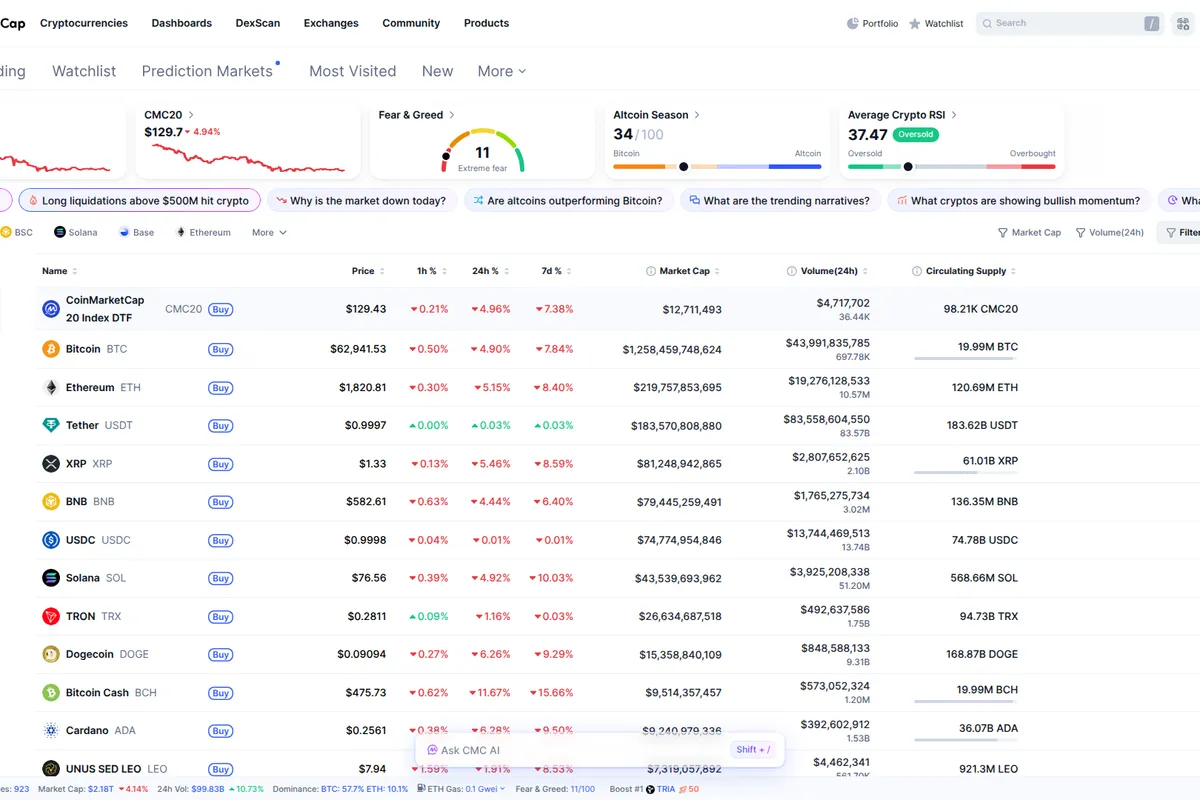
At its core, CoinMarketCap is a crypto market data aggregator. The homepage positions the site around “Top cryptocurrency prices and charts, listed by market capitalization,” with access to current and historic data across Bitcoin and a large universe of altcoins. [3]
Asset pages, rankings, and discovery
Charts and “quick research” tooling
Portfolio tracking, watchlists, alerts, and programs
The YouTube review also emphasizes portfolio and watchlist functionality and mentions basic alerts in the mobile app as part of the day-to-day utility for users who want to monitor holdings or a shortlist of tokens. [5]
Market dashboards and indicators (including ETFs and derivatives)
Exchange rankings, DEX tooling, and on-chain sections
A Trustpilot “Verified” review excerpt specifically praises CoinMarketCap DEX Signals as a useful free tool for tracking short-term DEX sentiment and “on-chain momentum,” while noting the interface can feel busy when many signals appear. [6]
Education, news distribution, and community
CMC’s product is also content. The company highlights news and educational material, including videos and podcasts, and its About timeline lists the launch of CMC Academy in September 2020 and CMC Community in January 2022. [1]
One subtle but important detail is that CoinMarketCap also serves as a distribution surface for third-party content. For example, a February 2026 “Headlines” page hosts a syndicated piece credited to Crypto Daily™, demonstrating that CMC’s “news” area can include externally produced editorial. [4]
APIs and widgets
Security and trust
Not a wallet or broker, and why that matters
Data integrity and methodology: initiatives and controversies
At the same time, CoinMarketCap’s history includes methodology changes that had market impact. Wikipedia describes a January 2018 incident where CoinMarketCap removed South Korean exchanges from its price calculations because prices there were consistently higher, which caused a significant decline in XRP’s market capitalization and broader market chaos. [2]
Ownership and perceived neutrality
Because CoinMarketCap is owned by Binance (per Wikipedia), some users and commentators raise concerns about neutrality. [2] The YouTube review also references “long-standing concern around ownership and neutrality,” recommending healthy skepticism even if the reviewer did not claim to see blatant favoritism in major metrics. [5]
This does not automatically negate CMC’s usefulness, but it does affect how professionals and power users validate data for high-stakes decisions.
User experience
CoinMarketCap is designed for breadth, and that comes with trade-offs.
On the positive side, users often praise it as a convenient reference point. A Trustpilot review excerpt describes CoinMarketCap as a “solid reference point for tracking crypto movements,” highlighting a clear layout, fast updates, and broad listings, with occasional slow chart loading. [6]
On the more critical side, the YouTube review flags UX and monetization friction, and recommends treating CMC as a baseline rather than a full decision engine, especially where small-cap data can be inaccurate. [5]
A useful way to think about the experience is that CoinMarketCap is optimized for scanning. It offers a large number of entry points, trending lists, dashboards, and adjacent products, which makes it powerful but can feel busy compared with simpler alternatives.
Pricing and fees
CoinMarketCap’s consumer experience is primarily free to use (browsing prices, rankings, and content). The platform also offers paid data access via its API product lines, and its About timeline distinguishes between a public API (2016) and a professional API (2018), implying tiered access and commercial plans for higher usage. [1]
Comparison with alternatives
CoinMarketCap remains a dominant destination, but it is no longer the only default.
Traffic and attention competitors (Semrush, January 2026)
Semrush’s competitor analytics frames alternatives as sites competing for the same keywords and audience. As of January 2026, Semrush lists coinmarketcap.com with 81.69M monthly visits and an Authority Score of 88, and shows overlapping-demand competitors including Binance (66.19M), Coinbase (35.1M), CoinGecko (21.99M), Crypto.com (8.91M), Kraken (8.53M), CoinDesk (6.07M), and CoinCodex (2.51M). [7]
This is not a like-for-like comparison in features, since exchanges and media brands appear alongside data index sites, but it reflects real user journeys. Many users substitute an exchange’s market page, a news site, or a competing index when looking up prices and context.
Like-for-like market data alternatives (CoinSutra picks)
If you want similar “coin listing plus metrics” functionality with different UI choices and methodology preferences, CoinSutra highlights five alternatives: CoinGecko, CryptoCompare, CoinCap, LiveCoinWatch, and CoinLib. [8]
When CoinMarketCap is the right tool, and when it is not
Final verdict
CoinMarketCap remains a highly useful crypto market data platform in 2026, particularly for fast baseline checks, broad asset discovery, and a growing set of dashboards spanning indicators, ETFs, derivatives, and on-chain tooling. Its longevity, broad reach, and API ecosystem make it a default reference for many users and builders. [1] [5]
The main caveat is trust perception. The platform’s Trustpilot profile shows an extremely low aggregate score with heavy scam-related complaints, even if CoinMarketCap itself publicly clarifies that it does not call users and does not support deposits, withdrawals, or trading. [6] Add in historical methodology controversy (such as the 2018 removal of Korean exchanges from price calculations) and ongoing neutrality concerns tied to Binance ownership, and CoinMarketCap becomes a tool you should use with verification habits rather than blind trust. [2]
If you want a single recommendation: CoinMarketCap is worth using as a broad, convenient crypto dashboard, but it is best paired with at least one alternative index (often CoinGecko) and on-chain validation for anything that could materially affect a trading or investment decision. [8]