Background and history
That positioning matters because Chainlink has already lived through at least one major “product-market fit” moment in crypto. In a 2026 investor-oriented article, The Motley Fool describes Chainlink as an oracle network that provided accurate pricing data to smart contracts and became tightly linked to the DeFi expansion in the 2019 to 2021 cycle, even calling it one of the “poster children” of DeFi in that era. [3]
Key features and services
Decentralized data feeds (including price feeds)
Verifiable randomness
For applications that need randomness that users can verify, such as games or certain NFT distribution mechanisms, Investopedia lists “verifiable randomness” as a Chainlink capability. It frames this as cryptographically secured randomness that can help applications avoid manipulation. [1]
Automation
Automation is another feature area highlighted by Investopedia. The basic idea is that smart contracts can automate critical functions and event-driven tasks, which can be relevant for both DeFi operations (for example, periodic actions) and enterprise workflows where triggers and scheduled execution matter. [1]
Cross-chain interoperability
Capital markets and tokenized assets positioning
Security and trust
Node operators, staking, and incentives
Open-source and Ethereum hosting
Investopedia characterizes Chainlink as an open-source blockchain project and adds that the Chainlink blockchain is hosted on Ethereum, which uses proof-of-stake. [1] Open-source development can improve transparency and auditability, although it does not automatically eliminate vulnerabilities.
Institutional credibility signals
Practical security caveats
- Data source quality and diversity. A decentralized delivery network is less helpful if upstream data sources are correlated or fragile.
- Configuration risk. Oracle safety depends on parameters such as update frequency and fallback logic.
- Dependency risk. Smart contracts that rely on oracles inherit oracle-layer risk.
These caveats are not unique to Chainlink, they apply to every oracle network, which is why some teams evaluate alternatives based on cost, scalability, flexibility, and reliability. [4]
User experience
Chainlink is primarily a developer and ecosystem platform, not a retail trading app. That affects how “user experience” should be evaluated.
For developers and product teams
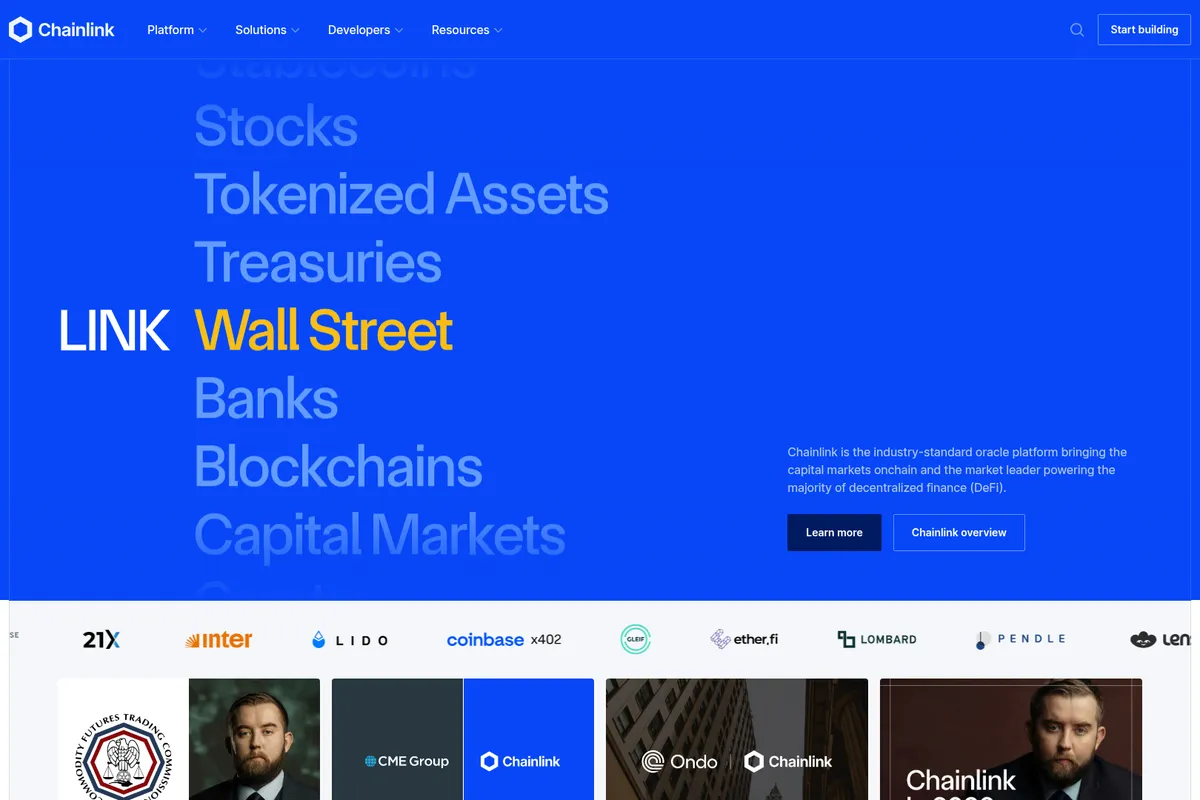
Chainlink’s marketing site also leans into broad applicability, listing categories like stablecoins, prediction markets, stocks, tokenized assets, and banks, and showcasing a wide range of ecosystem logos. [2] As always with logo walls, the exact nature of each relationship should be validated in the specific partner’s announcement or technical documentation.
For token holders and observers
Pricing and fees
Chainlink does not present itself like an exchange with maker-taker fees. Its economics are closer to infrastructure pricing, and the key “fee” concept is payment to node operators.
How fees work at a high level
This has two practical implications:
- Total cost is application-specific. A protocol using multiple feeds or high-frequency updates will have different costs than a low-frequency use case.
- Costs can vary by chain and oracle design. Teams building multi-chain products should model oracle costs for each target environment.
LINK supply context
Investopedia reports LINK has a maximum supply of 1 billion and that more than 650 million had been issued as of May 2025. [1] While supply numbers are not “fees,” they are part of the economic context that token holders tend to weigh.
Market context and 2026 narrative
The tokenized real-world assets thesis
To support the narrative, the article cites several indicators and estimates:
- BlackRock is referenced as having launched a tokenized money market fund with $2 billion in assets. [3]
- The total value of the RWA tokenization market is estimated at about $25 billion at the time of writing. [3]
- The article adds that consulting firms predict tokenization could become a multitrillion-dollar opportunity by 2030. [3]
Whether or not those forecasts materialize, the strategic point is coherent: tokenized assets often need reliable pricing, reference data, and cross-chain coordination, which are areas where oracle infrastructure can be mission-critical.
Price levels and volatility in the same period
Both sources also underline that Chainlink’s token (LINK) can move independently of perceived product progress.
- The Motley Fool notes LINK’s prior cycle surge from about $0.50 in May 2019 to an all-time high around $52 in May 2021, then shows a quote widget with a price of $8.18 as of Feb 24, 2026, plus a 52-week range of $7.40 to $27.70. [3]
- The Yahoo Finance republish (Coinspeaker) states LINK was trading around $11.92 at the time of writing (Jan 28, 2026) and highlights that it struggled to revisit the $52 all-time high set in May 2021. It also references a move to $27.70 on Aug 23, 2025 followed by months of bearish momentum. [5]
“Fundamentals” style indicators cited for a rebound
The Yahoo Finance republish lays out four reasons Chainlink could rebound, based on third-party data sources:
- Santiment data suggesting Chainlink recorded the second-highest developer activity among “AI and Big Data” platforms over the past 30 days. [5]
- DefiLlama data claiming $5 million in gross protocol revenue over the past four weeks, compared with $964,000 in Q1 2025, described as more than five times growth. [5]
- Coinglass data claiming 10.15 million LINK tokens left major centralized exchanges since Dec 20, 2025, interpreted as reduced immediate selling pressure. The same article states, as written, that “118.65 LINK coins are sitting in CEXs,” a figure that appears unusually low, but it is part of the published claim. [5]
- A contrarian interpretation of increased negative social sentiment and mentions of whale buying below $13. [5]
Notably, the same article also warns that macro events, including a U.S. Federal Reserve meeting and earnings from large technology companies, could strongly influence the broader crypto market. [5]
Comparison with alternatives
Chainlink is the best-known oracle brand, but it is not the only choice. Alternatives tend to differ on trust models, performance assumptions, and integration patterns.
Direct oracle network alternatives
A Metana roundup and Alchemy’s Dapp Store list a variety of oracle-focused competitors that may be evaluated alongside Chainlink depending on requirements:
- Band Protocol, often positioned around cross-chain compatibility and efficiency, and described as built on the Cosmos SDK. [4] [6]
- API3, described as focusing on decentralized APIs and connecting smart contracts more directly to Web APIs, with “first-party oracles” as a design theme. [4] [6]
- Tellor, described as using staking and dispute resolution with community governance for validation, often discussed in the context of robust and transparent price feeds. [4]
- DIA, positioned around transparent data sourcing and multi-chain oracle delivery. [4] [6]
- Pyth Network, described by Alchemy as providing high-fidelity, high-frequency market data for DeFi. [6]
- UMA’s Optimistic Oracle, described as allowing contracts to quickly request and receive data. [6]
- Additional options listed by Alchemy include SEDA, SupraOracles, and Relic Protocol, among others in its set of 13 alternatives. [6]
Directory-style “alternatives” can be misleading
This does not mean a wallet is a technical substitute for an oracle network. It mainly illustrates that buyers should start by defining what “alternative” means: an oracle network alternative, a broader Web3 infrastructure alternative, or a custody and security alternative.
Final verdict
Chainlink remains one of the most important pieces of middleware in the crypto stack. Based on the provided sources, its strengths are clear: a well-established oracle network model, a broad feature set that includes data feeds, verifiable randomness, automation, and cross-chain interoperability, and a persistent narrative connection to major on-chain trends. [1]
In early 2026, coverage also highlighted why Chainlink continued to attract attention despite volatility: a thematic tailwind from real-world asset tokenization and interoperability needs, plus reported activity signals like developer activity, protocol revenue, and exchange outflows, all framed as supportive of a potential recovery. [3] [5]