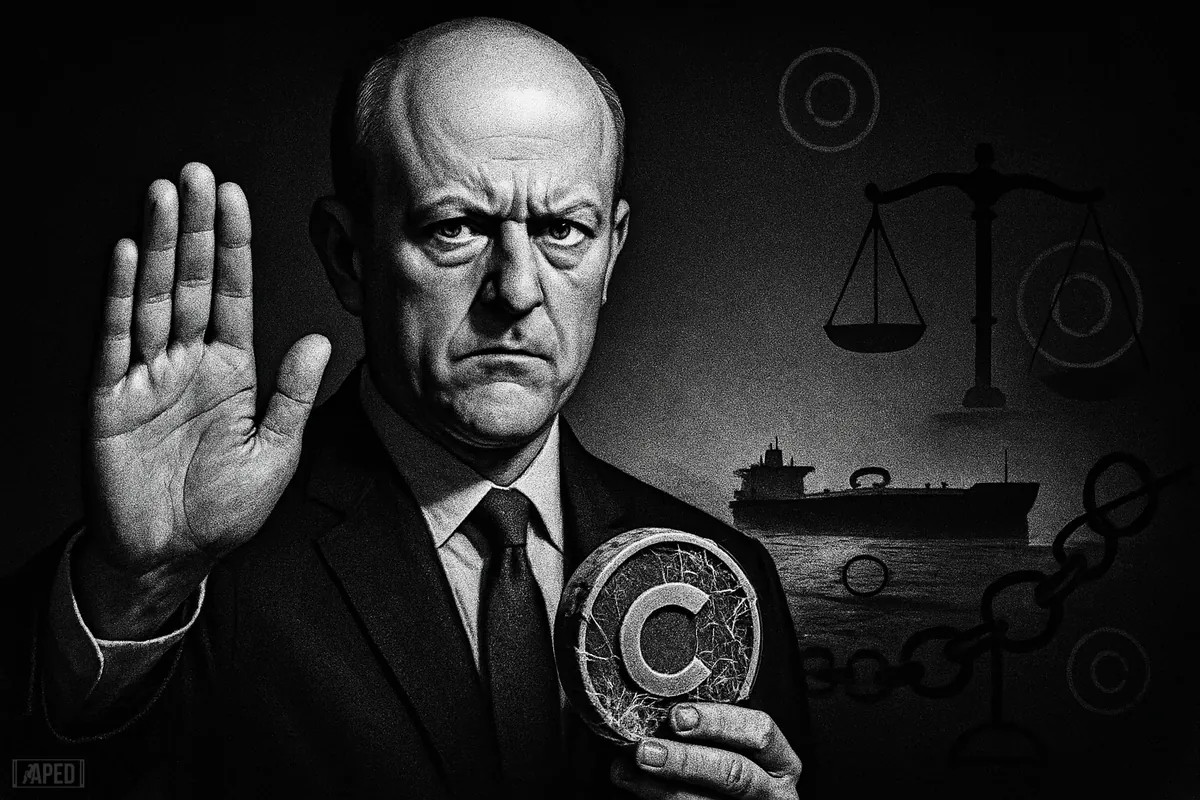
Circle is trying to shut down a very specific fear trade: that USDC$1.0005 could end up as the settlement rail for any Iranian crypto toll scheme tied to the Strait of Hormuz. Jeremy Allaire's answer was blunt, saying that outcome is highly unlikely because sanctioned actors know USDC can be frozen fast. [1]
The timing matters. Stablecoins are under a microscope after the Drift Protocol exploit earlier this month, when more than $230 million in stolen USDC was bridged from Solana$76.56 to Ethereum$2,366.26 before Circle froze nothing during the window. That left critics asking two awkward questions at once: can USDC be abused by bad actors, and if it can, why was it not stopped sooner? [2]
Enjoy articles without ads?
Register for free and get unlimited access to all articles.
Allaire's core argument: sanctioned users tend to avoid USDC
Speaking at a press event in Seoul on April 13, Allaire said Circle's compliance setup makes USDC$1.0005 a poor choice for any sanctioned regime looking to collect payments. His point was simple enough: if the odds of a freeze are obvious, the smart money, or at least the criminal money, routes elsewhere. [3]
That is consistent with how USDC is positioned in the market. Circle has built the token as a regulated product first and a crypto rail second. For ordinary users, that means institutional trust and broad exchange support. For sanctioned entities, it means counterparty risk in plain sight.
Allaire pointed to public reporting from the United Nations and blockchain forensics firms that, in his telling, shows sanctioned actors usually prefer other stablecoins. He did not name them, but the implication was clear. Not all dollar tokens carry the same compliance baggage, and not all issuers have the same willingness or ability to blacklist wallets. [4]
The Strait of Hormuz is not some random geopolitical talking point. It is one of the world's key energy chokepoints, so even a speculative idea about crypto-denominated transit fees lands with outsized force. Add Iran, sanctions, and stablecoins to the mix, and CT, short for Crypto Twitter, predictably did what it does best: jump three steps ahead of the facts.
Allaire's comments look like an attempt to stop that narrative hardening into received wisdom. Circle does not want USDC framed as a neutral tool equally useful to regulated fintechs and sanctioned states. That would be a proper problem for a business that sells itself on compliance credibility. [5]
The Drift exploit still hangs over the story
The pushback on Hormuz does not erase the harder question raised by Drift. On April 1, attackers exploited the protocol and moved a large chunk of stolen USDC$1.0005 across chains over roughly six hours. Critics argued that a freeze should have come sooner, especially given how central issuer controls are to the stablecoin model.
His argument is that letting a private issuer act as judge and executioner would create a dangerous precedent. That is fair enough, but it also exposes the trade-off at the heart of centralised stablecoins: users are told the controls are there for safety, then discover those controls may not activate on crypto timescales.
Allaire used the same appearance to argue for changes to the CLARITY Act, specifically safe-harbour provisions that would let issuers act preemptively in extreme cases. The key detail here is that Circle is not saying it wants unlimited discretion. It wants explicit legal authority.
That matters because it shows where the current framework breaks. Circle is compliant enough to market USDC as sanction-aware, but not empowered enough to move instantly when a hack is unfolding unless authorities are already engaged. For policymakers, that is a design gap. For traders and protocols, it is a reminder that blacklisting powers are real, but not frictionless. [6]
What this says about stablecoin hierarchy
The larger subtext is competitive. Stablecoins are not interchangeable when it comes to enforcement risk. Some are seen as cleaner and more institution-friendly, others as more permissive, and that difference shapes who uses them.
Allaire is effectively betting that compliance is a moat, not a handicap. If he is right, USDC stays attractive to banks, exchanges, and regulated payment firms even if it loses flow from users who want censorship resistance. If he is wrong, the market keeps rewarding stablecoins that are harder to police, especially in offshore and grey-market usage.
Why it matters
This story is less about whether Iran would literally choose USDC for a Hormuz toll plan, and more about what stablecoin issuers can credibly promise. Circle wants the market to believe two things at once: sanctioned actors avoid USDC because freezes are credible, and Circle cannot freeze at will without legal process.
Those positions are not contradictory, but they do create tension. The bullish case for USDC is that regulated money wins more real-world adoption. The invalidation is straightforward: if high-profile hacks keep showing that controls arrive too late, or if sanctioned flows turn up in size anyway, the compliance premium starts to look thinner than advertised.
Your reviews help us improve the quality of both current and future articles. All reviews are public and visible to other readers. We use both ratings and comments to improve future articles and to revise any articles that do not meet our standards.
 See more like this on Google