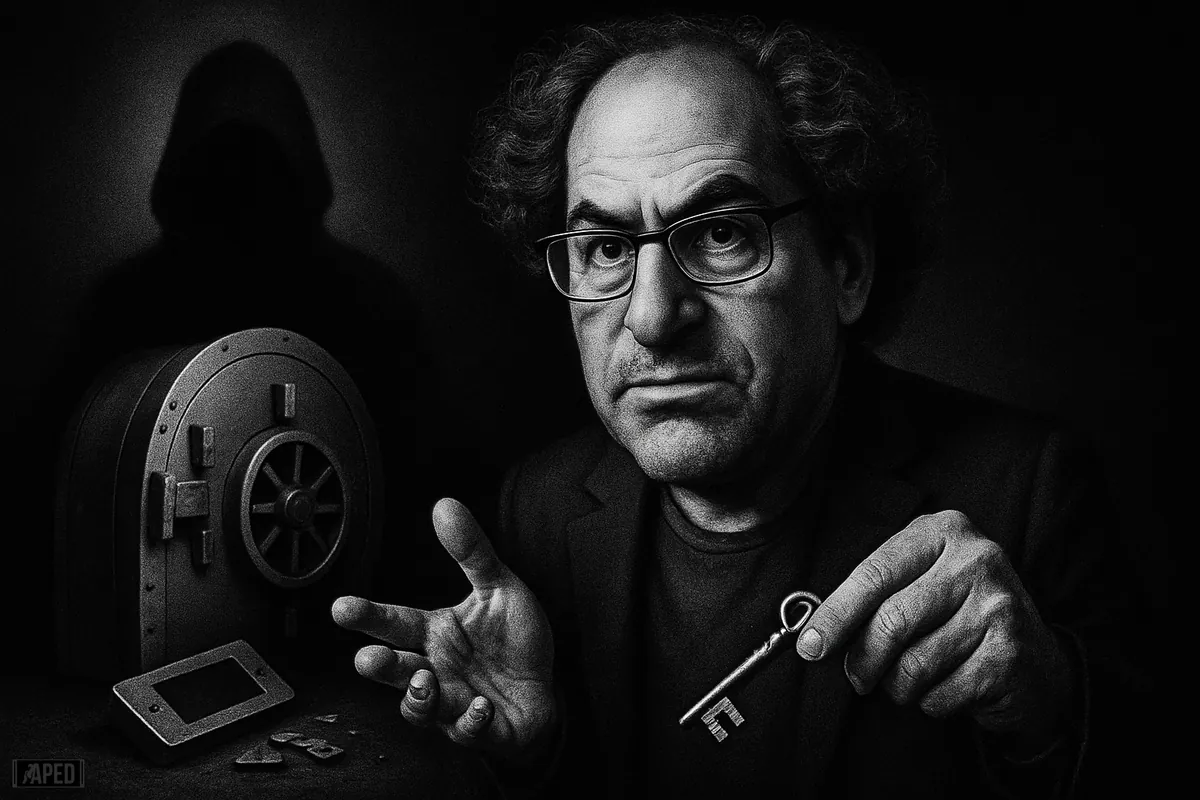
David Schwartz has weighed into the latest Satoshi Nakamoto discourse with a blunt take: the real story is probably not who Bitcoin$80,657.28's creator was, but that nobody alive is likely to control the keys to the stash widely attributed to Satoshi. [1]
The Ripple CTO emeritus made the comment as fresh media attention reignited the identity debate around Bitcoin's pseudonymous founder. His argument cuts past the usual CT theatre and goes straight to the market question: whether roughly 1 million dormant BTC could ever hit circulation. [2]
Register for free and get unlimited access to all articles.
Schwartz's core claim
Schwartz said it is increasingly hard to believe that a person or group with access to that much Bitcoin$80,657.28 would voluntarily sit on it for roughly 17 years without moving a single coin. At current broad market prices, that holding would be worth tens of billions of dollars, commonly estimated around $70 billion to $80 billion depending on BTC's price on the day. [3]
His logic is simple, but not daft. Human incentives change. Circumstances change. Security practices from Bitcoin's earliest days were often primitive by modern standards. Against that backdrop, Schwartz suggested the more plausible explanation is that the relevant private keys were lost or destroyed long ago. [4]
That framing matters because the "Satoshi overhang" has lingered as a kind of ghost risk in Bitcoin for years. Traders know the coins are there on-chain, but they also know they have never moved in a way that suggests active control.
The wallets linked to Satoshi are one of Bitcoin's longest-running open questions. If they were ever activated, the market impact would be enormous, not just because of the size of the holdings, but because it would shatter a key assumption embedded in Bitcoin's long-term supply narrative.
A million Bitcoin$80,657.28 is about 4.7 percent of Bitcoin's fixed 21 million supply. Even if only a fraction were moved, spot markets would likely treat it as a major event. Perpetual futures funding, open interest and exchange inflows would all be watched like a hawk. That is why every revival of the Satoshi identity debate tends to bleed into price speculation.
Schwartz's view effectively argues that this overhang may be fictional. If the keys are gone, those coins are economically out of circulation, even if they still exist on-chain.
Lost keys are not far-fetched in Bitcoin
That theory fits a broader pattern from Bitcoin's early history. Plenty of early holders lost access to coins through discarded hard drives, forgotten backups and poor wallet hygiene. Back then, BTC was worth little and key management was a proper mess compared with current custody standards.
Applying that lens to Satoshi is speculative, but not unreasonable. Bitcoin launched before institutional custody, multisig norms and hardware wallets became standard. A creator focused on shipping software rather than preserving future billions may not have built industrial-grade safeguards around the keys.
There is also the behavioural point Schwartz raised. A living holder with access to a fortune of that size would have had countless reasons to move at least a tiny amount, whether for personal use, legal structuring, signalling or estate planning. The total absence of activity strengthens the lost-key thesis. [5]
None of this proves the keys are gone. It only makes that explanation look more credible than the idea of a perfectly disciplined holder ignoring one of the largest fortunes in modern history forever.
That leaves Bitcoin in its usual strange spot. The chain shows the coins. The market mostly treats them as dead. And every time a new identity theory appears, the same question comes back: not who Satoshi was, but whether those coins are truly unreachable.
The bottom line
Schwartz's point is less about mythology and more about supply. If Satoshi's keys are indeed lost, one of Bitcoin's biggest latent risks may already have been neutralised. If that assumption is ever disproved, the market will know quickly, and the reaction will be anything but subtle.
Your reviews help us improve the quality of both current and future articles. All reviews are public and visible to other readers. We use both ratings and comments to improve future articles and to revise any articles that do not meet our standards.
 See more like this on Google