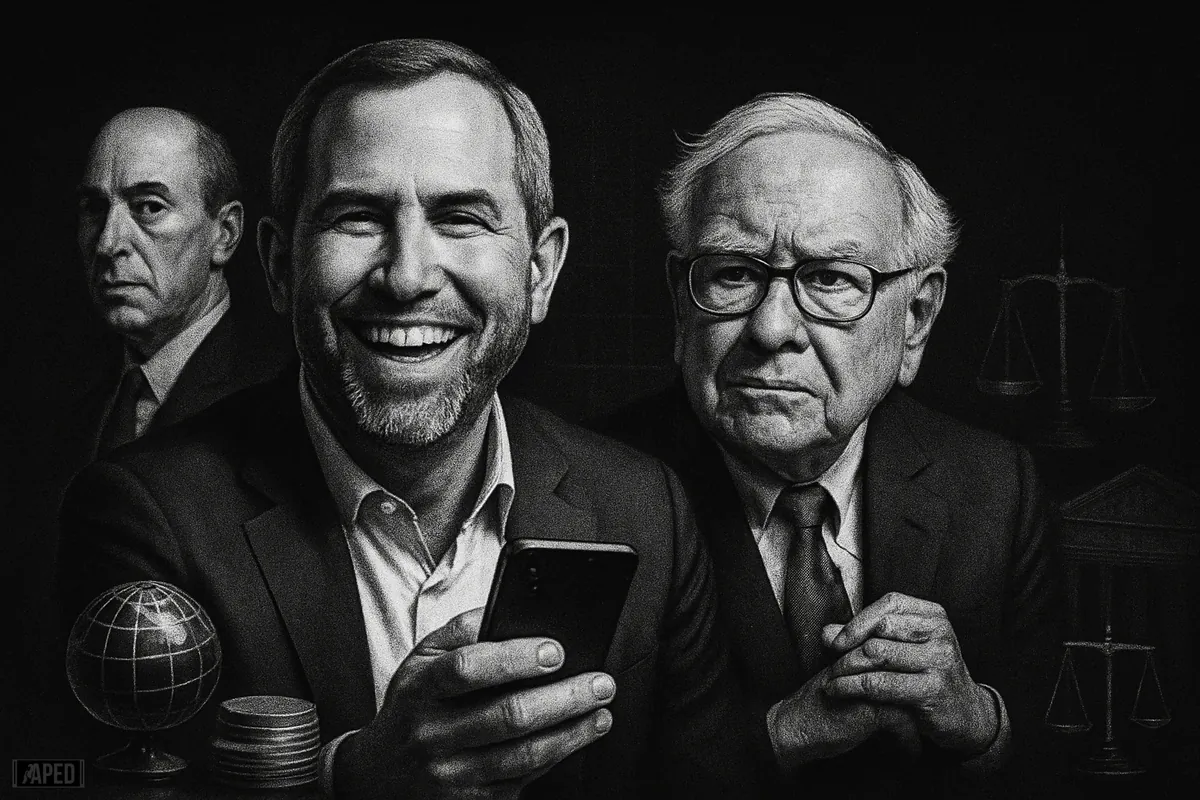
CT loves a receipts moment, and Brad Garlinghouse just posted one. Earlier today, the Ripple CEO resurfaced Warren Buffett's old "rat poison" jab at crypto to make a broader point: Wall Street's posture on digital assets has changed fast, and stablecoins are now the wedge product pulling large institutions on-chain. [1]
Garlinghouse's comment, posted on X on Monday, framed the shift as more than a sentiment flip. His argument is that traditional finance leaders who once treated crypto as pure speculation are now actively exploring how blockchain-based payments fit into treasury, settlement, and cross-border flows. That is a notable change in tone, especially coming from an executive whose company has spent years trying to sell banks and payment firms on blockchain rails.
Register for free and get unlimited access to all articles.
From "rat poison" to boardroom agenda
The Buffett line Garlinghouse referenced dates back to 2018, when the Berkshire Hathaway chairman dismissed Bitcoin$80,326.13 as "probably rat poison squared" after the asset's first major retail mania cracked. The remark stuck because it captured the dominant institutional view at the time: crypto was volatile, unserious, and detached from productive value. [2]
Garlinghouse is using that quote now as a before-and-after snapshot. The punchline is not that Buffett changed his mind. It is that the market around him did. Major corporates, payment firms, and financial institutions have spent the past year moving stablecoins from the "maybe later" pile to active internal discussion.
That distinction matters. Speculative tokens and enterprise payment tools are still very different conversations, but in practice stablecoins have become crypto's least cringe entry point for the C-suite. They offer a cleaner pitch, faster transfers, programmable settlement, and 24/7 movement of value without asking a board to suddenly become a degen fund.
Stablecoins are doing the heavy lifting
Garlinghouse recently described stablecoins as crypto's "ChatGPT moment," meaning the product category that makes the technology legible to mainstream executives. It is a tidy metaphor, but the underlying claim is straightforward: companies can now see an obvious use case. [3]
He pointed to roughly $3 trillion in stablecoin payments over the last year as proof that this is no longer a niche experiment. That figure does not mean every Fortune 500 finance team is ready to mint a treasury strategy tomorrow, but it does show why chief financial officers are being asked to pay attention. Payments is one of the few areas where crypto can be pitched less as ideology and more as infrastructure. [3]
For Ripple, that framing is especially strategic. The company has long centered its business on cross-border settlement and institutional payment rails, so stablecoin adoption strengthens the part of the crypto story that best fits its lane.
There is another layer here that Garlinghouse did not need to spell out too loudly. Institutional interest tends to follow legal clarity, or at least the expectation of it. Crypto's relationship with regulators over the past few years has left many firms in wait-and-see mode, particularly in the United States.
Garlinghouse has repeatedly criticized former SEC chair Gary Gensler's approach as regulation by enforcement, or "lawfare," a term used by industry figures to describe policy being shaped through lawsuits rather than clear rulemaking. Bringing up Buffett's 2018 dismissal now is a way to contrast two eras: one defined by skepticism and market blowups, another increasingly defined by product-market fit and a push for rules that institutions can actually work with. [4]
That does not mean the regulatory fog has fully cleared. It means enough executives now believe blockchain-based payments may be worth the compliance headache.
Why this landed now
The timing is not random. Crypto's public image has broadened beyond the old bitcoin-only debate, and stablecoins are the cleanest evidence of that shift. While CT still obsesses over price, floor, and bag-posting, the institutional crowd is watching transaction utility, issuer quality, and settlement efficiency.
Garlinghouse's post also works as narrative maintenance for Ripple itself. The company wants to be seen not just as an XRP$1.518-linked story, but as a core player in the next phase of financial plumbing. Invoking Buffett helps sharpen the contrast: what was once mocked is now being piloted, integrated, or at least seriously discussed. [5]
The practical takeaway is simple: watch stablecoin policy, not just token prices. If corporate treasury teams and payment providers keep leaning in, that is a stronger signal than another round of crypto culture-war headlines.
Readers should also keep an eye on whether this interest turns into real deployment. Boardroom curiosity is not adoption, and pilots can die quietly. The catalyst is clearer regulation and better institutional tooling. The risk is that enthusiasm outruns compliance, or that firms talk on-chain long before they are willing to move real volume there.
Garlinghouse's Buffett callback is good posting, but it also captures a real market shift. Crypto did not win the culture war outright. It just found a use case boring enough for finance to take seriously.
Your reviews help us improve the quality of both current and future articles. All reviews are public and visible to other readers. We use both ratings and comments to improve future articles and to revise any articles that do not meet our standards.
 See more like this on Google