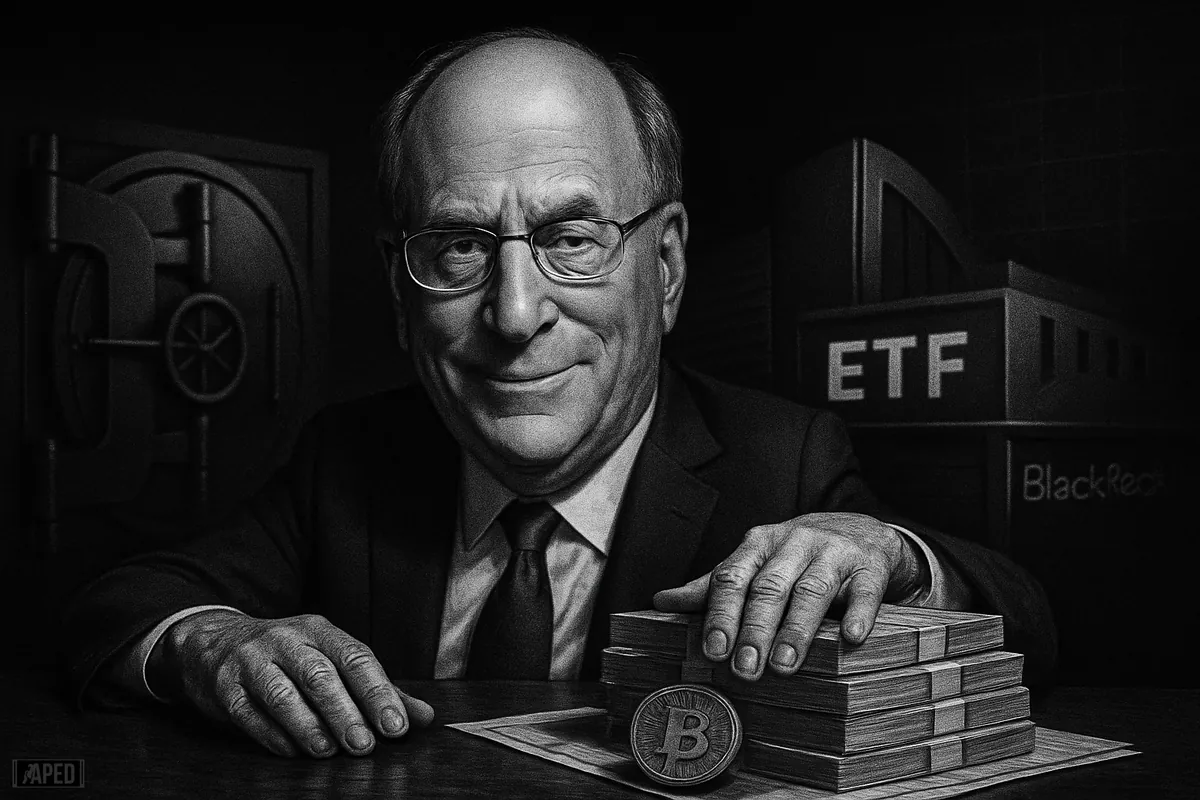
The suits got paid, and this time Bitcoin$80,321.65 helped foot the bill. BlackRock's 2025 numbers show Larry Fink collected his biggest payday yet as CEO, with the firm's spotBitcoin ETF maturing from launch-era curiosity into a proper fee engine.
BlackRock lifted Fink's total compensation to $37.7 million for 2025, up roughly 23% from the prior year, according to the firm's latest proxy filing. The package included a $1.5 million base salary, a $10.6 million cash bonus, and about $24.6 million in stock awards. Most of the jump came from the equity portion, which increased by roughly $6.5 million year on year. [1]
Enjoy articles without ads?
Register for free and get unlimited access to all articles.
Bitcoin became a real revenue line
The clearest crypto contribution came from the iShares Bitcoin Trust (IBIT). BlackRock's disclosures show the fund generated approximately $174.6 million in net sponsor fees in 2025, sharply higher than the $47.5 million it brought in during its 2024 launch year. The firm's spot Ethereum$2,326.44 product, ETHA, added another $18.4 million. [2]
Together, BlackRock's two flagship US crypto ETFs produced about $193 million in fees last year. Relative to the firm's $24.2 billion in total 2025 revenue, that is still a small slice. But the growth rate is the bit markets care about. For a manager BlackRock's size, nearly $200 million from a product category that barely existed on its books a year earlier is not trivial. It is evidence that crypto has moved from narrative to line item.
IBIT also crossed $100 billion in assets during the year, making it one of the fastest ETFs ever to hit that mark. That scale matters more than the headline alone. ETF economics are simple enough: sticky assets, recurring fees, and institutional distribution do the heavy lifting. Once a fund gets embedded in adviser platforms and treasury conversations, flows can become surprisingly durable. [3]
Fink's raise was not just about Bitcoin
Worth keeping the champagne corked. Bitcoin$80,321.65 did not single-handedly mint Fink's pay rise. BlackRock ended 2025 with a record $14 trillion in assets under management, helped by $698 billion in full-year net inflows. The firm also beat Wall Street profit expectations in the fourth quarter, posting $2.18 billion in net income excluding one-off charges. [4]
That broader backdrop matters because executive pay at firms like BlackRock is tied to overall performance, strategic growth and shareholder returns, not just one hot product line. Crypto helped, and helped visibly, but it was part of a larger machine that had a very good year across ETFs, private markets and wealth channels.
Fink himself has been fairly explicit about where he sees the next leg of growth. In his recent shareholder messaging, he grouped digital assets alongside private markets and active ETFs as businesses that could each become $500 million annual revenue streams within five years. That is not a moonboy forecast. It is a capitalallocation thesis from the world's largest asset manager. [5]
For crypto, the significance is less about one CEO's cheque and more about what it signals. Spot Bitcoin ETF revenue is now large enough to show up in compensation-era conversations at the top of traditional finance. That changes incentives. When digital asset products move from experimental to meaningfully profitable, firms tend to build more around them: distribution, research, model portfolio inclusion and, eventually, adjacent products.
It also sharpens the institutional case for Bitcoin as financial plumbing rather than just a directional punt. BlackRock is not earning these fees because degens are punting perpetuals at 3am. It is earning them because wealth managers, advisers and larger allocators are comfortable buying exposure through an ETF wrapper they already understand.
There is, however, a risk of reading too much into the headline. $193 million in crypto ETF fees is strong growth, but it remains modest against BlackRock's overall revenue base. If crypto markets cool, fee momentum can slow just as quickly as it arrived. ETF inflows are cleaner than leverage-heavy exchange flows, but they are still ultimately tethered to sentiment, price and allocation appetite.
The awkward bit: compensation swings both ways
There is a useful historical footnote here. Fink's compensation was cut by about 30% in 2022, showing that pay at this level is hardly a one-way staircase. Strong markets, healthy inflows and rising stock-based awards can boost the top line for executives. A rough year can do the opposite. Bitcoin may have helped produce a bumper year in 2025, but it is not a permanent shield against cyclical pressure. [6]
That is especially relevant for anyone tempted to extrapolate this into a straight-line institutional adoption story. ETF success does not remove market risk, and it does not guarantee every crypto-adjacent product will print. Some of this is hard revenue. Some of it is timing. Some of it is vibes with a Bloomberg terminal attached.
IBIT asset growth: whether BlackRock can keep gathering assets after the initial adoption wave.
Fee durability: sponsor fee revenue is the real signal, especially if price action turns choppy.
ETHA traction: Ethereum ETF fees are smaller so far, but growth there would broaden the institutional crypto thesis.
BlackRock product expansion: any move into new digital asset wrappers, model portfolios or tokenised fund rails would matter more than PR noise.
Market sensitivity: if Bitcoin stalls or reverses sharply, watch whether flows remain sticky or start leaking.
Executive commentary: Fink's future letters and earnings calls should show whether digital assets stay a strategic priority or remain just a very good side business.
Your reviews help us improve the quality of both current and future articles. All reviews are public and visible to other readers. We use both ratings and comments to improve future articles and to revise any articles that do not meet our standards.
 See more like this on Google