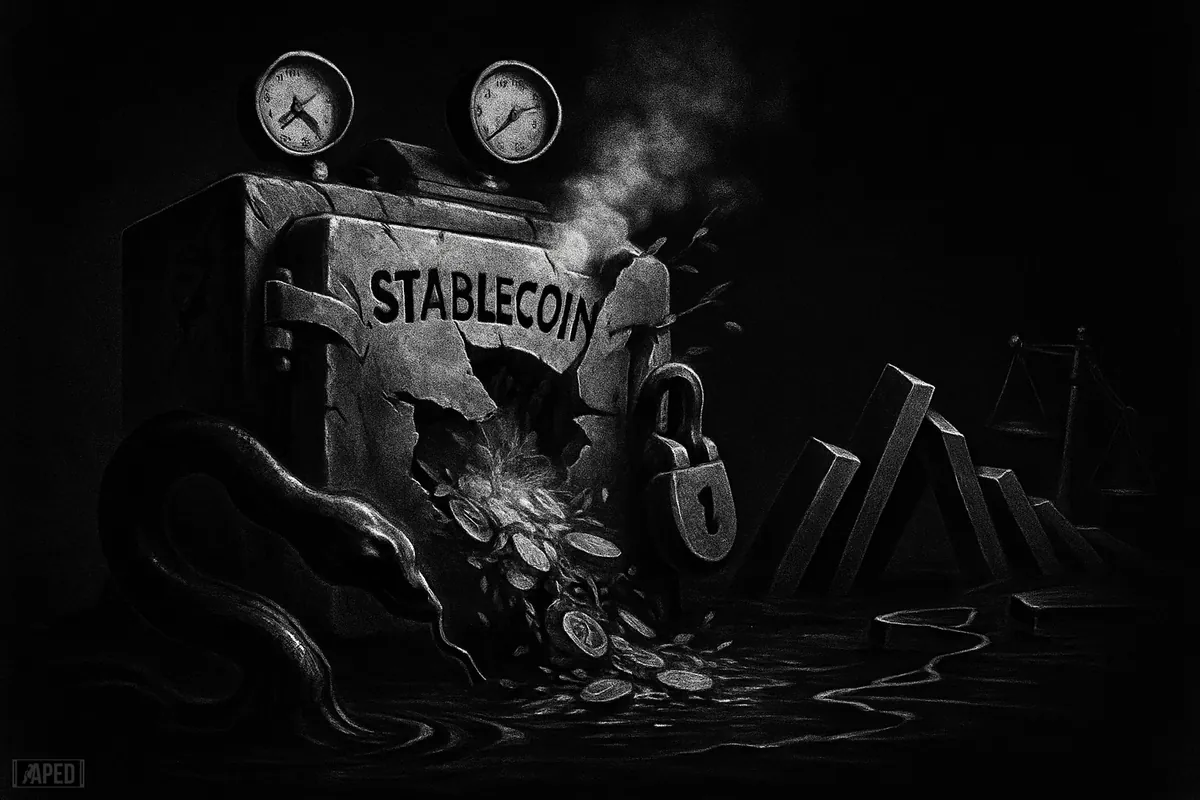
Resolv just ran the same DeFi horror script the market has seen before: bad mint controls at the protocol level, then stale collateral pricing at the lending layer. Result: roughly $25 million extracted, Resolv USR$0.809978 nuked from its peg, and a fresh reminder that "audited" does not mean "safe." The level that mattered was always $1. Once USR and Resolv wstUSR$0.244322 lost it while some venues still marked them near par, the trade became obvious and ugly. [1]
USR remains deeply depegged after Sunday's exploit, trading far below its dollar target after collapsing more than 70% over the past week. The direct damage hit Resolv first, but the bigger story is contagion. Fluid absorbed more than $10 million in bad debt, according to reporting from The Defiant, and saw over $300 million in single-day outflows. Morpho vaults were also hit, while Euler, Venus, Lista DAO, and Inverse Finance moved to pause related markets. [2]
Register for free and get unlimited access to all articles.
The exploit was simple, and that is the problem
At the center of the attack was Resolv's USR mint flow, which relied on a two-step process with an off-chain signer. A user deposited USDC$1.0005 through a requestSwap function, then a privileged key with SERVICE_ROLE authorized how much USR to mint via completeSwap.
That setup had a critical weakness: the contract enforced a minimum amount out, but no upper bound. If the signing key approved an absurd mint amount, the contract would still honor it.
That is exactly what happened. The attacker allegedly compromised Resolv's AWS Key Management Service access, then used the signer to authorize roughly 80 million USR against deposits reportedly in the low six figures. On-chain records cited by multiple analysts show two rapid mints, one for 50 million USR and another for 30 million USR. [3]
This is why the exploit has drawn such a sharp reaction from security researchers. The issue was not some exotic smart contract edge case. It was a privileged mint design with weak operational security and missing issuance limits. One analyst described it bluntly: the system behaved as designed, which is what made the design itself dangerous. [4]
Audits did not save it
Resolv had been audited many times, but repeated reviews did not eliminate the core structural risk. That matters because the industry still treats audit counts like a trust badge. They are not. Audits can identify issues, but they do not force teams to redesign unsafe architecture or fully harden key management.
The reported detail that stands out is that the admin role had multisig protection, while the mint-signing role did not. That is backwards from a risk perspective. If one key can create system liabilities at scale, that key is a crown jewel. Leaving it as a standard externally owned account is asking for trouble.
The lesson here is not subtle. Off-chain privileged signers need strict issuance caps, short-lived permissions, better segregation, and ideally a design where one compromised operator cannot print protocol liabilities into existence.
After minting the inflated USR balance, the attacker did not simply market-sell everything at once. They reportedly moved through wstUSR, the wrapped staked version, then rotated liquidity through Curve DAO$0.2156, Uniswap$3.076, and Kyber Network Crystal$0.1368 into Ethereum$2,366.44. The wallet tied to the exploit ended up holding about 11,400 ETH, worth roughly $24 million around the time the attack was analyzed. [3]
Meanwhile, Resolv's backing pool of BTC and ETH was not immediately drained. That is an important distinction. The collateral survived, but the stablecoin's credibility did not. Once users no longer believed redeemability and market price aligned, the peg broke hard.
That is where the second failure kicked in. Lending protocols that accepted USR or wstUSR as collateral were still valuing those assets near $1 even as the market price cratered.
The real contagion came from stale pricing
This is the old DeFi flaw the hack revived: treating a broken stablecoin as if nothing happened. Once secondary market prices diverged from oracle values, anyone could buy discounted collateral, post it at an inflated on-chain valuation, borrow stronger assets like USDC, and leave the bad debt behind.
Chaos Labs' Omer Goldberg highlighted this dynamic publicly, noting that wstUSR was still being marked around $1.13 in at least one setup while trading much lower in the market. That gap effectively created free money for anyone fast enough to exploit it. [5]
This is not new. Similar mechanics have shown up repeatedly across DeFi over the past year plus. The wrappers and venues change, but the exploit path stays familiar: depeg, stale oracle, overborrow, socialize the losses. Morpho, Euler, Fluid, and others have all had to think about this class of risk before. Yet markets still listed collateral that could fail faster than their pricing systems could react.
That is the real indictment here. Resolv created the initial shock, but composability amplified it because too many lending markets were comfortable with assumptions that only hold in normal conditions.
Teams like yield-bearing stablecoins because they are capital efficient and sticky. Lending protocols like them because users want more collateral options. Integrators like them because extra yield helps TVL grow. Everyone gets paid while the peg holds.
What gets underpriced is reflexivity. Once a synthetic or wrapped dollar product depends on off-chain operations, special roles, redemption assumptions, and secondary market liquidity all staying intact, it is no longer plain vanilla collateral. It is a layered risk product wearing a stablecoin costume.
The market keeps relearning that distinction during stress. If an asset can gap down 30% to 70% in hours, it cannot be treated like cash-equivalent collateral without aggressive haircuts, circuit breakers, and live repricing.
The bigger picture
Resolv's exploit is not just another hack headline. It is a case study in how one compromised key can metastasize across DeFi when risk systems are built for calm markets instead of failure modes.
The immediate watchlist is straightforward: whether USR finds any credible recovery path, whether affected protocols can fully ring-fence bad debt, and whether lending markets tighten standards for yield-bearing stable collateral. The broader takeaway is even simpler. If a token says "stable" but needs trust in off-chain actors, wrappers, and lagging oracles, treat it like risk collateral, not digitalcash. That rule keeps getting written in losses.
Your reviews help us improve the quality of both current and future articles. All reviews are public and visible to other readers. We use both ratings and comments to improve future articles and to revise any articles that do not meet our standards.
 See more like this on Google