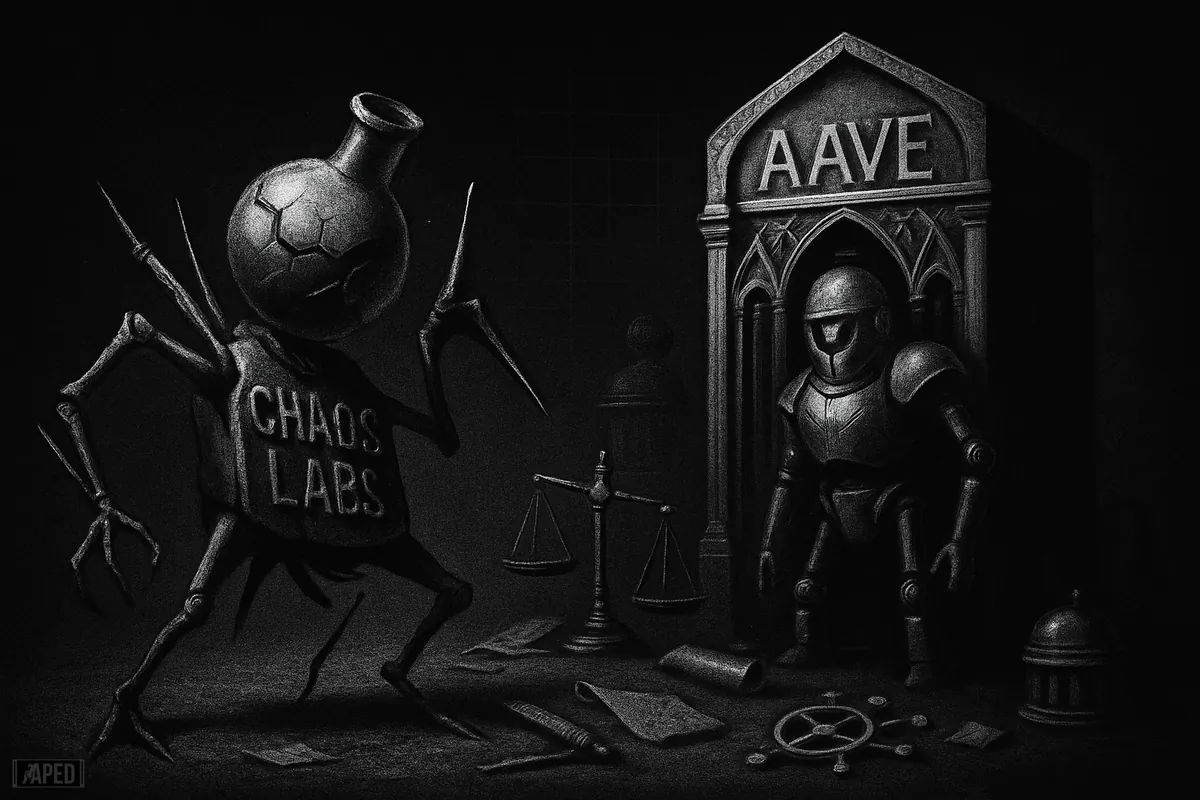
Chaos Labs just walked away from Aave, and this is not some routine vendor shuffle. It is a governance and risk story with real teeth. The firm says it is ending its engagement after three years because Aave's approach to risk, especially around the transition to V4, no longer matches what Chaos believes the job requires. The key level to watch is not a token price, it is trust in Aave's operating stack as core contributors keep heading for the exit. [1]
Monday's announcement makes Chaos Labs the third major contributor to step back from Aave in roughly two months. BGD Labs said it was leaving on April 1, and the Aave Chan Initiative had already announced a wind-down in early March. On its own, any one departure could be framed as politics or budget friction. Three in a row looks more like structural stress. [2][3]
Register for free and get unlimited access to all articles.
Why Chaos Says It Is Leaving
Chaos Labs said the split comes down to two things: money and philosophy. The firm argued that Aave's budget did not reflect the actual cost of securing and operating a lending protocol that is now much larger, more complex, and heading into a new architecture with V4.
According to Chaos CEO Omer Goldberg, the company has effectively been running its Aave mandate at a loss for three years. Aave Labs reportedly offered to increase the budget to $5 million, but Chaos said it would need at least $8 million to support Aave V3, the coming V4 system, and institutional go-to-market efforts. That is a large gap, but the more important detail is what it implies: the two sides no longer agree on what adequate risk coverage even looks like. [1][4]
Goldberg's argument is straightforward. Risk infrastructure is not a dashboard and a few parameter tweaks. It is continuous monitoring, simulations, tooling, market response, and increasingly, legal exposure. If Aave wants V3 running while V4 comes online, Chaos sees that as parallel operational load, not a clean handoff.
The V4 Dispute Is the Real Story
The budget fight is headline-friendly, but the V4 disagreement is the deeper issue. Chaos described Aave V4 as effectively a new protocol with a different codebase, architecture, and liquidation logic. That matters because the systems that helped manage risk on V3 cannot simply be copied over and called a day.
That is where the misalignment becomes obvious. One side appears to believe V4 is an evolution that can be staffed and budgeted like an upgrade. The other sees it as a fresh attack surface with fresh liability. In crypto, that gap is where "everything is fine" turns into post-mortems.
Aave is not some sleepy side protocol. It is the largest lending market in DeFi, and it has handled enormous volumes through volatile market cycles. Chaos pointed to metrics from the current era of contributors, including TVL growth from about $5.2 billion to more than $26 billion, over $2 billion in liquidations processed, and cumulative deposit volume above $2.5 trillion. [5]
When a protocol at that scale loses the team arguing for more risk spend, users should pay attention. Lending protocols live or die on edge-case handling. Most days are boring. The bad day is the business model.
The Knowledge Drain Problem
Chaos framed the situation as a "Ship of Theseus" problem, and that analogy lands. The protocol still has the Aave name, but the people who built and operated key parts of the system are leaving one by one. That creates a knowledge drain that is hard to quantify and even harder to replace on a deadline.
This is especially relevant during a migration period. Running V3 and V4 side by side does not split the workload in half. It can double it. Teams need to monitor both systems, coordinate governance, update parameters, model cross-market effects, and respond to stress in real time. Every contributor exit makes that operational handoff heavier.
DeFi governance often treats contributors like interchangeable service providers. Sometimes that works. Sometimes the protocol discovers that institutional memory was one of the main controls keeping the machine stable.
Chaos also flagged legal exposure as part of its decision. That point should not get lost. DeFi risk managers still operate in a gray zone, with no clear safe harbor if something fails and no settled framework for liability. For a firm being asked to support a more complex protocol with greater institutional ambitions, undefined legal risk is not a side note. It goes into the price.
That makes the funding dispute more rational than dramatic. If scope expands, architecture changes, and legal uncertainty remains high, the cost of doing the job properly rises. Saying "do more for less" is not a strategy. It is hope dressed up as treasury discipline.
What This Says About Aave Governance
The bigger read-through is governance. Aave has long been considered one of DeFi's more serious and battle-tested protocols. That reputation was built on process, technical depth, and risk management, not just TVL bragging rights. A streak of contributor exits threatens that image because it suggests the protocol's internal alignment may be fraying at exactly the moment execution risk is increasing. [6]
To be clear, contributor departures do not automatically mean Aave is unsafe. Protocols can replace teams, rework mandates, and emerge stronger. But the market should not hand-wave the pattern away either. If multiple experienced groups are independently signaling governance tension, budget strain, or disagreement over operating standards, that is signal, not noise.
There is also a strategic question here. Aave wants to keep pushing into new architecture and broader institutional relevance. That requires premium-grade risk operations, not bare-minimum coverage. TradFi firms spend heavily on compliance and risk because the cost of failure is nonlinear. DeFi does not get a free pass just because it moves faster.
The Bottom Line
Chaos Labs exiting Aave is not just another DAO forum spat. It is a warning that elite DeFi infrastructure still depends on a small number of specialized operators, and those operators will walk if the mandate, budget, and liability profile stop making sense.
For Aave, the watchlist is clear: who replaces the lost expertise, how V4 risk operations are staffed, whether governance can stabilize after three high-profile departures, and whether users see any slippage in responsiveness or parameter quality during the transition. If Aave fills the gap with credible operators and clear accountability, this becomes a rough chapter. If not, the protocol risks learning the oldest lesson in lending, right after everyone assumes the system is mature enough to run on autopilot.
Your reviews help us improve the quality of both current and future articles. All reviews are public and visible to other readers. We use both ratings and comments to improve future articles and to revise any articles that do not meet our standards.
 See more like this on Google