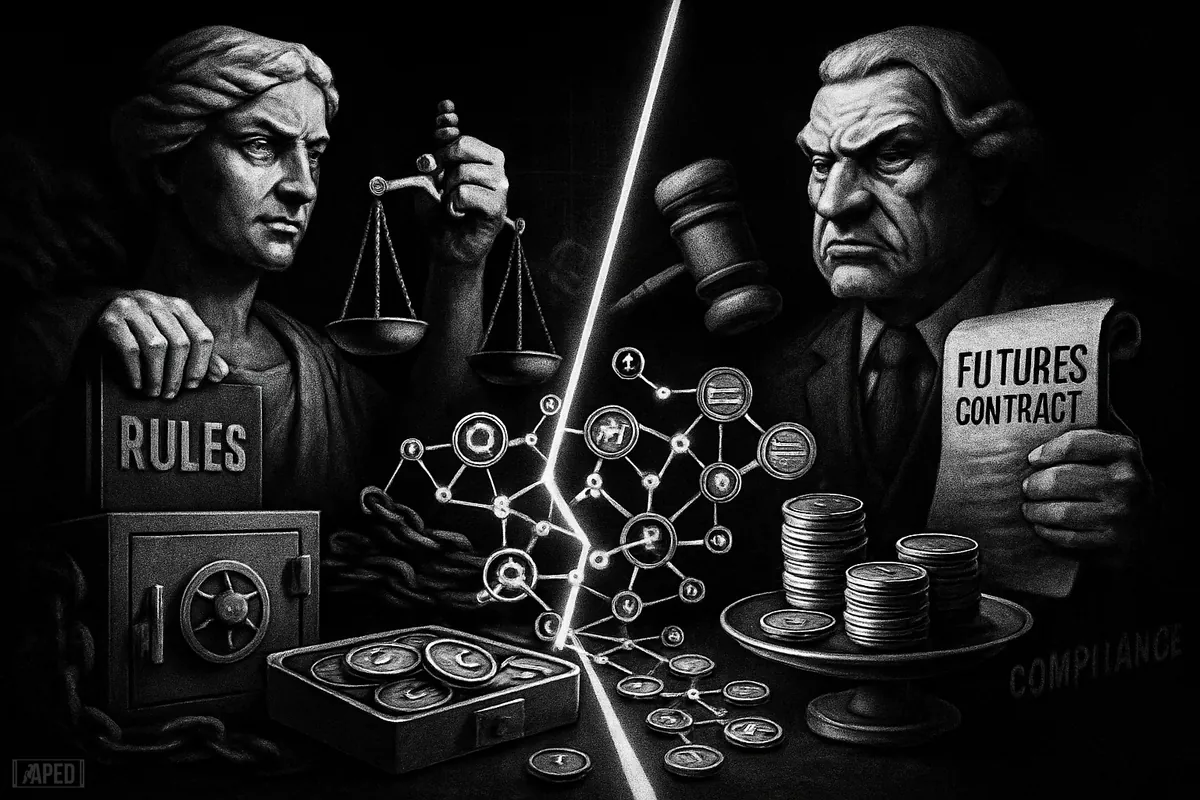
Regulators finally did the thing crypto has been begging for: they wrote down actual lines.
The SEC and CFTC have issued a joint framework that gives the market a clearer read on when a token looks like a security, when it is more likely a commodity, and where DeFi activity drags firms back into U.S. regulatory scope. That does not mean the fog is gone. It does mean the old game of "regulation by shrug" just got harder to play. [1]
Register for free and get unlimited access to all articles.
What the new framework actually does
At the core, the guidance splits the analysis into two buckets: the token itself, and the way it is sold, marketed, or embedded in a protocol.
That distinction matters. A token is not automatically a security forever just because it launched in a sketchy way. At the same time, slapping "decentralized" on a website does not magic away securities or derivatives laws. The agencies are effectively saying structure matters, but so do facts on the ground. [2]
For the SEC side, the familiar test still revolves around whether buyers are putting money into a common enterprise with an expectation of profits tied to the efforts of others. The update sharpens how that applies to crypto by focusing on things like treasury control, governance concentration, insider allocations, marketing promises, and whether a core team is still the obvious engine behind value creation. [3]
The CFTC side is clearer on spot commodities, token-linked derivatives, and leveraged arrangements. If a token functions more like a commodity and trades in cash markets, the CFTC is mainly watching for fraud and manipulation. If the product starts looking like a swap, future, margined retail commodity transaction, or synthetic exposure, CFTC territory expands fast. [4]
The big win: token status is now less hand-wavy
This is the part the market wanted.
Projects now have a more explicit set of markers for arguing that a token has transitioned away from securities-like characteristics. Those markers reportedly include broad distribution, reduced issuer control, limited information asymmetry, live network utility, and the absence of ongoing managerial promises that drive investor expectations. [5]
That is not a free pass for every governance token with a Discord and a dream. If a small team still controls upgrades, emissions, treasury deployment, and branding, regulators are likely to look through the decentralization cosplay.
The practical outcome is that lawyers, exchanges, funds, and token issuers now have a more standardized checklist. Expect listing committees and due diligence desks to start treating "sufficient decentralization" less like vibes and more like an evidence file.
DeFi is not exempt, it is just being analyzed differently
This is where some bags may get uncomfortable.
The framework appears to make clear that DeFi exposure is judged by function, not branding. If a protocol offers trading, lending, staking, leverage, or synthetic exposure, regulators will look at who built it, who profits from it, who can change it, and whether there are identifiable control persons or fee recipients. [6]
A front end, governance multisig, development company, foundation, or tokenholder group can all become relevant if they exercise meaningful influence. "Code is law" is not much of a defense when a multisig can pause markets by Friday.
For investment advisers, funds, and other institutions using DeFi rails, the guidance is especially important. Counterparty risk, custody, disclosure, valuation, and embedded derivatives exposure are no longer niche legal questions. They are front-and-center compliance items. If a fund is farming yield through a protocol that contains leverage or synthetic wrappers, that exposure may not be treated like simple spot token ownership.
Centralized platforms do not get to hide behind asset labels either.
An exchange, broker, dealer, clearing venue, or trading interface may need to reassess whether it is facilitating securities activity, commodity transactions, or derivatives access depending on the assets and product features involved. The same token can trigger different obligations depending on whether users are buying spot, earning yield, posting collateral, or entering perpetual-style exposure.
That is the real message here: regulators are moving from naming things to mapping behaviors.
Why the market will care immediately
First, this reduces some listing risk. Venues that were cautious about borderline assets now have a more detailed road map. That could help certain tokens stay tradable in the U.S. if issuers can show lower centralization and cleaner utility.
Second, it raises operational risk for pseudo-DeFi setups with obvious choke points. Protocols with admin keys, revenue-sharing tokenomics, centralized interfaces, and marketed profit expectations may get more scrutiny, not less.
Third, institutions may lean in harder now that the rules are more readable. Big money does not need perfect certainty, it needs process. A framework, even an imperfect one, is more useful than years of contradictory speeches and enforcement roulette.
The catch: clarity is not leniency
Nobody should confuse this with a regulatory pardon.
The framework does not erase prior token sales, wash away enforcement risk, or bless every DAO structure. It also leaves room for fact-specific judgment, which means two projects that look similar on Crypto Twitter can still be treated very differently under the hood.
There is also a political layer. Guidance can shape enforcement and market practice, but future commissions, courts, or Congress could still shift the ground again. Crypto has seen enough "final answers" turn into sequel content.
The Bottom Line
This is the most useful kind of regulation: less theater, more definitions.
The SEC and CFTC have given the industry a clearer way to separate token status from token behavior, and to measure how much DeFi is actually decentralized versus just wearing the hoodie. That should help compliant builders, serious investors, and exchanges that were tired of guessing.
If projects can prove shrinking insider control and real network utility, watch more confident U.S. listings and institutional participation. If a protocol still runs on admin keys, fee extraction, and marketing promises, expect regulators to treat the "DeFi" label like the meme it often is.
Your reviews help us improve the quality of both current and future articles. All reviews are public and visible to other readers. We use both ratings and comments to improve future articles and to revise any articles that do not meet our standards.
 See more like this on Google