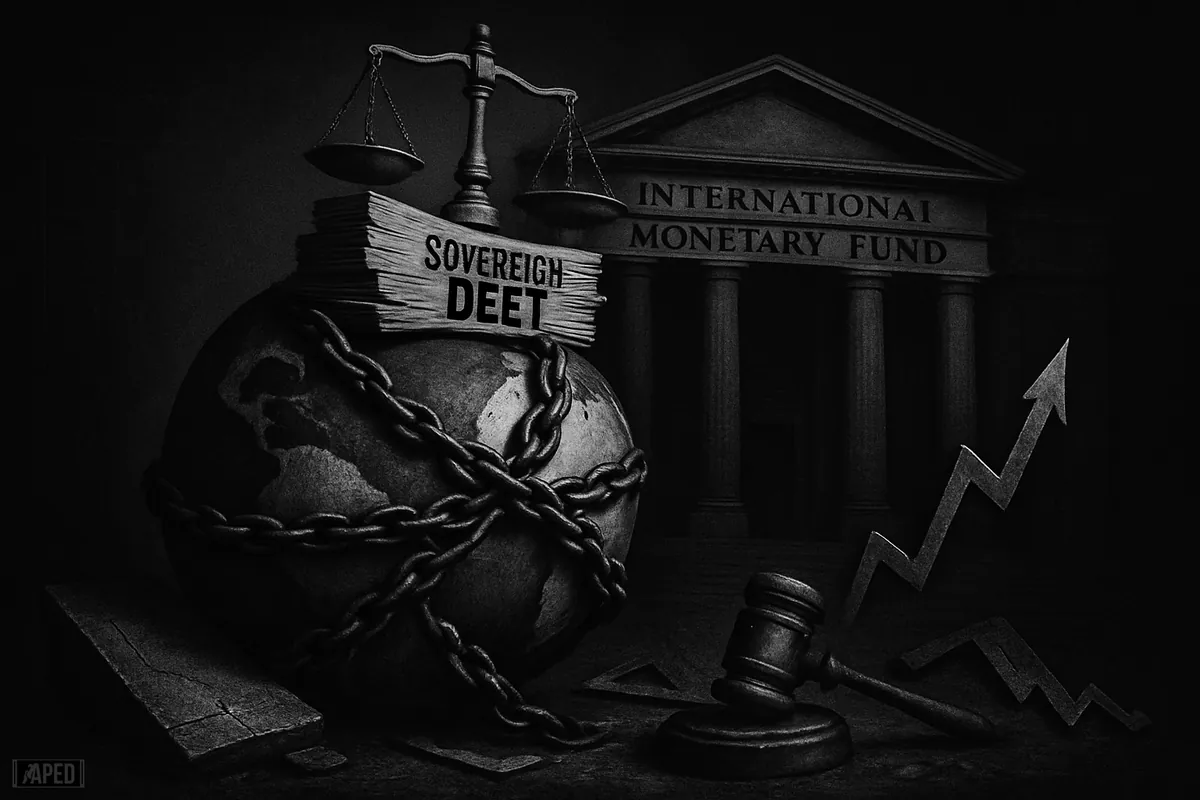
Global debt is back at almost wartime levels, except this time there is no victory bond poster coming to save the balance sheet.
The IMF warned this week that global public debt is nearing 100% of world GDP, a threshold not seen since the World War II era. The big difference is the trend. After WWII, debt ratios fell hard over the following decades. Now, the Fund says the line is still moving up. [1]
Enjoy articles without ads?
Register for free and get unlimited access to all articles.
The IMF's warning, minus the policy-speak
The IMF's message is simple: governments have run out of easy choices. Higher debt, higher rates, weaker growth, and aging populations are colliding at the same time.
According to the Fund, global public debt is on track to approach or exceed the postwar peak within the next few years. Research tied to the IMF's recent fiscal analysis points to debt topping 100% of global GDP by 2029 if current trends hold. That matters because refinancing old debt is no longer cheap. A lot of sovereigns borrowed heavily during the low-rate era. That tab is now coming due at a worse price. [2]
Era Dabla-Norris and Rodrigo Valdes, writing for the IMF, framed the core issue as one of trust. States are being forced to juggle spending demands, tax resistance, and debt servicing costs all at once. In plain English: someone gets squeezed. [3]
Why this cycle looks different from the last historic peak
Postwar debt fell from roughly 150% of GDP to below 50% within two decades, helped by strong growth, financial repression, inflation, and favorable demographics. Today's setup is weaker on nearly every front. [4]
Growth is slower, and rates are not your friend
Advanced economies are dealing with structurally slower growth and bigger entitlement burdens. Emerging markets face a different problem: tighter financing conditions and more volatile capital flows. Either way, interest expense is eating a larger share of budgets.
That is what makes the IMF warning less like a chart gimmick and more like a funding problem. High debt can be manageable if rates are low and growth is decent. Once that mix flips, debt stops being abstract and starts hitting fiscal room in real time.
Politics makes cleanup harder
The Fund is also hinting at something obvious that policymakers rarely say out loud: fiscal consolidation is politically toxic. Cutting spending hurts. Raising taxes hurts. Rolling debt forever gets harder when bond markets demand a premium.
So the "we'll fix it later" trade is looking pretty cooked.
Why crypto traders care
This is not automatically bullish for crypto, and anyone saying "debt up, Bitcoin$80,580.49moon" is doing lazy macro. But the setup does strengthen the long-term pitch for scarce, non-sovereign assets.
If governments keep leaning on deficits while central banks face pressure to contain borrowing costs, the credibility of fiat management gets tested. That does not mean a straight-line move into BTC or gold. It does mean hard assets stay in the conversation, especially when real yields fall or fiscal stress starts bleeding into currency markets.
For crypto specifically, the cleaner read is narrative support, not instant capital rotation. Bitcoin$80,580.49 tends to benefit when confidence in sovereign discipline weakens. Smaller tokens usually do not. Degens may want everything to pump, but macro stress is selective.
The IMF is not saying a debt crisis is guaranteed tomorrow. It is saying the room for policy mistakes is shrinking fast.
That makes this less about one scary chart and more about regime change. The world got used to debt that looked huge but felt cheap. That era is fading. If debt keeps climbing while borrowing costs stay elevated, expect tougher budgets, more political friction, and more investors looking for assets outside the usual sovereign stack.
If nominal growth outruns funding costs, governments can muddle through. If it does not, watch fiscal stress move from academic report to market problem.
Your reviews help us improve the quality of both current and future articles. All reviews are public and visible to other readers. We use both ratings and comments to improve future articles and to revise any articles that do not meet our standards.
 See more like this on Google