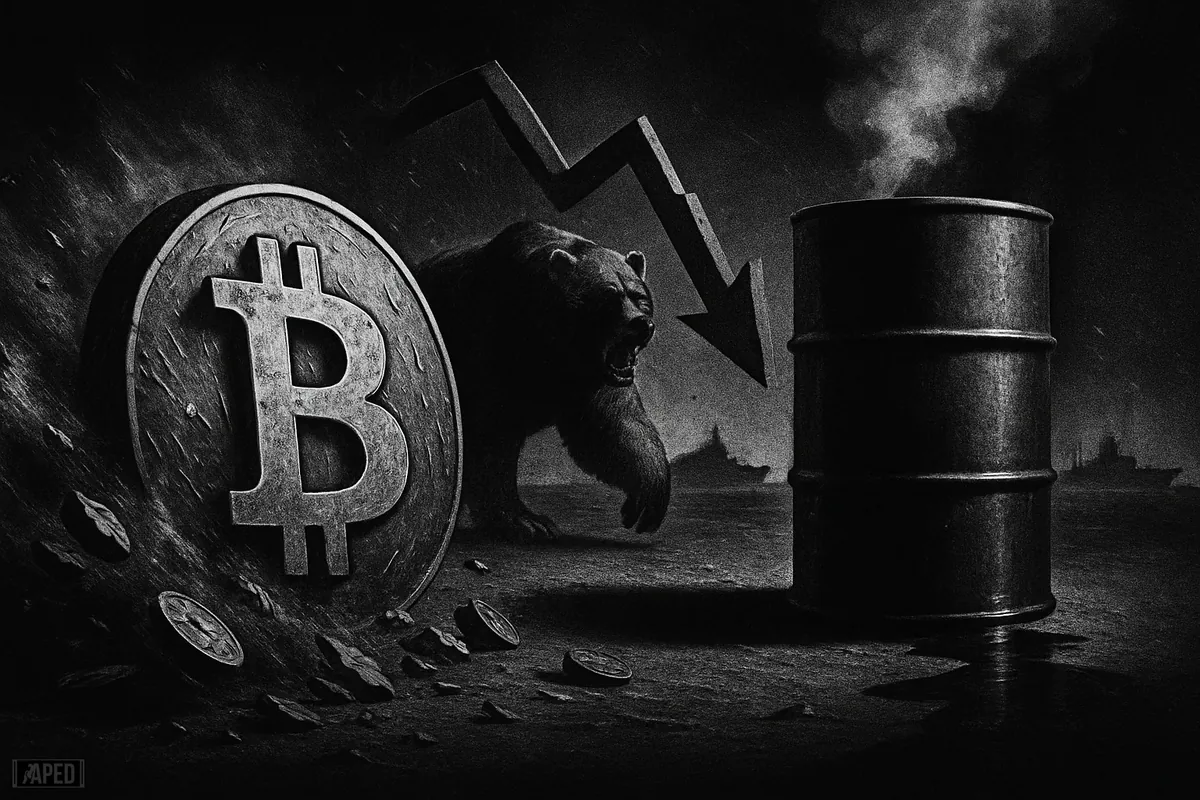
Markets love certainty right up until politics removes it. That is the setup facing Bitcoin$80,405.22 this week, as traders weigh the possibility that renewed U.S. pressure on Iran could spill into oil, equities, and crypto all at once. The basic irony is familiar: Bitcoin still gets marketed as a hedge against chaos, yet when actual geopolitical chaos shows up, it often trades like a nervous tech stock first and asks philosophical questions later. [1]
BTC was recently changing hands around $68,751, down about 1% on the day in the source data, while Ethereum$2,330.43 slipped to roughly $2,099. Broader altcoin weakness pointed in the same direction. Solana$76.56, XRP$1.518, and meme names were also lower, which matters because real flight-to-safety trades usually do not start with traders dumping the highest beta corners of crypto and calling it resilience. Sure. [2]
Register for free and get unlimited access to all articles.
Why Iran risk matters for Bitcoin
The market concern is not simply military headlines. It is the chain reaction those headlines can trigger across oil, inflation expectations, Treasury yields, and overall risk appetite. If U.S. and Iran tensions intensify, crude can spike on fears of supply disruption or shipping risk in the Gulf. That tends to revive inflation worries, which then complicates the Federal Reserve outlook. Higher inflation expectations can keep rates elevated for longer, and that is rarely kind to speculative assets. [3]
Bitcoin$80,405.22 sits awkwardly in that macro pipeline. It can benefit from long-term distrust in fiat systems, but in the short run it is still heavily owned and traded as a liquid risk asset. When fund managers need to reduce exposure quickly, BTC is easy to sell, trades around the clock, and has deep enough liquidity to absorb that positioning shift. That makes it useful, but not necessarily comforting, during geopolitical stress.
The oil link is doing the heavy lifting
Oil is the clearest transmission channel from Middle East tension into crypto pricing. A sharp move higher in crude would not stay neatly contained to the energy complex. It would feed into inflation-sensitive trades and likely pressure equities, especially growth stocks. Bitcoin has spent enough cycles trading in lockstep with broader risk assets that a major oil-led risk-off event would be hard to ignore. [4]
That is why traders are watching headlines around Iran less as a foreign policy debate and more as a volatility trigger. If oil remains contained, Bitcoin can likely keep treating the episode as background noise. If oil breaks higher fast, crypto probably loses the luxury of pretending it lives on its own island.
The recent move in BTC does not yet look like panic. A roughly 1% decline is better described as hesitation than capitulation. Still, the structure of the selloff matters. Bitcoin slipping under the psychologically important $68,000 area in related market coverage showed traders were quick to trim exposure as deadline-driven political risk rose. That is not the behavior of a market confidently pricing BTC as a clean geopolitical hedge. [5]
Ethereum's weaker showing and the broader red across large-cap alts suggest positioning is defensive rather than selective. When investors believe a specific crypto catalyst is in play, money often rotates within the sector. When everyone is simply reducing risk, correlation rises and most majors drift lower together. That appears closer to the current setup.
Not all weakness is purely geopolitical
To be fair, Bitcoin never moves on one variable alone. Traders are also dealing with rate expectations, ETF flows, equity sentiment, and the usual leverage build-up that makes crypto especially sensitive to abrupt headline shocks. Geopolitics is landing on top of an already macro-heavy market, not interrupting a calm one.
That distinction matters because it means Iran-related headlines could amplify an existing fragile mood rather than create one from scratch. If markets were broadly relaxed, Bitcoin might shrug off some of this. Instead, traders are already primed to react.
The hedge narrative runs into reality
Bitcoin's supporters often argue that it should benefit from global instability because it is borderless, censorship-resistant, and detached from any single government. Those points are directionally true over long horizons. The problem is time frame. In immediate risk-off episodes, investors usually prioritize dollars, Treasuries, and cash equivalents before they rotate into more thesis-driven stores of value.
That does not mean the hedge argument is wrong. It means it is conditional. Bitcoin can function as protection against monetary debasement or sovereign distrust over months and years. It is much less consistent as an intraday shield against war-risk headlines. Traders betting on instant safe-haven behavior from BTC are still confusing the pitch deck with the tape.
On-chain and positioning clues to watch
If this turns into a more serious macro event, watch for three things. First, elevated exchange inflows can signal holders preparing to sell. Second, rising stablecoin balances on exchanges may indicate traders are waiting in cash-like crypto instruments for a cleaner entry. Third, derivatives funding rates and liquidations can show whether the move is being driven by overleveraged longs getting flushed.
None of those metrics alone settles the "safe haven" debate, but together they reveal whether the market is de-risking methodically or unraveling quickly. In a headline-sensitive week, that distinction can disappear in a hurry.
Cross-market signals matter more than crypto slogans
Equities and oil are likely to give earlier warning than Bitcoin itself. If the S&P 500 weakens, Treasury yields stay sticky, and crude pushes higher together, crypto traders should assume the pressure is macro-driven and broad-based. If, by contrast, oil calms and stocks stabilize, BTC may regain footing even without a uniquely bullish crypto catalyst.
This is one of those moments where correlation matters more than ideology. Bitcoin can still outperform some risk assets on a relative basis, but if the whole complex reprices lower on geopolitical risk, "digital gold" branding will not stop fast money from heading for the exits.
Looking Ahead
The next few sessions will hinge less on crypto-native developments and more on whether Trump's posture toward Iran produces an actual escalation or merely another short, loud burst of political brinkmanship. Traders should watch oil first, then equity futures, then Bitcoin. That is the order of causality the market is implying right now. [6]
If crude stays contained and BTC holds the upper $60,000s, this episode may end up as another reminder that headline fear fades quickly when no supply shock follows. If oil jumps and risk assets wobble, Bitcoin is unlikely to be spared just because its marketing copy says otherwise. As everyone definitely predicted, the asset built to transcend the old system still has to survive it one news cycle at a time.
Your reviews help us improve the quality of both current and future articles. All reviews are public and visible to other readers. We use both ratings and comments to improve future articles and to revise any articles that do not meet our standards.
 See more like this on Google