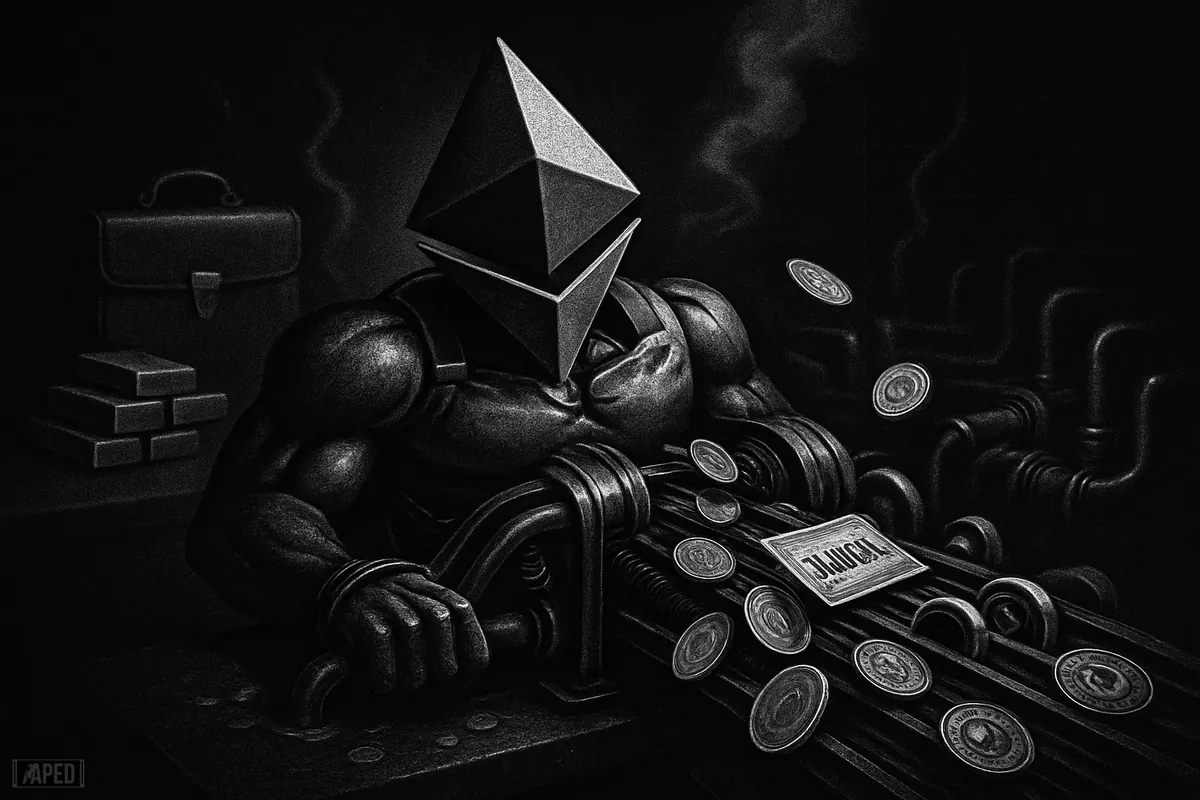
Ethereum$2,329.00 is doing more of the actual work, but ETH is not getting paid like it. That is the contradiction now sitting at the centre of the second largest chain: usage is climbing, institutional capital is settling on Ethereum rails, and yet the token's value capture still looks oddly thin. [1]
The short version is simple enough. Ethereum$2,329.00 has become increasingly useful as financial infrastructure, while ETH itself has become a weaker direct claim on that growth. More activity is happening, but not all of it turns into fees, burns, or sustained buy pressure. [2]
Enjoy articles without ads?
Register for free and get unlimited access to all articles.
Ethereum is winning the infrastructure trade
A lot of the fresh capital parked on-chain is not there to punt memes or chase leverage. It is there for settlement, yield, and programmable finance.
Stablecoins on Ethereum now account for roughly $166.1 billion, according to the source data. That is a hefty pool of dollar liquidity sitting on the network and its surrounding ecosystem. Tokenized U.S. Treasuries have also crossed $12 billion, a sign that real-world asset issuance is no longer a fringe experiment. Traditional finance is starting to use blockchain rails for something practical, not just promotional. [3]
That shift matters because it changes the character of demand. Capital coming on-chain today is often looking for predictable utility. Think collateral movement, treasury management, automated settlement, and yield-bearing products. That is a proper upgrade in Ethereum's strategic position, even if it is less flashy than a speculative mania.
Quarterly stablecoin transfer volume nearing $8 trillion makes the point even clearer. Money is moving through Ethereum-linked pipes at scale. The network is increasingly the base layer for high-value flows, especially where users want composability, liquidity depth, and battle-tested infrastructure. [4]
More usage does not automatically mean more value for ETH
Here is where the maths gets a bit dodgy for the bullish one-liners.
Despite the growth in network usage and capital parked on-chain, daily fees were cited at roughly $157,000. That is not the sort of number that screams powerful value accrual for a trillion-dollar-grade settlement layer narrative. At the same time, ETH issuance has reportedly continued to outpace burns, meaning the asset is not consistently benefiting from the scarcity dynamics many holders expected after the network's shift in monetary design. [2]
This is the heart of the issue. Ethereum can be indispensable as infrastructure while ETH underperforms as an investment vehicle if the network is not capturing enough of the economic activity it hosts.
A decade of crypto taught the market to assume that chain growth and token growth move together. On Ethereum$2,329.00, that relationship has become weaker. Activity is rising, but monetisation is lagging.
Rollups made Ethereum cheaper, and that came with a catch
The biggest reason for the disconnect is not especially mysterious. Ethereum scaled by pushing more execution away from mainnet and into rollups.
Base fees around 0.6 Gwei tell the story. Mainnet has become relatively cheap compared with prior peak cycles, which is good news for usability and broader adoption. It lowers friction, supports more applications, and makes the stack more accessible for users and developers.
It also means the base layer captures less direct fee revenue from each burst of activity.
That is the trade-off. Ethereum is trying to become the settlement and security layer for a much larger economy, but in doing so it has outsourced a lot of the user-facing action to Layer 2s. Those networks may still depend on Ethereum for final settlement and security, but the immediate fee extraction that once flowed straight to ETH holders is more diluted. [5]
From a product perspective, that is rational. From a token valuation perspective, it is a bit of a mess.
Capital is on-chain, but it is not rotating hard enough
Ethereum's DeFi total value locked sits near $52.6 billion in the source material, which shows there is still meaningful capital inside the ecosystem. But DEX volume of around $548 million suggests that a lot of that money is not moving with much urgency.
That matters because dormant capital does less for fee generation than actively traded capital. If users are mostly parking funds in stablecoin pools, treasury products, and low-turnover structures, the network can look healthy on deposits while still producing weak economic throughput.
This is a different kind of bull case from the old retail cycle. Instead of frantic speculation pushing gas fees into the stratosphere, Ethereum is hosting slower, more measured financial usage. That is arguably more durable. It is also less immediately lucrative for ETH if the transaction mix stays subdued.
The market wants proof that capital parked on Ethereum will rotate, rebalance, and transact enough to reignite fee pressure. Until that happens, the chain can keep winning mindshare in on-chain finance while ETH trades as if the growth is someone else's revenue.
One argument for future demand is that software agents, especially AI-driven ones, could generate huge transaction counts. If autonomous systems start making payments, adjusting positions, managing collateral, or routing liquidity on-chain, Ethereum and its rollup ecosystem could see a massive increase in transaction demand.
That is plausible, but it needs a caveat. More transactions only help ETH if those transactions ultimately deepen value capture at the base layer. Millions of cheap interactions are not enough on their own. The quality of activity matters as much as the quantity.
If agents mostly transact on low-cost rollups with minimal economic spillover to mainnet, Ethereum's role grows, but ETH holders may still not see the full benefit. The chain becomes more essential, while the token remains only partially linked to that success.
The market is repricing what ETH actually is
This is the real takeaway. ETH is being forced through a market identity shift.
For years, the clean pitch was that Ethereum usage would translate into higher fees, higher burns, and stronger token economics. That thesis has not disappeared, but it is no longer automatic. Ethereum today looks more like critical financial middleware, a settlement asset, and a reserve asset for the on-chain economy than a simple growth proxy on network activity. [6]
That distinction matters for valuation. Infrastructure can be hugely important without being neatly priced by older crypto reflexes. Investors now have to judge whether Ethereum's strategic dominance will eventually convert into stronger ETH capture, or whether the network's success will keep leaking outward to stablecoins, rollups, and application-layer businesses.
Ethereum's usage surge is real. Stablecoins are there. Treasuries are there. Settlement volume is there. The chain is doing proper financial work, not just farming hype on CT.
But ETH still needs a cleaner path from network utility to token value. If fees remain muted, issuance keeps outpacing burns, and activity continues migrating to places that do not materially enrich the base layer, then the contradiction persists.
The bullish case is that Ethereum is building the plumbing first and monetisation comes later. The bearish case is that the plumbing is valuable, but not especially to ETH holders. What invalidates the optimistic read is straightforward: if capital keeps growing on Ethereum while fees, burns, and on-chain circulation stay flat, the market will keep asking the same awkward question, what exactly is ETH capturing?
Your reviews help us improve the quality of both current and future articles. All reviews are public and visible to other readers. We use both ratings and comments to improve future articles and to revise any articles that do not meet our standards.
 See more like this on Google