 See more like this on Google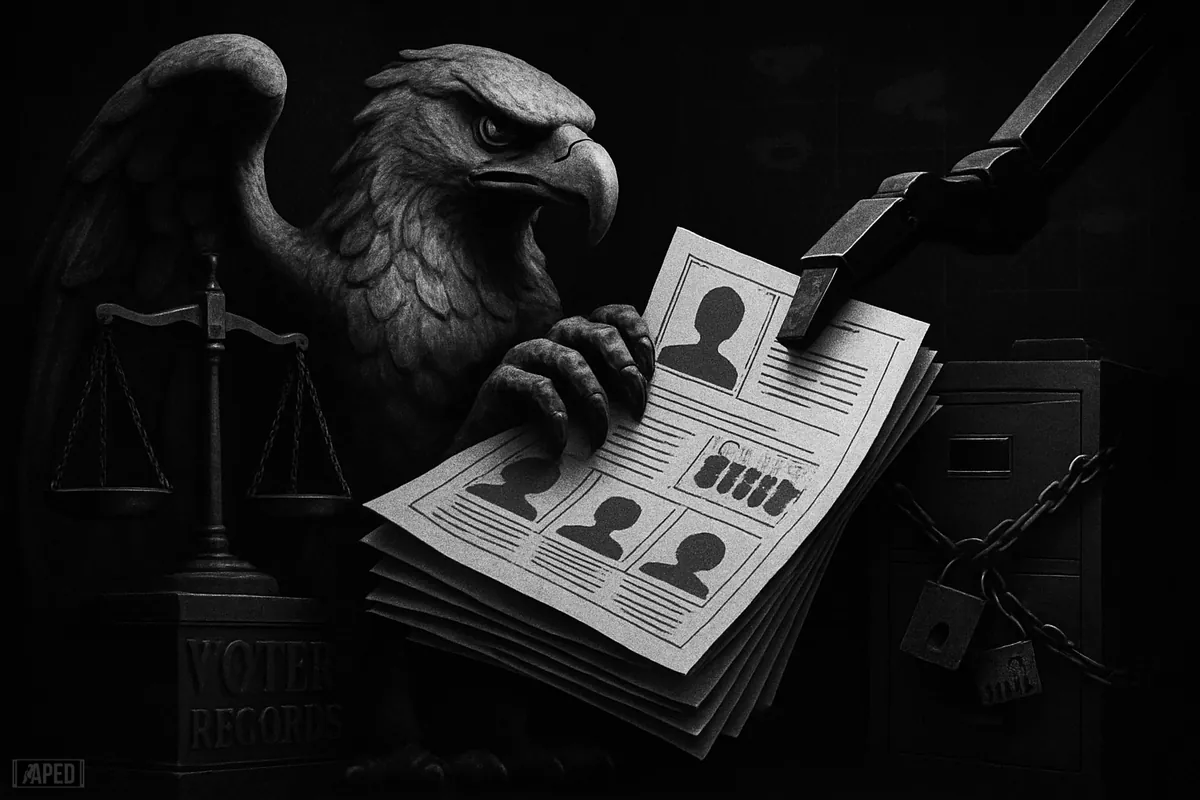
Share article
Share article
Two things tend to set off alarm bells in Washington: a senior privacy official walking out, and a plan to move Americans' sensitive data across agencies. This week, the Department of Justice managed both.
Enjoy articles without ads?
Register for free and get unlimited access to all articles.
What happened
The resignation centers on the Justice Department's top privacy apparatus just as DOJ is reportedly gearing up to transfer state-provided voter records to DHS. Those records are said to include some of the most sensitive identifiers Americans hand over to state agencies: SSNs, driver's license numbers, and other personal data tied to voter registration systems. [2]
Why the data sharing plan is drawing heat
The core issue is purpose creep. States collect voter registration data to administer elections. Federal agencies may now seek to repurpose parts of that data for immigration enforcement, citizenship verification, or broader identity checks through DHS systems.
Critics say that is especially dangerous when the records involved include identifiers that are difficult, or impossible, to "rotate" after exposure. You can change a password. You cannot really change your Social Security number without serious disruption, and even driver's license data can create durable fraud and surveillance risks if mishandled.
Why voter records are a uniquely sensitive target
That means the public debate is not simply about whether voter lists exist. It is about whether the federal government should aggregate the nonpublic portions of those systems, then widen access beyond the original election-administration purpose.
Civil liberties groups argue that such a step could have a chilling effect, particularly for naturalized citizens and mixed-status households who may fear that registering to vote, or interacting with election offices, could expose family data to unrelated federal scrutiny. [3]
The legal and policy fault lines
Federal privacy rules do not create a clean, universal ban on data sharing, but they do require agencies to justify collection, use, and disclosure under specific legal authorities. That is why the reported internal fight matters. If DOJ's own privacy leadership balked, the concern may not be merely political optics. It may be about whether the transfer complies with the Privacy Act, agency notice requirements, and long-standing limits on secondary use.
This is where the story gets sharper. "Taxpayer privacy is not optional. It's the law" has become a rallying line among critics pushing back on broader federal data access fights. The same principle applies here: legal authority is not a vibes-based concept. If the government wants to stitch together voter and homeland security datasets, it needs more than a broad claim of administrative convenience. [4]
Some Republican-led states have also reportedly resisted DOJ demands for sensitive voter information. That adds an unusual twist. Opposition is not falling neatly along the usual partisan rails. States that usually back stricter election enforcement have shown discomfort when Washington starts asking for raw personal identifiers in bulk. [5]
Why the resignation matters beyond one office
Senior privacy officials are there to do the tedious but essential work of friction. They ask whether an agency should do something, not just whether it can. When one quits during a live dispute over data sharing, that signals the internal guardrails may be under strain.
Why this matters to the crypto crowd too
The industry has spent years arguing that privacy is not inherently suspicious and that identity systems built without minimisation become attack surfaces. Whatever one thinks of voter integrity efforts, building larger interoperable datasets of sensitive credentials is the exact opposite of minimisation.
That does not make every government verification effort illegitimate. It does mean the burden of proof should be high. If an agency wants access to SSNs and licence records tied to voter files, the public should know the legal basis, scope, retention policy, oversight mechanism, and whether people have any meaningful way to challenge errors.
Risks, unanswered questions, and the politics underneath
Several key details remain unclear. DOJ has not publicly laid out the full operational contours of the reported data-sharing arrangement, including how much information would be transferred, how often, under what safeguards, and whether states can limit what they provide.
Those gaps matter because implementation risk is where these plans usually go sideways. A narrow one-time review is one thing. An automated feed into another agency's systems is something else entirely. So is any model that allows derived profiles or investigative flags to be built from election records.
There is also the political context. Voter data has become a proxy battlefield for larger fights over immigration, federal power, and election administration. Once that mix hardens, careful privacy review tends to get treated as obstruction rather than governance. That is usually when bad precedents get set.
What to watch next
- Whether DOJ publicly confirms the resignation and names an interim or replacement privacy lead.
- Any formal explanation of the legal authority for sharing voter data, especially SSNs and driver's license numbers, with DHS.
- Whether states refuse, narrow, or litigate federal requests for sensitive voter-registration records.
- Signals from civil liberties groups or state attorneys general about Privacy Act challenges.
- Clarification on scope: one-off audit, recurring transfer, or full pipeline.
- Basic but crucial controls, retention limits, audit logs, and redress for false matches.
For now, the cleanest read is also the least reassuring: when the privacy referee leaves just before the data starts moving, it is worth checking who plans to blow the whistle after they're gone.
