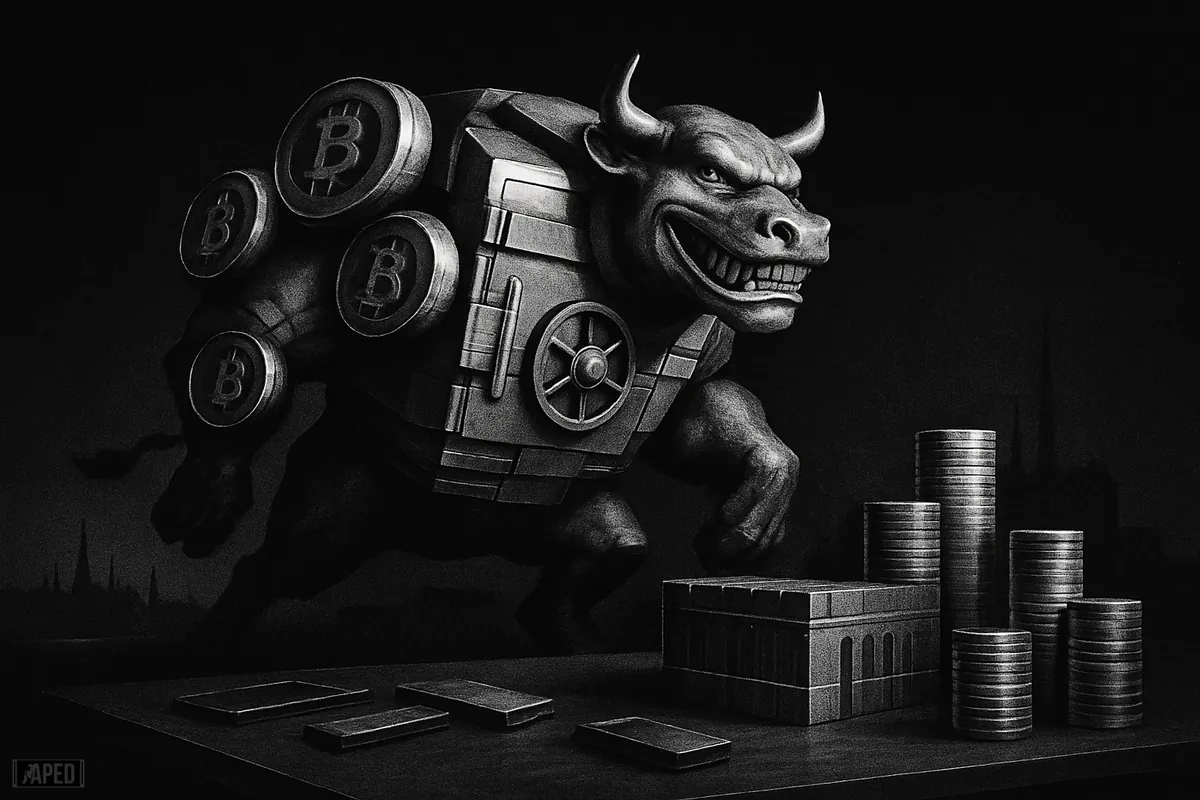
Risk stayed front and centre on March 29. Crypto spent the day balancing real dip-buying from institutions and treasury firms against soft momentum, rising fear, and a steady drip of on-chain signals that said traders were still more eager to de-risk than chase.
Enjoy articles without ads?
Register for free and get unlimited access to all articles.
Market mood: fear, but not full capitulation
Early in the session, Bitcoin$81,661.57 was framed by two competing narratives. One was defensive: broader market fear has deepened, with BTC pinned around the upper $60,000s and sentiment still fragile. The other was constructive: despite geopolitical stress around the Hormuz narrative, Bitcoin broadly held key levels and at points traded above $70,000, giving fresh ammunition to the "partial decoupling" crowd. [1]
That decoupling case remains incomplete. BTC behaved better than many risk assets under stress, but not well enough to settle the digital gold debate once and for all. What mattered more for traders today was that Bitcoin did not collapse through support while fear was elevated. That kept the market in "uneasy hold" mode rather than outright panic.
Michael Saylor added to that support early, hinting that Strategy could buy more Bitcoin$81,661.57 into weakness. With BTC near $68,600 at the time, the message landed as a familiar one: if retail is jittery, corporate treasury buyers may still be perfectly happy to clip coins on red days. Shortly after, Arkham-linked data reinforced the same theme, showing BlackRock and Fidelity bought roughly $400 million in Bitcoin last week, partly offset by about $250 million in sales. Net, the big money still looked like a dip buyer. [2]
Those flows matter because they help explain why BTC can sit in an ugly sentiment tape without completely losing structure. Spot accumulation from institutions does not remove downside risk, but it does give the market a better bid on pullbacks. The catch is obvious enough: if ETF and treasury demand slows while macro fear stays high, that floor gets a lot less convincing very quickly.
A later outlook piece kept the caution alive. Bitcoin$81,661.57 is still holding the mid-$60,000 area, but fear remains the dominant emotional tone, and traders are clearly watching whether this is a consolidation before recovery or simply a pause before another flush. For now, the market has support from buyers with size, but not yet the sort of broad conviction that turns a nervous bounce into a clean trend.
Ethereum and altcoins: whales stir the tape, but conviction is thin
Ethereum$2,396.26 had a more mixed day, with one large bullish treasury signal offset by a rather less comforting exchange deposit. A dormant ICO-era whale moved 15,000 ETH, worth around $31 million, to Coinbase earlier this week, reviving the usual sell-pressure fears. Large transfers to exchanges do not always mean immediate distribution, but they are rarely read as bullish in a soft tape, and this one landed badly. [3]
That pressure was balanced by Bitmine, which disclosed another $138 million ETH buy last week, extending a three-week accumulation streak and pushing its holdings above 4.66 million ETH. Treasury accumulation of that size is difficult to ignore. It suggests at least some large allocators see recent ETH weakness as inventory to absorb rather than a reason to run. [4]
Put together, the ETH picture is messy but useful. Spot supply may be heading to exchanges from old hands, while newer treasury-style buyers keep stacking. That usually produces choppy trade rather than clean direction. If more whale deposits appear, traders will assume overhead supply is building. If treasury bids keep coming, dips could stay relatively shallow. Right now, it is a tug-of-war, not a trend.
Elsewhere in majors, Monero$383.82 looked technically vulnerable. XMR traded near $359 and remained stuck below the $370 resistance zone, with weak buyer conviction leaving a bearish structure in place. The downside scenario flagged was a 16% drop if support gives way. For a privacy coin with thinner liquidity than BTC or ETH, that sort of move is hardly exotic. If bids remain hesitant, the path of least resistance still looks lower.
XRP$1.518 offered a decent lesson in why raw volume spikes can mislead. Futures volume on BitMEX jumped 2,095 percent earlier this week, which at first glance looks like a speculative frenzy. But falling open interest and weaker price action suggested the move was mostly traders unwinding positions rather than pressing fresh bullish bets. Big volume with shrinking OI is often clean-up, not breakout fuel. A lot of traders still manage to learn that the hard way. [5]
Treasury adoption and the corporate bid
One of the more notable strategic stories came from Europe. H100 said it wants to become the continent's largest listed Bitcoin treasury by acquiring two BTC-heavy firms in a bitcoin-for-bitcoin transaction worth 3,500 BTC. That is not merely a balance sheet tweak. It is another sign the treasury playbook pioneered elsewhere is still spreading geographically and structurally.
This matters because treasury demand changes market plumbing. Coins parked in listed vehicles can tighten liquid supply, but they also concentrate risk in equity wrappers that trade on sentiment, financing conditions, and management credibility. If the strategy works, equity investors get leveraged Bitcoin exposure with a corporate halo. If it goes wrong, the unwind can be messy and public.
The broader point is that corporate and institutional accumulation stayed one of the few properly constructive themes on the day. Between Saylor's signal, ETF-linked buying, Bitmine's ETH purchases, and H100's ambitions, there is still a meaningful class of buyer that appears happy to scale in while discretionary traders remain nervous.
Regulation and policy: delay in Brazil, pressure in the US
Policy headlines skewed cautious. Brazil delayed a disputed crypto tax plan that could classify some transactions as foreign exchange, with election-year politics stalling reform. That delay offers short-term relief from an unpopular proposal, but it also prolongs uncertainty around how crypto activity will be taxed and categorised in one of Latin America's most important markets. For businesses, ambiguity is not much of a gift. [6]
In the US, lawmakers moved to target sports betting on prediction platforms such as Polymarket and Kalshi through a planned bipartisan bill. While this is not directly a token market story, it does hit a fast-growing overlap between crypto rails, event markets, and regulatory grey zones. If Washington tightens this segment, platforms exposed to political and sports wagering could face a sharper compliance burden, and liquidity may retreat accordingly.
Stablecoins and infrastructure: one real growth lane still intact
One brighter long-range theme came from Bernstein's view that stablecoins could benefit from AI-driven machine payments. The idea is straightforward enough: if autonomous agents start paying each other for compute, data, APIs, or services, stablecoins are a more natural settlement rail than card networks or bank transfers. [7]
The caveat is that this remains early. Adoption of autonomous agents is uneven, and the infrastructure for reliable machine-to-machine payments is still immature. Still, unlike some of the market's more mystical narratives, this one has practical legs. If crypto finds a mass-market use case beyond trading, stablecoins remain the most credible candidate, particularly where speed, programmability, and global settlement matter.
What to watch next
March 29 left the market with a fairly clear checklist.
First, watch whether Bitcoin can keep holding the high $60,000s to low $70,000s while fear stays elevated. If institutional and treasury bids continue to absorb weakness, the market can stabilise. If those flows fade, the softness in sentiment will matter much more.
Second, keep an eye on on-chain ETH transfers to exchanges. Bitmine's buying is supportive, but another wave of whale deposits would shift the near-term balance back toward supply risk.
Third, separate real positioning from noisy headline metrics. XRP's volume spike without open interest support was a reminder that not all activity is bullish. Same goes for thin altcoin bounces in a nervous tape.
Finally, regulation is still sneaking up on side sectors. Brazil's delay buys time, not clarity. US scrutiny of prediction markets could spread pressure into adjacent crypto venues if lawmakers decide the grey areas have grown a bit too lively.
For now, the vibe is simple enough: big buyers are still around, traders are still cautious, and plenty of charts look one bad headline away from an unpleasant afternoon.
Your reviews help us improve the quality of both current and future articles. All reviews are public and visible to other readers. We use both ratings and comments to improve future articles and to revise any articles that do not meet our standards.
 See more like this on Google