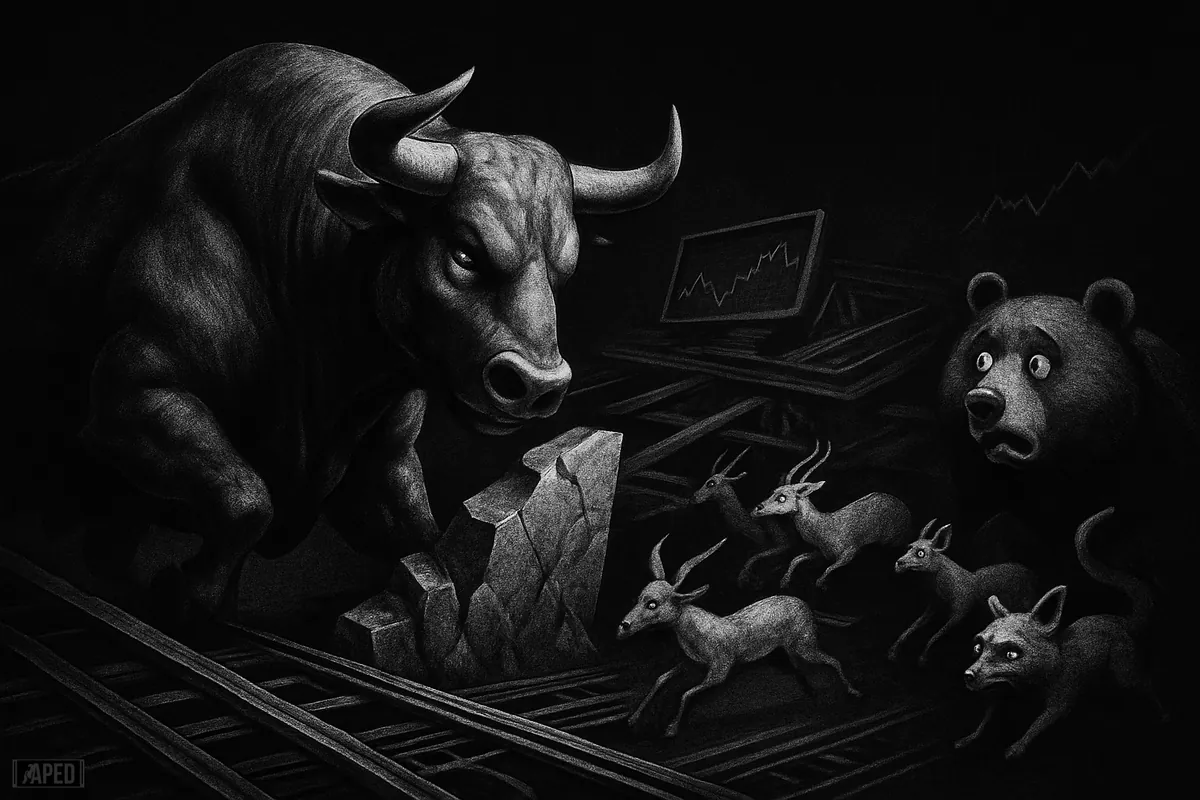
Risk stayed front and centre on April 18. Bitcoin$80,500.00 spent the day leaning on a crowded short setup near $75,000, alt pockets flashed selective strength, and a few structural stories, from exchange fragmentation to L2 fee wars, reminded traders that not all green candles are created equal.
Yesterday's backdrop mattered. April 17 had already set a constructive tone with Bitcoin nearing breakout territory, leverage coming out of XRP$1.518, and DeFi sentiment improving. That left today's tape looking less like a fresh narrative reset and more like a test: could majors actually clear resistance, and could sector-specific adoption stories hold up without the usual reflexive froth?
Bitcoin retests $75K with liquidation fuel overhead
By mid-morning UTC, Bitcoin$80,500.00 was back probing $75,000, with roughly $200 million in short liquidations clustered above $75,500. The setup was straightforward enough: a clean break through that level could force late shorts to cover and turn a grind higher into a squeeze. [1]
That said, the market was trading a very specific map. The bullish case depended on reclaiming resistance decisively, not merely wicking into it. When large liquidation pools become obvious, they often act like magnets, but they can also become trap zones if spot demand fails to follow through. Earlier optimism from April 17 gave the move some narrative support, yet the level itself remained the whole story.
Halving midpoint arrives, but the cycle looks oddly muted
Later in the day, a more sobering datapoint landed. Bitcoin has now passed the midpoint of its 2024 to 2028 halving cycle, but gains sit at just 15%, far below the sort of mid-cycle expansion traders got used to in earlier eras. [2]
That matters because it reframes the breakout chatter. A test of $75,000 can still trigger a tactical squeeze, but the broader cycle has been notably less explosive so far. Institutional flows, ETF-related supply absorption, and a more mature market structure may be smoothing the path, though "smoother" also means less forgiving for anyone expecting the old post-halving playbook to simply reappear on schedule.
Algorand$0.08382 was one of the cleaner movers on the board, jumping 10% after filling a key imbalance zone and reviving momentum toward $0.1271. Unlike some low-float bursts that disappear as quickly as they arrive, this move had a defined technical trigger and a clear nearby target, which gave traders a more disciplined framework than usual alt-season wishcasting. [3]
Still, ALGO's next step is where the trade gets interesting. Sharp rebounds into known resistance often invite profit-taking, especially when the broader market is still waiting on Bitcoin confirmation. If BTC stalls under $75,500, higher-beta names like ALGO may struggle to keep pressing without fresh rotation.
XRP$1.518 got a more fundamentally useful headline in the afternoon, as Rakuten began enabling XRP in Japan from April 15. Users can buy the token with Rakuten points and spend via Rakuten Cash across millions of merchants. [4]
For XRP, this is the sort of adoption story the market tends to ask for and rarely gets in a clean format. It ties the token into an existing consumer ecosystem rather than another abstract partnership deck. It also follows yesterday's leverage reset in XRP, which means the token entered today's positive news flow without the same degree of overheated positioning. That combination is generally healthier than a headline landing into crowded longs.
Bittensor's TAO spread worsens, and the warning is obvious
Not all alt stories were constructive. TAO's cross-exchange spread was first reported at 30.4% around midday, then worsened to 31.2% by late evening, both tied to April 14 conditions. The repeated updates painted the same ugly picture: persistent liquidity fragmentation, weak cross-venue arbitrage, and broken price discovery. [5][6]
This is not a cosmetic market microstructure issue. When one asset prints 30% plus spreads across exchanges, price becomes conditional on where you're standing, and risk management turns into guesswork. That is fine for screenshots and absolutely dreadful for serious size. If there was a lesson buried in today's alt tape, it was that momentum means very little when liquidity is patchy and venue quality is doing half the valuation work.
Tether$0.999021 launched a self-custodial wallet for Bitcoin, USDT, and other tokens, pushing the company further down the consumer stack. This is more strategic than it looks at first glance. Tether has long dominated stablecoin infrastructure, but a wallet product lets it compete directly for user relationships, payments flow, and potentially merchant integration. [7]
The competitive angle is worth watching. Self-custody remains one of crypto's most important narratives, but it is also a brutally crowded product category where convenience, distribution, and trust do the heavy lifting. Tether has distribution and brand familiarity. Whether that translates into meaningful wallet adoption is another matter, especially against entrenched apps and exchange-linked consumer funnels.
Earlier in the day, Senhwa announced a $16 million GEM drawdown facility to support AI drug discovery. The nuance matters here: this was not an upfront cash injection, but a committed financing line that can provide liquidity support over time.
It sits a bit outside the core crypto tape, but it still fits the market's ongoing interest in AI-linked capital formation. The main takeaway was not immediate revenue or product traction, but access to funding. For traders, that distinction is everything. Facilities can stabilise runway, but they are not the same thing as cash in hand, and they rarely deserve to be priced as if they are.
Regulation, Restitution and Infrastructure Competition
OneCoin victims get a path to partial recovery
The DOJ opened a claims process for OneCoin victims to seek payouts from $40 million in seized assets, offering at least some restitution nearly a decade after the roughly $4 billion scam. The amount is modest relative to the damage, but the symbolic value is larger than the raw number. [8]
Crypto has no shortage of unresolved wreckage, so any formal recovery process stands out. It also serves as a reminder that enforcement can move painfully slowly, but it does move. For victims, partial recovery is better than none. For the industry, the story is a grim footnote to an era when basic diligence was optional and marketing often did the entire job.
The day ended with one of the more consequential infrastructure stories. Scroll said it will cut costs and overhaul its DAO after Ether.fi$0.4589 moved to Optimism, taking nearly $160 million in TVL and roughly $13 million in annualised fees with it. [9]
That is a sharp illustration of how brutal the L2 market has become. Loyalty is thin, distribution is expensive, and protocols will follow cheaper execution and better economics with very little sentimentality. Scroll's response suggests the team knows the problem is not cosmetic. If TVL can leave that quickly, governance design and cost structure stop being abstract forum topics and become existential.
Bitcoin at $75,500: that remains the near-term trigger level. A proper break could squeeze shorts, while another rejection keeps the range intact.
Cycle expectations: the halving midpoint data argues for caution. This market may still grind higher, but it is not behaving like earlier post-halving runs.
Alt quality versus alt performance: ALGO showed tradable momentum, but TAO's 31.2% spread was the day's best reminder that liquidity quality matters more than a pretty chart.
XRP adoption follow-through: Rakuten's integration is real utility, not just vibes. Watch whether the market treats it as a durable payments story or a one-day headline.
Wallet wars and L2 competition: Tether's wallet launch and Scroll's reaction to losing Ether.fi both point to the same thing, user ownership is where the next fight is.
Your reviews help us improve the quality of both current and future articles. All reviews are public and visible to other readers. We use both ratings and comments to improve future articles and to revise any articles that do not meet our standards.
 See more like this on Google