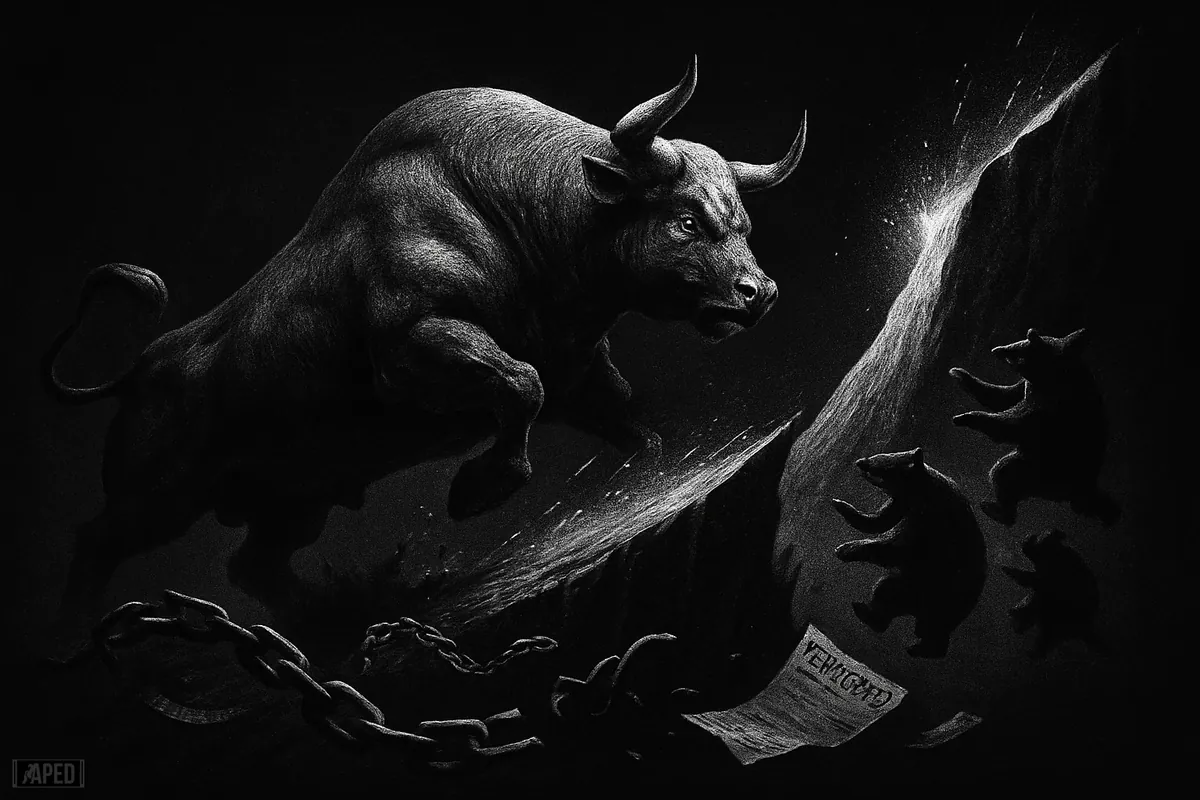
Bitcoin$80,624.99 is back at the same awkward doorstep it has been rattling for weeks: $75,000. This time, though, there is roughly $200 million in short positions stacked above the market, and if BTC clears about $75,500, the squeeze could do some of the lifting itself. [1]
That is the immediate catalyst. After grinding sideways for more than two months, bitcoin has pushed into a level that has repeatedly knocked it back since early February, turning a tired range into a proper liquidation test.
Register for free and get unlimited access to all articles.
The $75K level is not just psychological
Bitcoin was trading around $74,600 when the move came into focus, up sharply on the day and dragging the wider market with it. Ethereum$2,346.88 was above $2,380, while majors like XRP$1.518 and Solana$76.56 also caught a bid, a sign that traders were not treating this as an isolated BTC wick. [2]
What matters more than the round number is where leverage is parked. Futures data flagged a dense pocket of short exposure above $75,500, with liquidation estimates around $200 million. That does not guarantee a breakout, but it does create obvious fuel. If price starts running through those positions, forced buybacks can turn a clean move into a fast one. [3]
Crypto traders call this a squeeze for a reason. Shorts betting on another rejection have to buy back into a rising market once margin limits are hit, and that can add momentum that spot demand alone might struggle to generate.
Derivatives are leaning bullish, but not quietly
The set-up is not just about liquidation maps. Open interest in both Bitcoin$80,624.99 and ether futures has been climbing, which tells you fresh positions are entering rather than old ones simply being closed out. Rising open interest alongside rising price is usually read as confirmation that the market is willing to add risk.
Funding rates have also stayed positive. In plain English, longs are paying shorts to keep bullish positions open, which shows directional appetite is skewed to the upside. That can be constructive when the market is still breaking out, but it is also where things get a bit dodgy if everyone ends up on the same side of the boat.
This is the balancing act. A squeeze can start with shorts getting run over, then quickly morph into an overcrowded long trade if momentum chasers pile in too late.
Bitcoin has been trapped below $75,000 since early February, with repeated failed attempts to reclaim the level. Every test has trained traders to fade the move, which is why short interest has likely built there in the first place.
That kind of repetitive price memory matters. Range highs become obvious levels for systematic traders, discretionary bears, and market makers hedging around known liquidity zones. The more visible the ceiling, the more violent the reaction can be when it finally gives way.
Still, obvious levels cut both ways. If BTC tags the area and fails again, that same concentration of bets can reinforce the rejection and send price back into the middle of the range.
Volatility is sending a mixed signal
One of the more interesting tells in this move is that implied volatility has stopped falling even as spot prices rise. Earlier in the range, volatility had been compressing, which often happens when traders expect more chop than trend.
That has now shifted. Options markets are no longer pricing the rally as a sleepy drift higher. Instead, volatility is holding up, suggesting traders see a larger move coming, even if they are not fully agreed on direction. [4]
This is not a neat bullish confirmation. Persistent implied vol during a rally can mean traders are paying up for upside exposure, but it can also reflect hedging demand and uncertainty about whether the breakout sticks. In other words, the market senses motion, not consensus.
A breakout would likely be mechanical first, fundamental second
If bitcoin punches through $75,500, the first leg higher could be more about market structure than a sudden change in macro or fundamentals. Liquidations, stop orders, and momentum algos can force a repricing quickly, especially when liquidity above resistance is thinner than it looks on paper.
That is often how these moves work. They begin as a leverage event, then traders retrofit a narrative once the candle is already printed. For anyone watching on-chain or order book data, the cleaner question is whether real spot follow-through arrives after the squeeze.
Without that follow-through, a breakout can turn into a classic local top, with late longs left holding the bag.
Broader market reaction matters too
The wider crypto tape has been supportive, which helps BTC's case. Ether futures activity has also picked up, and the broader bid across majors suggests risk appetite is not confined to one instrument. That usually gives bitcoin a better shot at sustaining a move, because broad participation is healthier than a single-asset spike driven purely by derivatives.
Even so, traders should be careful not to overread cross-market strength. Altcoins often rally on bitcoin breakout hopes before confirmation arrives. If BTC stalls at resistance again, those fast rotations can reverse just as quickly.
Community sentiment on CT, shorthand for crypto Twitter, has also turned more aggressive around the idea of a short squeeze. That can amplify momentum, but it is not evidence by itself. Sentiment works best when it follows positioning data, not when it replaces it. [5]
A clean reclaim of $75,000 would do more than liquidate a few overconfident bears. It would break a two-month ceiling, validate rising futures participation, and potentially reset market expectations for the next leg of the cycle.
But this is still a resistance test, not a confirmed escape. The invalidation is straightforward: Bitcoin$80,624.99 fails to hold above the breakout zone, open interest stays elevated, and the move starts looking like leverage chasing leverage. If that happens, the squeeze story flips into a trap.
For now, the set-up is real. So is the risk. Bitcoin is close enough to $75K that the next move might not be gradual, and with $200 million in shorts sitting in the blast radius, the market does not need much of a shove.
Your reviews help us improve the quality of both current and future articles. All reviews are public and visible to other readers. We use both ratings and comments to improve future articles and to revise any articles that do not meet our standards.
 See more like this on Google