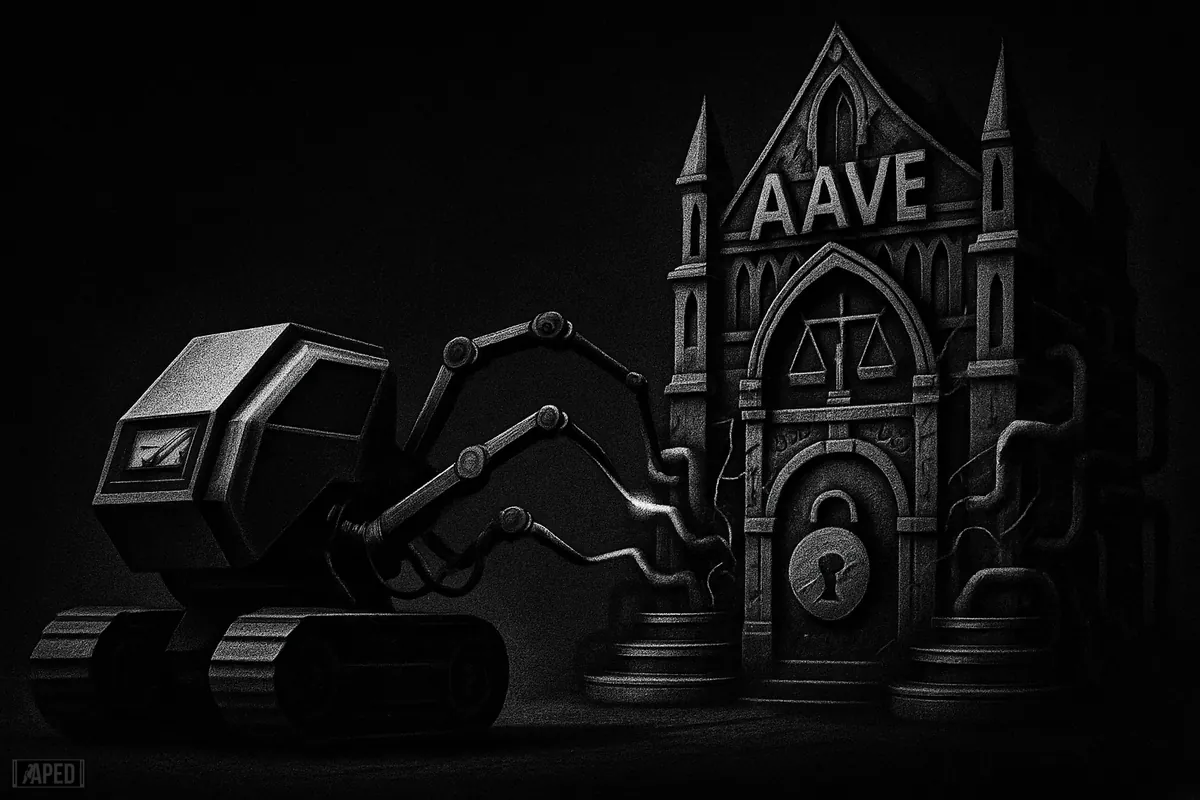
CT loves a governance spat until it turns into a plumbing issue. This one is both. Chaos Labs said Monday it is leaving its role as a risk service provider for Aave after roughly three years, ending one of DeFi's more visible protocol adviser relationships just as Aave pushes toward its V4 upgrade. [1]
Chaos founder Omer Goldberg framed the exit as a principled break, not a negotiation tactic. In a public statement, he said Aave Labs had supported raising Chaos Labs' budget to $5 million to keep the firm onboard, but that the engagement no longer matched Chaos' view of how protocol risk should be handled. Put plainly: more money was on the table, but the mandate was the problem. [2]
Register for free and get unlimited access to all articles.
Why the split happened
The disagreement appears to center on Aave V4 and how much authority an outside risk provider should have during that transition. Chaos Labs said the planned migration introduced risks it was not willing to underwrite under the current structure. Aave's side, meanwhile, suggested the firm wanted a larger scope, effectively positioning itself as the sole risk service provider. [3]
That distinction matters. Risk providers in DeFi are not just spreadsheet operators. They recommend collateral parameters, monitor market stress, and help decide how much bad day exposure a lending market can safely absorb. If Aave and Chaos could not agree on the boundaries of that job, the breakup was probably inevitable.
Why Aave's risk stack matters
Aave is one of the largest decentralized lending protocols, which means its risk process is less back office detail and more core product. Borrow caps, liquidation thresholds, and asset listings all shape how much leverage users can take and how quickly losses spread when volatility hits.
Aave has historically leaned on specialized external firms to provide that analysis, giving governance a data-rich basis for proposals. Losing a long-standing provider does not mean the system suddenly stops working, but it does create a transition period where roles, review processes, and accountability need to be clarified fast. For a protocol handling large pools of user deposits, ambiguity is not a cute look.
The timing is doing a lot here. Aave V4 has been pitched as a major architecture update, and migrations of that scale tend to reshuffle responsibilities between contributors, service providers, and governance delegates. More modular design can improve resilience, but only if the handoffs are clean. [4]
Chaos' comments suggest it saw unresolved exposure in that handoff. Aave's response suggests it was wary of concentrating too much influence in one external firm. Both concerns are defensible, which is why this reads less like a simple falling out and more like a disagreement over protocol power design.
Community and market readthrough
The immediate reaction across governance circles was less panic, more concern about continuity. That is usually the mature response in DeFi: nobody wants to scream rug when the issue is service-provider churn, but nobody wants to shrug either. For delegates and large depositors, the next question is who covers the analytical workload Chaos leaves behind and on what timeline.
Reports tied to the broader Aave contributor landscape have also pointed to fresh tensions elsewhere in the ecosystem, which adds to the sense that V4 is becoming a stress test for governance alignment, not just code deployment. When multiple key contributors start reevaluating roles at once, people notice. [5]
Chaos Labs' exit is not just personnel news. It is a reminder that DeFi risk management depends as much on governance structure as quantitative models. Aave now needs to show that its risk framework remains robust without one of its best-known advisers, especially heading into V4. Readers should watch for replacement mandates, updated governance proposals, and any signs that risk decisions are slowing down. In lending, the boring operational details are usually where the real drama lives.
Your reviews help us improve the quality of both current and future articles. All reviews are public and visible to other readers. We use both ratings and comments to improve future articles and to revise any articles that do not meet our standards.
 See more like this on Google