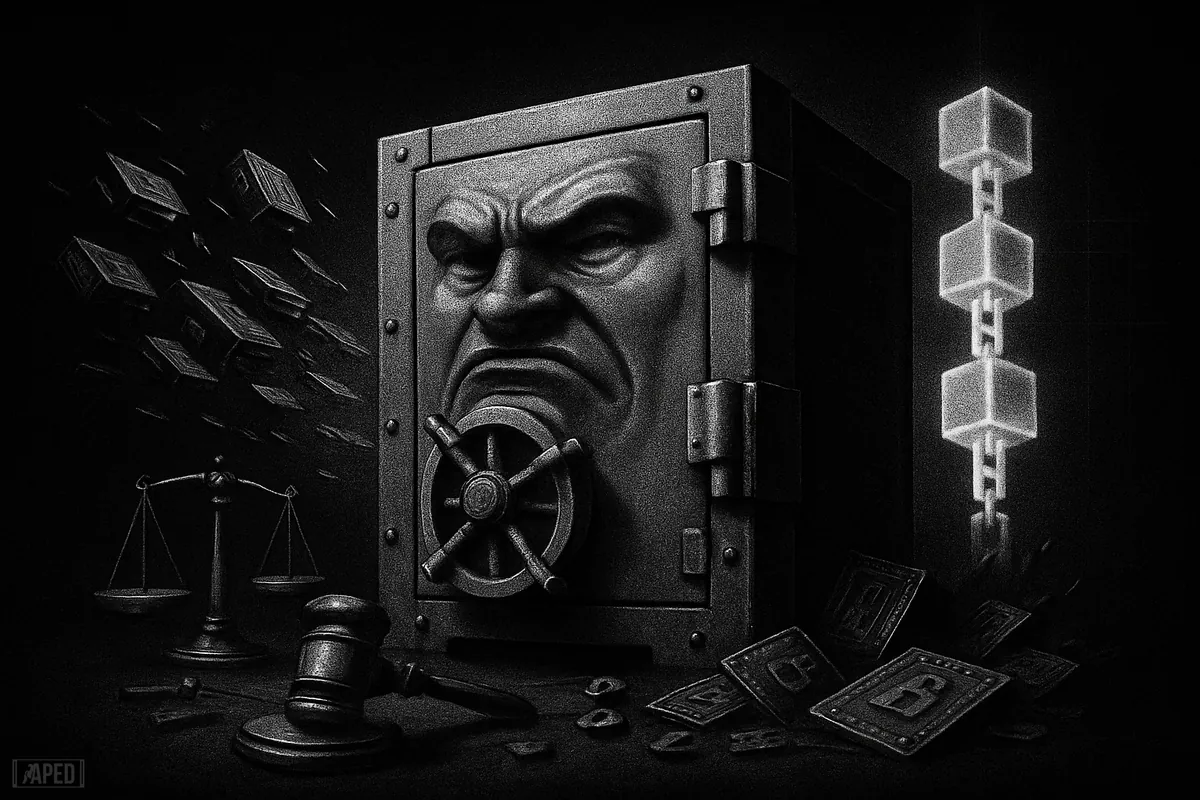
Bitcoin$80,578.85's latest debate is not about price, ETFs, or the next mempool panic. It is about the software that keeps the chain honest. Jimmy Song's pitch is simple: Bitcoin$80,578.85 needs a nodeclient that is explicitly conservative, slow to change, and biased toward preserving the asset's monetary rules. The level to watch here is not a chart, it is governance risk. If too much of the network defaults to a culture of "ship it," Bitcoin's core promise starts looking less like hard money and more like editable software. [1]
Song made that case while discussing ProductionReady, the nonprofit he co-founded to fund open-source Bitcoin node software and education. The group's operating principle is blunt: if a proposed change does not clearly improve the money, do not merge it. That stance is less glamorous than a flashy roadmap, but that is the point. Bitcoin is supposed to be boring at the base layer. [2]
Enjoy articles without ads?
Register for free and get unlimited access to all articles.
Why "conservative" matters for Bitcoin
Bitcoin's value proposition rests on predictability. Users, miners, businesses, and long-term holders rely on the assumption that the rules governing supply, validation, and final settlement are stable. A node client that treats change as a last resort helps defend that assumption.
Song's argument is that every code change carries hidden tradeoffs, even when it looks small on paper. More complexity can introduce bugs, create implementation ambiguity, or slowly widen the gap between developers and the users who actually enforce consensus by running nodes. For a system meant to outlive founders, companies, and political cycles, that is not a side issue. That is the whole game. [3]
A conservative client also matters for decentralization. The more resource-intensive, complex, or socially contentious node software becomes, the harder it is for ordinary users to verify the chain independently. If validation drifts toward a smaller set of technically elite operators, institutions, or infrastructure providers, Bitcoin keeps the branding of decentralization while losing some of the substance.
The ProductionReady thesis
ProductionReady appears to be positioning itself as a funding and education layer for a more cautious development culture. Song said the organization has a built-in bias against major code changes unless there is overwhelming community backing. That phrase matters. It implies a high social threshold, not just a technical one. [4]
This is a subtle but important distinction. Bitcoin development is open source, but open source does not automatically mean socially neutral. Influence tends to cluster around maintainers, reviewers, mining interests, wallet providers, and large custodians. A conservative client can act as a counterweight by making "do nothing" a legitimate default, instead of treating non-upgrade paths as backward or obstructionist.
That framing will resonate with Bitcoiners who see the protocol less as a startup and more as monetary infrastructure. You do not want your base money optimized like a consumer app. Nobody wants their savings secured by the software equivalent of "we pushed a patch Friday night, should be fine."
What node software actually protects
Full nodes do not produce blocks unless they are also miners, but they still do crucial work. They verify transactions and blocks against Bitcoin's rules. They reject invalid history. They give users a way to check balances and chain state without trusting a third party. That is why node diversity and user-run validation are not just philosophical nice-to-haves. [5]
If a broad set of economically relevant users run their own validating software, consensus changes become harder to force through without genuine buy-in. That dynamic is a key defense against rule drift. It also limits the odds that a small technical class can reshape Bitcoin through inertia, branding, or convenience.
The conservative approach is basically saying that node software should prioritize clarity, security, and auditability over experimentation. That will annoy people who want faster iteration, but Bitcoin is not competing on feature velocity. Its moat is credible restraint.
The tension with innovation
There is a real counterargument here. Being too conservative can freeze worthwhile improvements, slow bug fixes, and make the network less adaptable over time. Bitcoin still needs active maintenance, better tooling, and occasional upgrades. "Conservative" cannot become a fancy word for paralysis.
That is where the debate gets practical. The question is not whether Bitcoin should ever change. It is how high the burden of proof should be, who gets to decide, and what kinds of changes deserve the risk. Song's answer appears to be that changes should clear a very high bar unless the upside to Bitcoin's money properties is obvious and broadly accepted.
That posture lines up with a long-running norm in Bitcoin culture. The base layer should move carefully because mistakes there are expensive and hard to unwind. If experimentation is needed, the cleaner path is often higher layers, sidechains, or adjacent tools rather than messing with consensus-critical software too casually.
Why this debate is heating up now
The timing makes sense. Bitcoin is more institutionalized than ever, and that cuts both ways. More capital means more eyes on the protocol, but it also means stronger incentives to lobby for changes that suit infrastructure providers, financial products, or scaling preferences. Once an asset becomes systemically important, governance pressure does not disappear. It gets more sophisticated. [6]
That creates an opening for groups like ProductionReady. Their role is not to out-market the bigger institutions. It is to defend a development philosophy that treats Bitcoin's rule set as something to preserve, not constantly optimize. For holders worried about soft capture, that matters.
There is also a reputational angle. Bitcoin has spent years differentiating itself from chains that frequently rewrite narratives, tokenomics, or governance norms. If Bitcoin wants to keep the "credible neutrality" premium, it has to show that its software process remains resistant to fashion, urgency, and donor-driven priorities.
Risks to consider
A conservative client is only useful if it stays credible, well-maintained, and technically competent. If "conservative" turns into under-resourced or ideologically rigid, users may simply ignore it. The market for node software is not decided by slogans. It is decided by reliability, review quality, and trust.
Another risk is fragmentation. Multiple clients can improve resilience, but they can also create coordination headaches if implementations diverge around consensus edge cases. Bitcoiners know this already. Client diversity is healthy until it starts introducing ambiguity in the rules everyone thinks they share.
The Bottom Line
Song's argument lands because it speaks to Bitcoin's core trade: less flexibility in exchange for more certainty. A conservative node client is not about resisting progress for the sake of it. It is about forcing every proposed change to prove it is worth the risk to the money itself.
That is the watchlist item. If Bitcoin development keeps rewarding restraint, user validation, and broad consensus, the network strengthens its claim to being hard money. If convenience and speed start setting the tone, the chain may still work, but the social contract gets a little softer. In Bitcoin, that is the kind of slippage that matters most.
Your reviews help us improve the quality of both current and future articles. All reviews are public and visible to other readers. We use both ratings and comments to improve future articles and to revise any articles that do not meet our standards.
 See more like this on Google