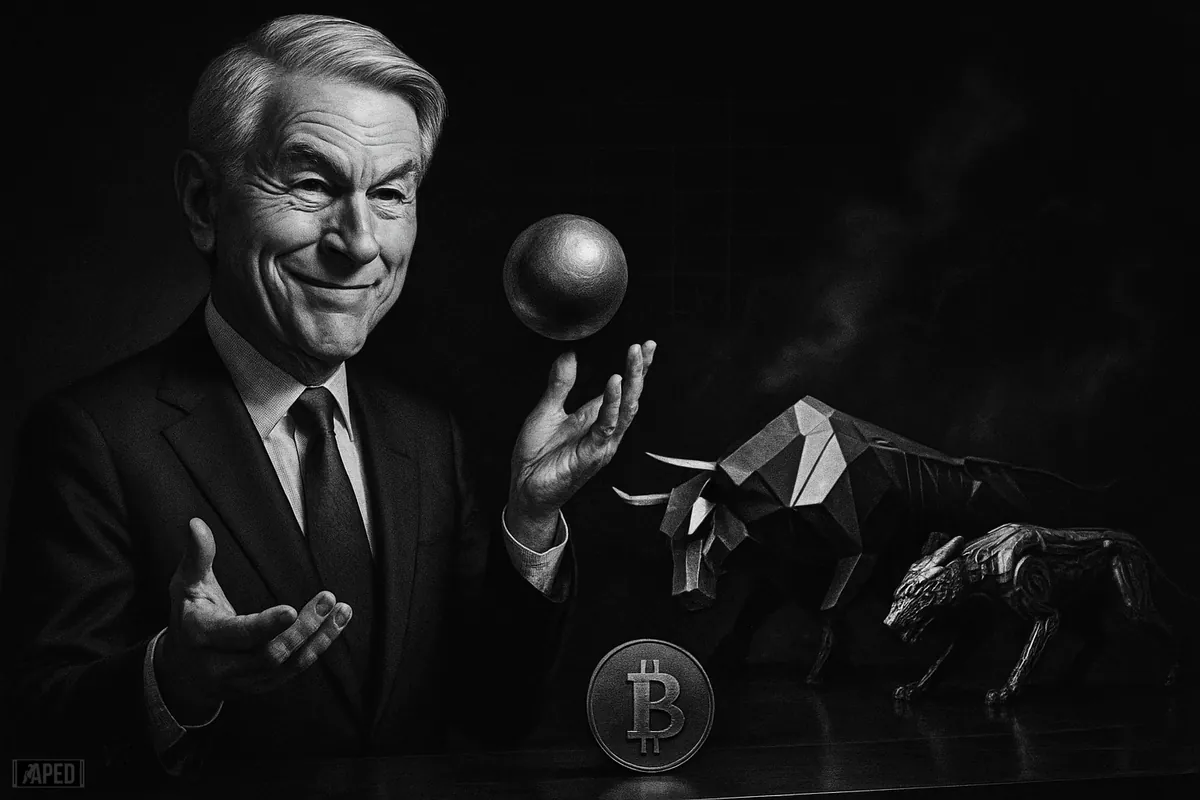
That shift, flagged in analysis referenced by Charles Schwab, adds another data point to a narrative traders have been leaning into for months: Bitcoin$80,201.51 is behaving less like a perpetual meme grenade and more like a large, highly liquid macro asset. [2]
Register for free and get unlimited access to all articles.
Volatility compression is the story
The core claim is simple. Bitcoin's recent realised volatility has dropped to around 42 percent, below the level seen in Tesla and Nvidia over the same stretch. That does not make BTC "safe", obviously. It does mean one of the market's oldest assumptions, that bitcoin is automatically the wildest thing on the screen, is no longer reliably true. [3]
The backdrop matters. Bitcoin$80,201.51 has spent much of this cycle trading in a deeper, more institutionally owned market than in prior years. Spot ETF demand in the US, broader treasury and corporate participation, and thicker derivatives liquidity have all helped absorb flows that might once have caused uglier swings. When liquidity improves, volatility often compresses. Finance remains annoyingly consistent on that point. [4]
Why this is happening now
Several structural changes help explain the drop.
First, market depth is stronger than it used to be. Bitcoin now trades across a broad stack of spot venues, CME futures, offshore perpetuals and ETF wrappers. That creates more arbitrage and tighter pricing, which tends to dampen abrupt dislocations.
Second, ownership has broadened. Retail is still here, but bitcoin is no longer driven only by tourists and leverage-chasing degens. Asset managers, corporate treasuries and systematic allocators have become bigger players. Their positioning is often slower and less emotional, which can smooth short-term price behaviour.
Third, bitcoin's market cap is simply larger. As assets grow, it takes more capital to move them by the same percentage. That does not eliminate volatility, but it can reduce the frequency of truly absurd candles outside liquidation events.
Tesla and Nvidia are carrying equity-specific heat
The comparison with Tesla and Nvidia is striking because both names have become magnets for concentrated thematic exposure. Nvidia remains one of the market's cleanest AI proxies, while Tesla still trades as a mix of auto manufacturer, robotics option and Elon premium. That sort of narrative density can make single stocks far more jumpy than investors expect, especially around earnings, guidance, margins and macro rate shifts. [5]
Bitcoin has catalysts too, but they are increasingly spread across a 24/7 global market with a much larger participant base. A single earnings print cannot hit BTC the way it can hit an individual equity. Stocks carry company-specific risk on top of market beta. Bitcoin carries protocol, regulatory and macro risk, but not quarterly delivery numbers.
For allocators, the more important takeaway is not that bitcoin has become low volatility. It has not. The point is that the gap between BTC and mainstream risk assets may be narrower than old models assume.
That matters for portfolio construction. If bitcoin's volatility profile is compressing while its liquidity and institutional accessibility improve, the case for treating it as a standalone allocation bucket gets easier to make. Schwab and other large platforms have increasingly had to address this question directly as clients ask whether bitcoin deserves a place beside equities, bonds, gold and cash. [1]
Correlation still matters more than a headline volatility ranking, and bitcoin can still lurch when macro liquidity tightens. But if investors are comfortable holding high-beta tech stocks, the argument that BTC is uniquely too volatile starts to look a bit dated.
Traders should not get complacent
There is also a trap here. Lower recent volatility often invites leverage, and leverage is how "mature" markets suddenly rediscover their inner circus. If funding starts climbing while open interest expands faster than spot demand, bitcoin can go from placid to nasty in a hurry.
That is the key risk around this narrative. Realised volatility is backward-looking. It tells you what has happened, not what must happen next. A macro shock, ETF flow reversal, regulatory headline or crowded basis trade can change the picture quickly.
On-chain and market structure signals are worth watching here. If exchange balances start rising, long-term holder distribution increases, and perp funding turns overheated, that would suggest the current calm is vulnerable. If spot-led demand remains firm and leverage stays relatively clean, the lower-vol regime has a better chance of holding.
Bitcoin being less volatile than Tesla and Nvidia is a useful signal, not a coronation. It supports the idea that BTC is maturing into a more conventional macro asset, but it does not cancel downside risk or make the market boring. Sadly for engagement farmers, nuance survives.
Checklist
Realised and implied volatility: Watch whether BTC stays below major tech names or if the gap closes on the next macro move.
ETF flows: Persistent net inflows would support deeper liquidity and steadier price action.
Funding rates and open interest: Rising leverage without spot confirmation is how calm regimes break.
CME basis and perp spreads: Useful tells for whether institutional and offshore positioning is getting crowded.
On-chain exchange flows: Coins moving onto exchanges can hint at sell pressure returning.
Macro catalysts: Rates, dollar strength and risk sentiment still matter more than crypto likes to admit.
Listen to “Bitcoin volatility drops below Tesla and Nvidia as ETFs and liquidity reshape the market” on YouTube as we share all our news to our channel 24/7.
Be part of the conversation!
Discuss the "Bitcoin Less Volatile Than Tesla and Nvidia, Schwab" article and follow us to get 24/7 updates.
Your reviews help us improve the quality of both current and future articles. All reviews are public and visible to other readers. We use both ratings and comments to improve future articles and to revise any articles that do not meet our standards.
 See more like this on Google