 See more like this on Google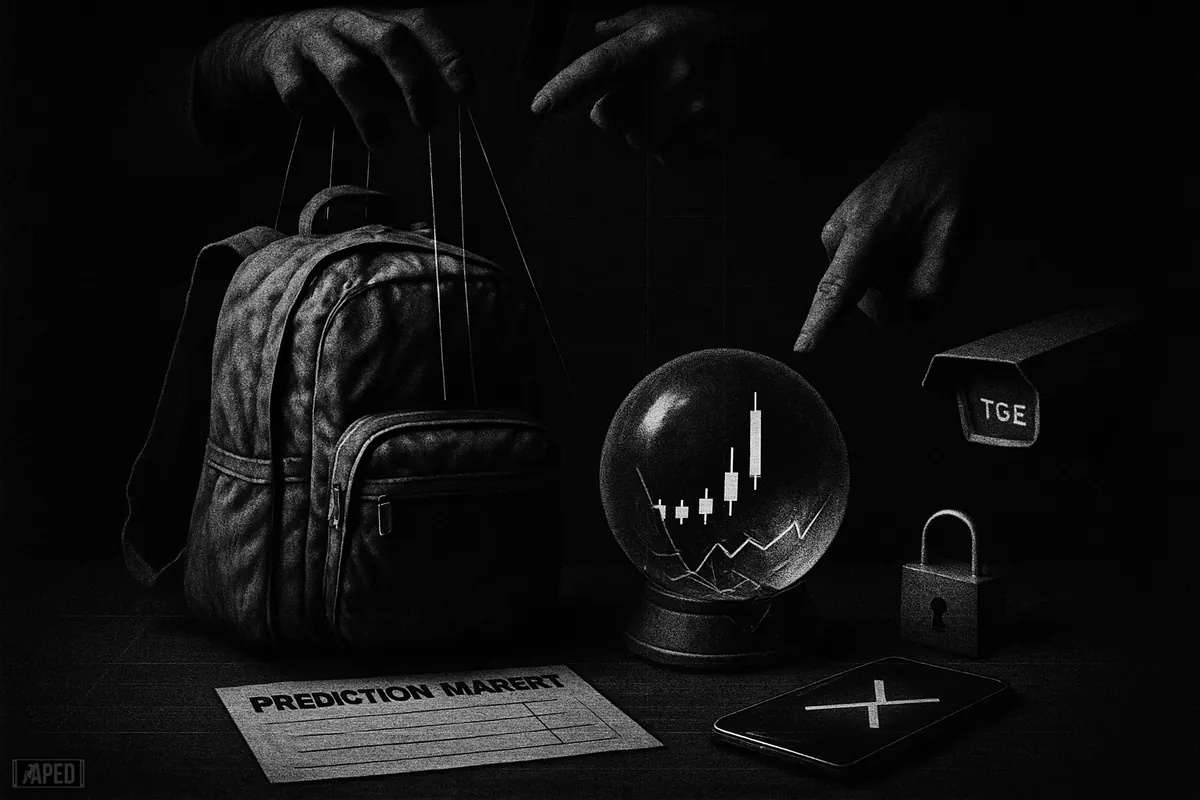
Share article
Share article
A $0.20 print became the whole trade for Backpack$0.1544 on Wednesday, not because of fundamentals, but because a Polymarket contract effectively turned that level into a payday. Backpack said a large prediction market position betting BP's fully diluted valuation (FDV) would clear $200 million one day after token generation event (TGE) appeared to trigger last-minute spot buying as the contract's resolution window closed, with BP changing hands around $0.19 at the time.
In a post on X, Backpack (the company behind the Backpack brand) wrote that "certain traders purchased a significant amount of Backpack$0.1544 tokens in an attempt to push the price above $0.20 and win their Polymarket bet." The firm said it "investigated immediately" and concluded the traders "are not insiders" and "not employees, directors, officers, advisors, or in any way affiliated with Backpack," adding it has "zero tolerance for insider trading of any kind."
The mechanics matter. Polymarket markets resolve to a yes or no outcome based on predefined terms and an oracle process, usually referencing a specific price source and timestamp window. When a market is structured around FDV, small moves near a key price can flip the outcome if the FDV calculation is effectively pinned to a single spot price at resolution. Backpack's tweet points to that dynamic: BP hovering near $0.19, a $0.20 threshold that would map to the contract's $200 million FDV line under the market's definition, and aggressive buying into the close.
This is a familiar stress test for thin or newly launched tokens. Around TGE, liquidity can be fragmented across venues, market depth is still forming, and short time-window oracles are most vulnerable to price impact. Even if there is no insider angle, a trader can still attempt to "buy the close" to move a reference price long enough to collect on a derivatives or prediction market payout. That behavior can look like manipulation to spot participants who are not watching the incentive structure sitting in adjacent markets.
Backpack's statement also reads as a reputational firewall. Prediction market-driven price antics tend to get blamed on teams, market makers, or early insiders, especially when the timing coincides with token launch milestones. By publicly stating it investigated and found no affiliation, Backpack is trying to separate company governance risk from what it frames as external, opportunistic trading.
For BP traders, the risk is straightforward: if spot demand was partially "incentive demand" tied to a single settlement window, it can vanish as soon as the contract resolves. That is the classic recipe for abrupt reversals, especially if leverage is piled on after a visible level becomes a magnet. The counterpoint is that a battle for a round number like $0.20 can also bootstrap liquidity and attention, which sometimes persists after the catalyst passes, but only if organic bids show up once the artificial incentive is gone.
Watchlist takeaway: $0.20 is the line the market just told you matters. If Backpack$0.1544 cannot hold above that area after the Polymarket resolution window is definitively over, the "prediction market bid" narrative stays alive and downside volatility risk rises. If it reclaims and holds $0.20 on normal flow, that is the first sign the move is not purely settlement-driven.
Companies Referenced



Tags
Original tweet
