Background and history
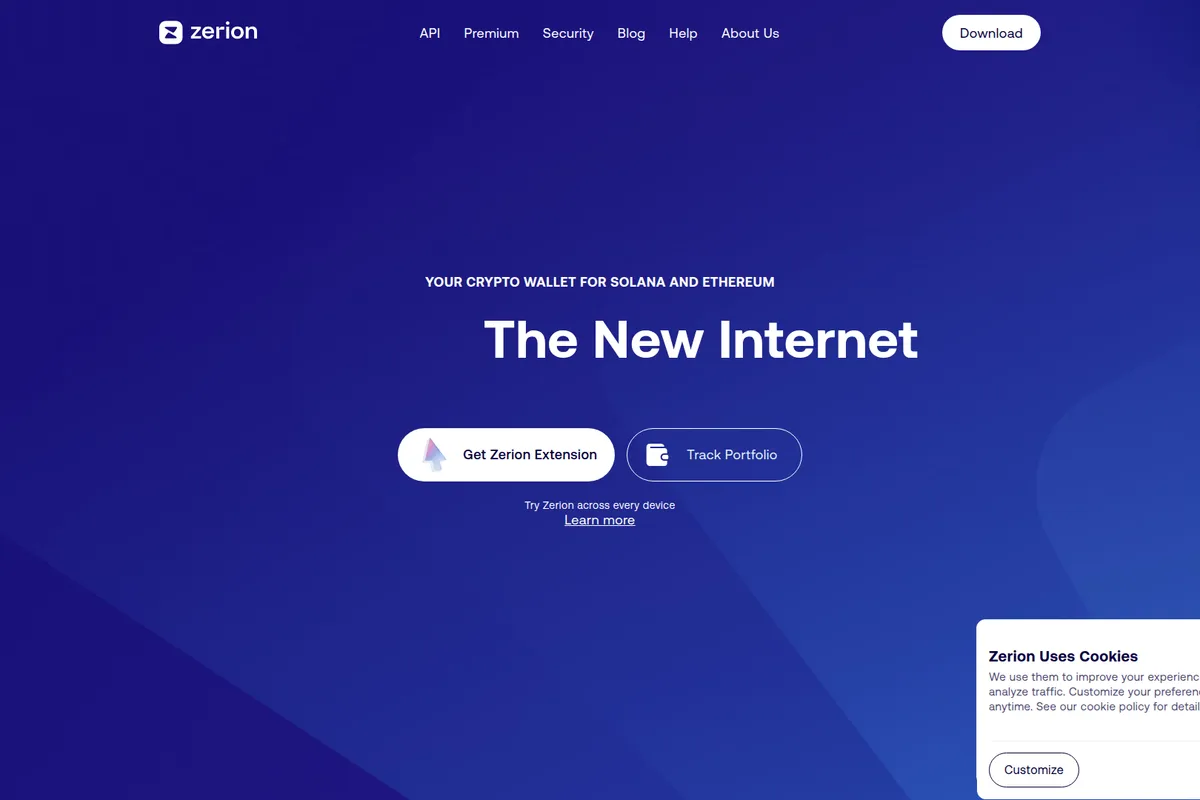
Zerion is a self-custodial crypto
wallet and Web3
portfolio manager built around the idea that users should be able to see and manage their onchain life in one place. In its own positioning, Zerion aims to cover “every dapp, every
asset, every chain,” with a particular emphasis on Ethereum, Solana, and major EVM networks.
[1]Unlike
centralized exchanges that
custody user funds, Zerion describes itself as a self-custody wallet where only the user holds the private keys. Its help center characterizes the product as a wallet available through a mobile app and
browser extension, designed for buying, storing, sending, receiving, swapping, bridging, and tracking assets across multiple networks, as well as interacting with
decentralized apps and managing NFTs.
[2]By 2025 and 2026, Zerion’s distribution footprint spans a mobile-first experience plus desktop access through a web app (app.zerion.io) and a browser extension. This multi-surface approach matters because Zerion is used both as a day-to-day wallet and as a “dashboard” for monitoring multiple addresses and DeFi positions without always initiating transactions. [2]
Product development signals in the iOS version history show an expansion beyond an Ethereum-centric experience. The App Store listing repeatedly highlights that Solana support arrived in mid 2025, and it later references TRON support added in version 4.9.0 dated 18/12/2025. [3]
Key features and services
Zerion’s feature set blends three product categories that are often separate in Web3: a
software wallet, a portfolio tracker, and a DeFi and NFT discovery surface.
Self-custodial wallet with multi-chain coverage
Zerion’s app listings emphasize “Your Keys. Your Assets. Your Privacy,” stating that the company does not have access to user assets or private keys. In practice, this means key management,
seed phrase storage, and transaction signing responsibility sits with the user, which is aligned with the standard
non-custodial model.
[4]From a
network perspective, Zerion markets itself as a “Crypto & DeFi Wallet for Solana, Ethereum & 50+ Chains,” and the homepage reiterates support across Ethereum, Solana, and major EVM networks. The iOS listing mirrors this language, calling it “One Wallet For All Your Crypto On Solana, Ethereum and 50+ Chains.”
[4] [1] [3]For users, the practical advantage is not just holding tokens on multiple chains, but viewing and managing a
cross-chain portfolio without juggling separate apps for EVM networks and Solana.
Swaps and bridging
Zerion promotes in-app swapping and bridging, including language about getting the “best deal” and being able to bridge and swap in one transaction, with Solana support explicitly mentioned. The help
documentation also states users can swap and bridge at “best available rates,” and that these functions are available in the web app when a wallet is connected.
[1] [2]As with most wallet-aggregated swaps, users should still expect to pay network fees, and in many cases aggregator or routing spreads can apply. The provided sources do not specify exact swap fees, routing providers, or how “best deal” is measured, so cost-conscious traders may want to compare quotes across wallets when executing larger swaps.
Portfolio tracking, P&L, and transaction history
Portfolio tracking is one of Zerion’s clearest differentiators in user feedback. The homepage promotes “portfolio tracking across chains,” and the App Store listing references tracking portfolio value, P&L, and transaction history. On the review side, multiple Trustpilot comments frame Zerion as a standout portfolio dashboard, particularly for Ethereum and
Layer 2 ecosystems and for monitoring DeFi positions like LPs and vaults.
[1] [3] [5]
Zerion’s web app also supports “tracking wallets” directly in a browser, which is useful for users who want a dashboard view without necessarily importing keys into every device. [2]
NFTs and richer asset viewing
Zerion positions NFTs as first-class citizens alongside tokens and DeFi positions. Its help documentation explicitly includes collecting and managing NFTs, and the homepage promotes tracking “every
token, staked asset and NFT” across Ethereum and Solana, with additional claims like playing video and music NFTs.
[2] [1]Discovery, wallet-following, notifications, and XP
Zerion leans into discovery and “social” utility. The help center describes real-time wallet activity notifications and the ability to track other wallets and receive alerts when they trade or mint. The mobile listings also mention discovering trending tokens and NFT mints, earning XP and rewards for onchain activity, and getting alerts related to airdrops and perks. [2] [3] [4]
This feature set will appeal to users who want a single place to monitor activity across addresses, but it also introduces a potential tradeoff: discovery and gamified elements can encourage frequent trading, which increases exposure to
market volatility and onchain
scam risk. Zerion partially addresses this with “built-in
security checks,” discussed below.
[4]Premium tier and early-access perps
Zerion’s website navigation includes a Premium section, and the iOS version history mentions
perpetual futures (perps) becoming available in early access for Premium users. The provided sources do not include subscription pricing, eligible jurisdictions, or how perps are implemented, so prospective users should treat this as an emerging feature and review the in-app disclosures carefully before using leverage-based products.
[1] [3]Security and trust
Security in a self-custody wallet is a mix of product design and user behavior. Zerion’s
trust profile, based on the provided sources, comes from its custody model, safety UX claims,
hardware wallet support, app store disclosures, and public review sentiment.
Non-custodial design and hardware wallet support
Zerion emphasizes that it does not have access to user private keys, aligning it with a non-custodial model where the user controls funds. It also promotes
Ledger support, which is relevant for users who want to keep keys on a hardware device while still benefiting from Zerion’s UI and portfolio tools.
[4]Transaction clarity and safety checks
Zerion’s website claims transactions are presented in “human-readable language,” and that users can understand outcomes before signing. App listings also mention “built-in security checks for safe browsing.” These UX-level safety features are valuable, particularly for users interacting with DeFi contracts, where malicious approvals and
phishing are common.
[1] [4]No wallet UI can eliminate risk entirely. Users should still treat approvals, signature requests, and
airdrop links with caution, and consider using separate wallets for experimentation versus long-term holdings.
Privacy and data safety disclosures
Zerion’s iOS listing includes privacy-forward messaging such as “Your wallet. Your keys. Your data,” and a claim that it never cross-associates or shares wallet addresses to preserve privacy and anonymity. Separately, Google Play’s “Data safety” section indicates the app may collect and share certain categories of data, including financial info and app activity, while also noting
encryption in transit and the ability to request deletion. These statements can coexist, but they highlight an important nuance: self-custody does not automatically mean zero data collection, especially when apps provide onramps, support chat, analytics, or notification features.
[3] [4]Reputation indicators and review caveats
On Trustpilot, Zerion shows a 4.6/5 rating from 164 reviews and is categorized as a non-bank financial service. Trustpilot also displays a general warning that the company may be associated with high-risk investments, a common label for crypto-related businesses. Trustpilot further notes that it does not fact-check reviews, which is important context when weighing both praise and complaints. The profile interface also indicates Zerion has not replied to negative reviews, which can be a missed opportunity to demonstrate public-facing resolution processes. [5]
Traders Union, in a review updated Feb 17, 2026, reports a 4.7/5 Trust Index and breaks down component scores, including a user reviews score derived from Trustpilot and other methodology elements such as a popularity score sourced from Similarweb. While this is a favorable
signal, it remains an aggregation rather than a security
audit.
[6]User experience
Zerion’s user experience is consistently one of its strongest themes across both product descriptions and third-party reviews.
Interface and usability
The Android listing pitches an “all-in-one” wallet for buying, storing, swapping, and tracking tokens and NFTs. User reviews cited in the provided sources describe a clean interface, smooth transactions, and the convenience of tracking assets in one place. On Trustpilot, multiple reviews characterize Zerion as an exceptionally helpful portfolio dashboard, especially for navigating Ethereum
mainnet and Layer 2 ecosystems.
[4] [5]Support experience
Support is another recurring positive. Trustpilot reviewers frequently praise in-app chat support, sometimes naming individual staff members and describing extended, step-by-step sessions. Google Play responses also direct users to a “Chat with us” support pathway inside the app. Strong support is a meaningful differentiator for self-custody products, where users often need help understanding transaction states,
bridges, or third-party provider issues.
[5] [4]Known friction points
The two most concrete friction points in the provided sources are:
First, at least one Trustpilot complaint reports non-receipt of coins after a purchase, including a transaction
hash and a claim that support was unable to resolve the issue within hours. Because Trustpilot does not fact-check, this should be treated as a user-reported risk rather than verified fault, but it is directly relevant to users relying on card onramps.
[5]Second, a Google Play review points to dApp compatibility gaps, where a third-party app did not offer Zerion as a wallet connection
option, and the developer response indicated outreach to the dApp team. This is a common issue in Web3: even if a wallet supports a chain, dApps may only integrate a subset of wallet connectors.
[4]Pricing and fees
Zerion’s mobile apps are listed as free to download on iOS, and its
core wallet and tracking functionality is generally positioned as an accessible entry point for managing assets. The site navigation references “Premium,” implying a paid subscription tier, and the iOS version history notes perps early access for Premium users. However, the provided sources do not include a price, billing period, or a complete feature comparison for Premium.
[3] [1]For transaction costs, the sources do not provide a fee table. Users should assume the following general cost categories apply when using Zerion to transact:
- Network gas fees on the relevant chain.
- Swap or bridge routing spreads, and potentially aggregator or provider fees, depending on the route.
- Onramp fees and FX spreads for card purchases, which are typically set by third-party payment providers.
Because one of the prominent negative reports relates to purchase fulfillment, users may want to start with small test transactions when using card buys or cross-chain bridges for the first time. [4] [5]
Comparison with alternatives
Zerion sits at the intersection of wallet UX and portfolio tracking. The best alternative depends on whether you prioritize dApp connectivity, chain coverage, security model, or analytics depth.
Wallet-first alternatives (broad dApp compatibility)
If your main requirement is universal dApp connectivity across EVM chains, Alchemy’s “Zerion alternatives” list highlights several wallet substitutes that are widely integrated:
- MetaMask, described as a popular EVM-compatible wallet. [7]
- Rabby Wallet, described as a wallet for Ethereum and all EVM chains. [7]
- Rainbow, positioned as Ethereum-first with bridging and cross-chain swaps to Layer 2s. [7]
Compared with these, Zerion’s edge tends to be the integrated portfolio view and discovery layer, while the tradeoff can be that some dApps may not offer Zerion as a connection option.
Multi-chain, including Solana
For users who want a single wallet spanning Solana and EVM chains, Alchemy’s list calls out Phantom as a leading multichain wallet on Solana, Ethereum, and Polygon, and Backpack as an Ethereum and Solana wallet with an xNFT focus. Zerion also competes here directly given its explicit Solana support and its mid-2025 rollout noted in iOS release notes. [7] [3]
Portfolio dashboards and discovery tools
If your primary
use case is tracking and discovery rather than transacting, CB Insights frames Zapper and CoinStats as comparable tools in the broader competitor set. Zapper is described as making
blockchain readable across DeFi, NFTs, and DAOs, with tools like wallet exploration, swaps, NFT discovery, and DAO treasury analysis. CoinStats is positioned around portfolio tracking across wallets and exchanges, with additional buy and swap functionality.
[8]Zerion’s advantage is that its tracker and wallet are tightly integrated across mobile, extension, and web, while dashboard-only tools can offer broader
exchange integrations or reporting features, depending on the product.
Security model alternatives
Alchemy’s alternatives list includes Zengo, described as an MPC wallet. MPC approaches can reduce seed phrase risk for some users, although they come with different trust and recovery assumptions than a traditional seed-based wallet. Users choosing between Zerion and an MPC-style wallet should consider their threat model and preferred recovery method. [7]
Final verdict
Zerion is a strong choice for users who want a self-custodial wallet that doubles as a polished
multi-chain portfolio tracker, with particular strength in presenting DeFi positions and NFTs in a single, readable interface. Its product direction also suggests it is expanding from
spot management into more advanced tooling, including Premium features and early access perps mentioned in iOS release notes.
[2] [3]On trust and reputation, the dataset is broadly favorable: strong ratings on Trustpilot and Google Play, and a high Traders Union Trust Index score as of Feb 2026. At the same time, Zerion is not immune to the practical risks of Web3 wallets, especially where third-party providers are involved. User-reported issues around purchase fulfillment and compatibility gaps in external dApps are the most notable downsides in the provided sources. [5] [4] [6]
For most users, the best way to approach Zerion is to treat it as a primary interface for viewing and managing a multi-chain portfolio, while maintaining standard self-custody hygiene. Use small test transactions when trying new onramps or bridges, verify dApp connection support ahead of time, and consider Ledger integration for higher-value wallets. [4]