Background and history
VVS Finance,
short for “Very Very Simple Finance,” is a
decentralized finance (DeFi) platform built around an
automated market maker (AMM) decentralized exchange (DEX) experience on the Cronos
blockchain. Its stated positioning, repeated across third-party coverage, is to make DeFi feel more approachable for newcomers by emphasizing a simpler interface and reduced jargon.
Capital.com summarizes this thesis directly, noting that the project’s name reflects a goal of making DeFi “more accessible,” and it highlights Cronos as a practical chain choice for low fees and high transaction speeds.
[1]The project is widely associated with the Cronos ecosystem, and third-party explainers often frame it as a flagship Cronos-native DEX. CoinStats describes VVS Finance as an AMM DEX and calls it the largest project built on Cronos, additionally stating it was launched by Crypto.com in 2021. [2]
From a market-history standpoint, the VVS
token has experienced the high-volatility arc typical of many DeFi
protocol tokens that launched in the 2021 cycle. Capital.com documents VVS going live on 22 November 2021 and reaching an early peak shortly after, followed by a significant decline through 2022 as broader risk sentiment deteriorated.
[1]It is important to separate two things when evaluating VVS Finance in 2026: the
on-chain product utility (swaps,
liquidity, farming,
staking, token launches) versus the investability and historical performance of the VVS token. Many publicly indexed pages about “VVS Finance” are primarily token-market content and forecast simulations, not hands-on product testing. This review focuses on what the provided sources actually describe about the platform and where the evidence is thin.
Key features and services
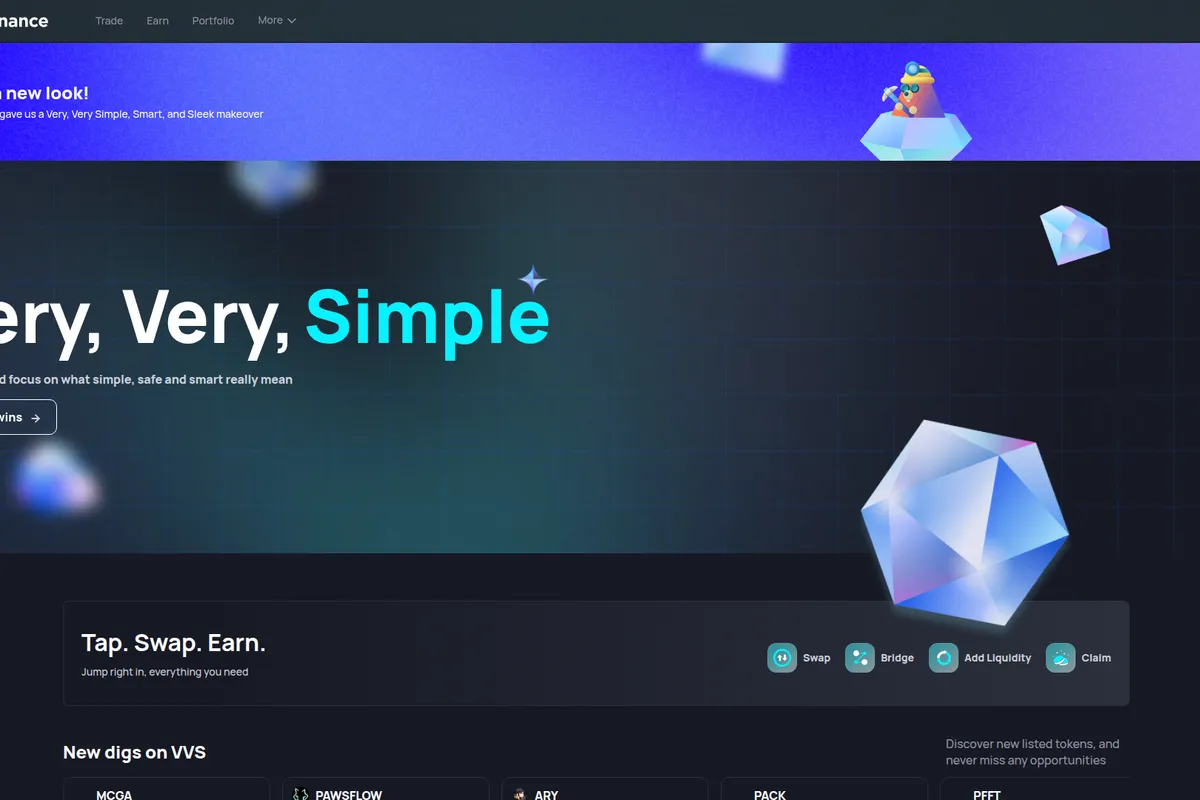
VVS Finance is best understood as a DeFi hub with a DEX at its core. The official vvs.finance homepage is organized around straightforward actions such as Swap, Bridge, Add Liquidity, and Claim, reflecting the product’s simplicity-first positioning. [3]
Swaps (Bling Swap)
CoinStats describes VVS Finance as an AMM where users trade through liquidity pools rather than an
order book, and it highlights “Bling Swap” as a routing system that can route trades across multiple liquidity pools to improve execution for a token
pair.
[2]On fees, CoinStats reports a 0.3% swap fee.
[2] In practice, total swap cost for a user also includes
network gas fees, which on Cronos are often positioned as lower than some alternative chains, although gas pricing is dynamic.
Liquidity provision and fee sharing
Like most AMM DEXs, VVS allows users to supply liquidity to trading pairs, receiving an LP token representing their share. CoinStats states VVS uses CRC-20 pool tokens (LP tokens) on Cronos. [2]
A key economic detail in the supplied research is the swap fee split. CoinStats describes a launch-era model where liquidity providers received two-thirds of swap fees and one-third went to a treasury, expressed as 0.2% and 0.1% of swap
volume respectively at launch.
[2] Capital.com similarly notes that liquidity providers earn two-thirds of all swap fees on the platform.
[1]Liquidity provision also introduces
impermanent loss risk. CoinStats explicitly flags impermanent loss as a factor liquidity providers should weigh against rewards.
[2]Yield earning: Crystal Farms and Glitter Mine
VVS Finance’s yield features are generally described in two layers.
First, Crystal Farms are targeted at liquidity providers. CoinStats describes Crystal Farms as places where users stake LP tokens to earn VVS token rewards, and it outlines typical interface functions like staking, tracking APR and earnings, and claiming rewards. [2] Capital.com also references Crystal Farms as a staking and farming product where users stake funds to earn rewards. [1]
Second, Glitter Mine is framed as a staking pathway for VVS holders, including those who are not providing liquidity. CoinStats states Glitter Mine allows users to stake VVS to earn VVS or partner tokens, and it calls out an auto-compounding feature for an Auto VVS pool. [2]
The official homepage also highlights “Earn” opportunities with APR callouts by token and strategy type (liquidity versus staking). These figures appear to be dynamic and should be treated as indicative UI values rather than fixed promises. [3]
Token launches: Initial Gem Offerings (IGOs)
CoinStats describes Initial Gem Offerings (IGOs) as a method to access new Cronos ecosystem projects early, using VVS-CRO LP tokens to participate. It outlines two participation tracks: Basic Sale (with a cap per user and no participation fee) and Unlimited Sale (no cap, with an initial participation fee stated as 1% that decreases with overflow). Both formats include an overflow mechanism in which unspent committed LP tokens are returned if the sale is oversubscribed. [2]
Bridging and broader functionality
The official UI presents Bridge as a first-class navigation item, suggesting VVS aims to cover common onboarding flows for users moving assets to Cronos. [3]
A CoinMarketCap page labeled “By CMC AI” also claims VVS has expanded with features such as recurring orders (positioned as DCA automation) and
cross-chain swaps via Relay Protocol, and it mentions stable pools via FerroProtocol. Because this page is explicitly AI-authored, it is best treated as a secondary synthesis rather than canonical
documentation, but it is directionally useful for understanding how VVS is being presented in 2025 to 2026.
[4]Security and trust
Non-custodial design and wallet connectivity
As a DeFi web app, VVS Finance is accessed by connecting a
wallet rather than creating a
custodial exchange account. CoinStats specifically mentions support via the Crypto.com Wallet Extension and WalletConnect-compatible mobile wallets, including the Crypto.com DeFi Wallet.
[2]This
non-custodial model reduces certain custodial risks (for example, the platform holding your funds in an exchange account) but introduces direct
smart contract interaction risk. Users remain responsible for wallet
security, transaction approvals, and verifying they are interacting with the correct contracts and domains.
Smart contract risk and the limits of the provided evidence
The supplied research set does not provide
audit confirmations,
bug bounty details, or incident reports. That does not mean audits do not exist; it means they are not evidenced in the provided sources. As a result, a cautious stance is appropriate: treat VVS like any DeFi protocol where smart
contract vulnerabilities, oracle issues, liquidity attacks, and integration risks are possible.
Team transparency
CoinStats states the VVS team is
anonymous and refers to itself as the “Craftsmen.”
[2] Anonymity is not unusual in DeFi, but it can affect perceived
accountability, especially for users deploying meaningful capital.
Tracxn, a company database, presents VVS Finance as a venture-style company profile, including a claim of founding in 2021 and an Atlanta base, with an undisclosed raise from BIP Ventures. This is best treated as “what Tracxn reports” rather than definitive protocol metadata, since database entity mapping can be imperfect for crypto protocols. [5]
Market sentiment snapshots (context, not a security metric)
Several forecast-oriented pages include sentiment indicators such as Fear and Greed scores. For example, WeAreBlox shows “Extreme Fear” (value 5) updated around late February 2026.
[6] Hexn also reports an Extreme Fear reading and bearish sentiment, although its page contains internal numerical inconsistencies, which reduces its reliability as a
market data reference.
[7]These indicators can help explain user risk appetite at a point in time, but they should not be confused with protocol security or platform quality.
User experience
VVS Finance’s product design is repeatedly framed around being simple for mainstream users. The official site emphasizes short verbs, Swap, Bridge, Add Liquidity, Claim, and presents a “Tap. Swap. Earn.” message intended to reduce the cognitive overhead that often comes with DeFi. [3]
Beyond execution, the homepage also includes token discovery and trending modules that resemble a lightweight market dashboard. This is a meaningful UX choice: DEXs compete not only on fees and liquidity but also on discovery, navigation, and surfacing opportunities without requiring users to jump to third-party screeners. [3]
That said, like most DeFi apps, the experience still assumes the user can manage a wallet, understand token approvals, and interpret APRs, LP exposure, and impermanent loss. CoinStats’ own explanation of impermanent loss is a reminder that “simple UI” does not remove financial complexity. [2]
Pricing and fees
The best-cited “hard number” in the supplied sources is the swap fee. CoinStats reports a 0.3% fee for swaps on VVS Finance. [2]
For liquidity providers, the same explainer describes a fee split where two-thirds of swap fees go to LPs and one-third to a treasury, expressed as 0.2% and 0.1% of swap volume respectively at launch. [2] Capital.com reiterates the two-thirds LP share. [1]
Other costs to consider are network fees (gas) and any opportunity costs or risks associated with LP positions. On-chain APRs shown on the homepage can
change rapidly as incentives, prices, and pool utilization shift.
[3]The VVS token: utility, incentives, and risk considerations
Most coverage in the provided research set blends platform description with token-market discussion.
On utility, CoinStats describes VVS as the protocol’s utility, reward, and
governance token on Cronos, using CRC-20 architecture.
[2] Capital.com frames VVS as central to incentives, noting that liquidity providers and Crystal Farms users can earn rewards, and that Glitter Mine allows staking VVS to earn more VVS.
[1]On supply dynamics, CoinStats includes an emissions-model statement indicating very large issuance in early years (for example, 50 trillion in the first year, then half that in subsequent years). This style of emissions is common in DeFi to bootstrap liquidity, but it can create sustained sell pressure if utility growth does not keep pace. [2]
On market context, WeAreBlox reports a
circulating supply snapshot of 43,550,331,872,464 VVS and provides a price and market cap snapshot around late February 2026, alongside negative multi-year
ROI figures and an Extreme Fear reading.
[6]Forecast pages also deserve careful handling. WeAreBlox explicitly labels its forward-looking numbers as simulations and not advice or a guarantee, warning that real outcomes can differ significantly.
[6] Capital.com similarly emphasizes crypto
volatility and the uncertainty of predictions while compiling third-party forecasts.
[1]Comparison with alternatives
If your primary
use case is swapping on Cronos, you can evaluate VVS against other DEX-category apps and swap routers. Alchemy’s Dapp Store lists four alternatives under a Cronos-filtered view of DEXs: Bored Candy City, CroSwap, OpenOcean (a
DEX aggregator), and Swoop Exchange (cross-chain swaps).
[8]A practical way to compare options is by matching them to the “job” you want done:
- If you want a Cronos-native, simplicity-first DEX and earn hub, VVS’s product surface is specifically designed around that goal, with Swap, Bridge, and Earn flows in a single UI. [3]
- If you want route optimization across venues or chains, aggregator-style alternatives like OpenOcean and cross-chain focused options like Swoop Exchange may be relevant, depending on supported routes and assets. [8]
- If you want a broader “super app” experience that blends DEX, NFTs, and gaming, Alchemy’s listing describes Bored Candy City as an all-in-one platform including a DEX, NFT marketplace, and play-to-earn hub. [8]
Finally, it helps to zoom out. CoinGecko’s DeFi category page provides macro context on the DeFi sector’s overall market cap,
trading volume, and TVL, reminding users that protocol-level outcomes are often heavily shaped by broader market cycles.
[9]Final verdict
VVS Finance stands out in the supplied research set as a Cronos-native AMM DEX built around a mainstream-friendly design philosophy: fewer steps, clearer verbs, and a unified place to swap, bridge, provide liquidity, and earn. The core mechanics are familiar and battle-tested within DeFi: AMM pools, LP fee sharing, and incentive layers via farms and staking. CoinStats’ description of Bling Swap routing, Crystal Farms, Glitter Mine (including auto-compounding), and IGOs paints VVS as more than a simple swap page, it is a full Cronos DeFi venue. [2]
The main drawbacks are not about the UI, they are about risk and evidence. The provided sources do not confirm audits or formal security practices, and third-party coverage notes an anonymous team, which can be a
trust hurdle for some users.
[2] Additionally, many widely indexed pages about “VVS Finance” focus on token price predictions and sentiment snapshots, and at least one (Hexn) contains contradictory market data displays, underlining the importance of verifying metrics via reputable primary data sources and the protocol itself.
[7]For users who want a straightforward Cronos DeFi on-ramp, VVS Finance is a credible
option to consider, especially if you value a simplified front-end and a single hub for swapping and earning. For users who prioritize maximum transparency and independently verifiable security assurances, you should treat VVS like any DeFi protocol: proceed with careful position sizing, understand impermanent loss, and verify contract and audit information directly before committing significant funds.