Background and history
In terms of project origins, Nansen reports that Stargate Finance launched in March 2022 and was developed by LayerZero Labs. The same source names co-founders Bryan Pellegrino, Caleb Banister, and Ryan Zaric, and notes “notable contributors like 0xMaki,” described as a key figure in SushiSwap. [1]
A quick naming caution is warranted because “Stargate” also appears in mainstream business coverage unrelated to crypto, for example an AI data center initiative discussed in a Yahoo Finance article about Oracle’s stock performance. That item is about OpenAI, SoftBank, and Oracle, not the Stargate Finance protocol or the stargate.finance domain. [2]
What stargate.finance offers
Cross-chain transfers with route, time, and fee previews
The core protocol concept described in third-party explainers is unified liquidity. Nansen explains that Stargate enables users and dApps to transfer native crypto assets across multiple blockchains through unified liquidity pools, with the aim of eliminating the need for wrapped tokens and enabling a seamless cross-chain transfer experience. [1]
Assets and networks
The supplied research set provides examples rather than a canonical live list of networks and tokens. Nansen lists major supported networks as including Ethereum, BNB Chain, Avalanche, Polygon, Arbitrum, Optimism, and Fantom. [1]
DeFi functionality beyond bridging
The presence of a first-class “Stake” section in the app navigation reinforces that staking is a core part of the product surface, even if the precise parameters and yields are not detailed in the provided dataset. [3]
Stargate V2: what changes (and why it matters)
Nansen provides a structured comparison of Stargate V1 versus Stargate V2. Key changes described include:
- Supported chains: V2 expands to “even more chains,” including emerging L3s. [1]
- Asset types: V2 supports both native and wrapped assets, whereas V1 was focused on native assets. [1]
- Bridge modes: V2 adds optional batching (“bus”) and a fast mode (“taxi”), implying a trade-off between cost efficiency and speed. [1]
- Verification: V2 is described as using LayerZero DVNs and multisigs, while V1 used Stargate-selected permissioned verifiers. [1]
From a reviewer perspective, V2’s significance is less about a single new feature and more about optionality: users and integrators can choose different transfer modes and verification configurations depending on their risk tolerance and latency requirements.
Security and trust considerations
What can be stated from the sources is:
- Stargate is built on LayerZero, and V2 is described as built on LayerZero V2 messaging. [1]
- Nansen’s V2 comparison explicitly mentions LayerZero DVNs and multisigs as part of the enhanced verification framing. [1]
Token, governance, and the shifting STG narrative
The supplied sources show two different snapshots of STG’s role.
CoinMarketCap’s CMC AI explainer (Feb 2026) describes a later-stage change: it claims that in August 2025 the LayerZero Foundation acquired Stargate in a $110 million deal, reportedly approved by the Stargate DAO, and that STG was “retired as a standalone governance and rewards token.” The same source says STG primarily functions as a redemption instrument with a permanent fixed-rate conversion to ZRO at 1 STG = 0.08634 ZRO. [4]
Because that description comes from an AI-generated explainer, the prudent takeaway is not the exact legal or governance structure, but the practical implication for users: the STG token’s utility and long-term value drivers may differ from the classic “governance plus emissions” model, and anyone interacting with STG should verify the current mechanics through official Stargate or LayerZero communications.
User experience: who it suits
Good fit for
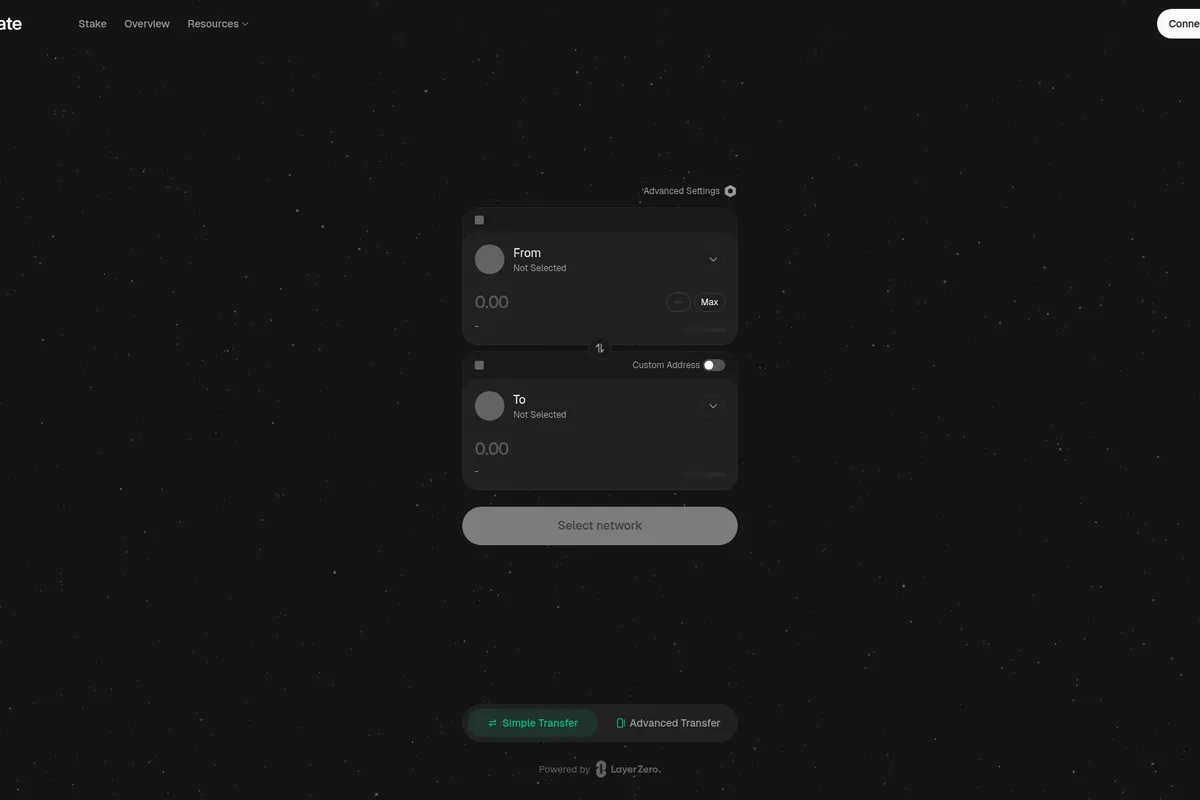
Stargate’s UX, as evidenced by the app surface, is designed for users who want an explicit quote and a structured path through bridging. The presence of “Simple” versus “Advanced” transfer modes, plus a custom destination address field, is useful for:
- Users moving funds between their own wallets on different networks
- Teams funding a destination address for on-chain activity
- More advanced users who want to review routing and parameters before submitting
The approach aligns with Stargate’s positioning as a “liquidity rail” for multichain activity, rather than a generalized swap aggregator.
Potential friction points
Even with a streamlined UI, bridges can be confusing for newer users due to:
- Differences between source-chain gas fees and protocol fees
- Network switching in wallets
- The need to verify that the destination chain and token are correct
The stargate.finance UI does at least foreground “Total Fee” and “Time,” which helps reduce uncertainty at the moment of execution. [3]
Pricing and fees
The provided dataset does not include a formal fee table for Stargate. What can be confirmed is that the app displays a “Total Fee” field and a “Time” estimate for a route, indicating a quote-based UX where costs are presented prior to submitting the transaction. [3]
For users comparing bridges, this is important context: “low fees” claims are common across the category, but real-world costs vary based on gas conditions, chain selection, and liquidity conditions. In the absence of quantified benchmarks in the sources provided, an evergreen best practice is to compare quotes across at least two bridges at the time you intend to transfer.
Market data context (STG): interpret carefully
If your interest in Stargate is partially investment-driven, it is worth separating protocol utility from token price commentary.
CoinCodex’s STG price prediction page (updated Feb 24, 2026) shows STG at $0.1284 with a -8.17% move, “Bearish” sentiment, and a Fear and Greed Index value of 8 labeled “Extreme Fear.” It also lists indicator snapshots such as 50-day and 200-day SMAs around $0.15 and an RSI of 42.55 labeled neutral. [5]
Comparison with alternatives
Bridge choice is usually driven by four variables: destination network coverage, liquidity depth for the specific asset, speed and finality expectations, and the security model.
A useful directory-style comparison source in your dataset is Alchemy’s Dapp Store, which lists “41 Stargate alternatives” under Web3 Bridges. The visible portion of the list includes Across, Synapse Protocol, Hop Protocol, Wormhole, Router Protocol, deBridge, Connext, LayerZero, Layerswap, Allbridge Core, and others. [7]
How Stargate typically compares by category, using only what is supported by the provided sources:
- Versus L2-focused bridges such as Hop or UX wrappers like Superbridge: Stargate emphasizes unified liquidity pools and native asset transfers across a broader set of chains, while L2-focused tools may optimize specific rollup routes. [7]
- Versus interoperability stacks such as Wormhole, Router Protocol, or deBridge: these can be broader messaging and app interoperability frameworks; Stargate is frequently discussed as liquidity and transfer infrastructure built on LayerZero. [7] [1]
- Versus LayerZero itself: Alchemy lists LayerZero as an “alternative,” but the relationship is nuanced because Stargate is described as built on LayerZero, which makes the comparison more “application on top of a protocol” than two interchangeable apps. [7] [1]
Final verdict
Stargate Finance, accessed via stargate.finance, presents a clear and widely understood value proposition in DeFi: moving native assets across chains at a 1:1 rate using unified liquidity pools, with an app that emphasizes up-front route, fee, and timing visibility. Its reported history and ecosystem ties to LayerZero, plus Nansen’s description of a V2 evolution featuring new transfer modes and updated verification concepts, support the view that Stargate is serious infrastructure rather than a short-lived bridge front end. [3] [1]
At the same time, a cautious user should recognize the limits of the provided evidence: the research set here does not include audits, incident history, or a definitive fee schedule. Additionally, the STG token’s governance and utility narrative appears to have shifted over time, with CoinMarketCap’s CMC AI describing a post-acquisition conversion-focused role rather than active governance, which is material for anyone interacting with STG beyond simple transfers. [4]