Background and history
The IPFS case study provides a clear origin story. Snapshot was originally built by Fabien, identified as Founder and CEO of Snapshot Labs, while working at Balancer. The initial goal was to support flexible governance for BAL held inside Balancer pools, where on-chain computation was too heavy. Moving voting off-chain, and persisting the resulting data on IPFS, provided the flexibility needed. In this telling, gasless voting was not the initial target but became a beneficial side-effect of the architecture. The implementation was then generalized and open-sourced, and it saw early adoption by DeFi projects including Yam and Yearn. [2]
Snapshot’s adoption is also visible from its own interface and ecosystem usage. The v1 directory page presents Snapshot as “where decisions get made,” and shows a very large list of governance “spaces,” which are community-specific hubs for proposals and voting. At the time of the captured interface, the directory displayed 72K spaces. [3]
Key features and services
Spaces, proposals, and votes
Gasless, off-chain voting via signed messages
Voting strategies and validations
Multiple voting systems
Snapshot supports multiple voting systems, which allows communities to tailor decision-making to their governance culture. Snapshot documentation explicitly mentions single choice, approval voting, quadratic voting, and more. The IPFS case study also lists weighted voting among supported types. This flexibility is one reason Snapshot is often used across different community sizes and governance maturity levels. [1] [2]
ENS-based space creation and IPFS-hosted configuration
Snapshot’s approach to identity and configuration is a defining design choice. Both Snapshot’s docs and the IPFS case study state that an ENS domain is the requirement to create a space. The IPFS case study goes deeper: a space is created by adding an ENS text record with the key snapshot that points to an IPFS CID containing the space’s JSON configuration. The case study cites GnosisDAO as an example of this mechanism in practice. [1] [2]
This architecture is frequently seen as a governance-positive tradeoff. It makes space configuration portable and content-addressed, but it also introduces a practical onboarding step. Communities that do not yet have an ENS name must acquire one first.
Plugins, custom domains, and admin ergonomics
From an operator’s perspective, Snapshot is not only about vote casting. Administration, configuration, and extensibility often determine whether governance tooling is sustainable.
Harmony’s migration post provides useful, experience-based color here. Harmony describes Snapshot.org as a “reliable product” and highlights that space owners get full control to edit spaces when they want, without requiring pull requests. It also calls out support for predefined and custom strategies, custom domains, and plugins. [4]
Security and trust
Verifiability via signatures, and auditability via IPFS
Snapshot block numbers and balance integrity
A common challenge in token-based governance is last-minute balance shifting. Snapshot addresses this through a proposal-level snapshot block number, which serves as the balance reference for voting power. The IPFS case study explicitly describes this as a mechanism intended to prevent manipulation such as temporarily acquiring tokens after a proposal is created to influence the outcome. [2]
Important limitation: off-chain voting is typically non-binding
The provided sources frame Snapshot as a tool to “run and manage” organizations and conduct elections and proposal votes, but they do not claim that Snapshot itself provides automatic on-chain execution. Harmony’s usage description is consistent with Snapshot acting as a key coordination venue for DAOs. [4]
User experience
Wallet-based flow and discoverability
Snapshot is wallet-first. The v1 interface prominently features a “Connect wallet” entry point and an explore directory of spaces. This is aligned with how most Web3 governance communities operate, where token ownership and wallet signatures are the foundational identity mechanism. [3]
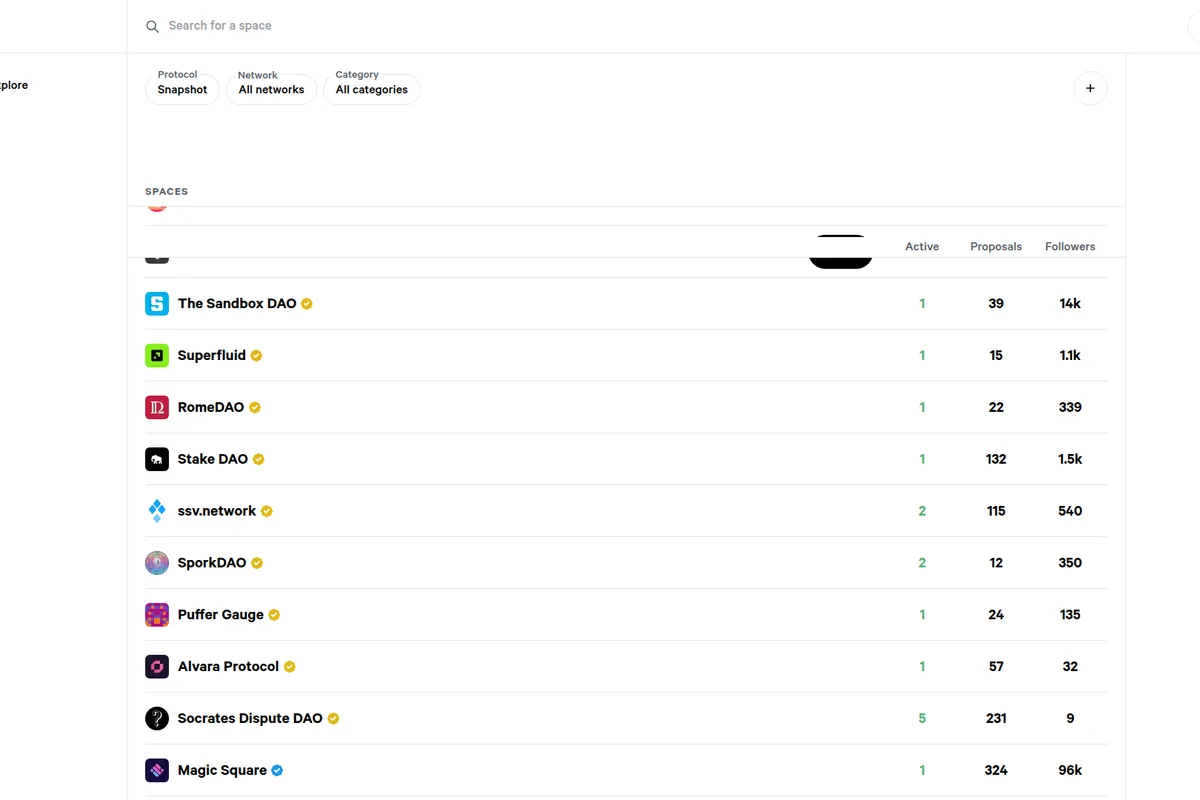
The explore view also gives a sense of the range of communities using Snapshot. Examples shown in the directory include large communities like Decentraland (35K members), The Sandbox DAO (14K), and Magic Square (96K), alongside much smaller spaces with tens of members or fewer. This distribution matters because it suggests Snapshot’s UI pattern can work for both early-stage collectives and mature ecosystems with large voter bases. [3]
v1 vs v2 interface transitions
Snapshot’s v1 interface includes prompts to switch to a newer interface and links indicating a v2 experience. From a product maturity standpoint, this suggests ongoing iteration. From a user standpoint, it can also introduce mild fragmentation if different communities link to different interface generations. [3]
Admin experience and self-service configuration
Pricing and fees
Snapshot usage is commonly described as free, particularly from the perspective of running proposals and collecting votes without gas costs for participants. Harmony explicitly stated that “the service is free to use,” while also noting an important practical nuance: new spaces may need to use or purchase an ENS name using ETH as a one-time expense. [4]
Adoption and scale
Snapshot’s usage metrics, as reported in the IPFS case study, are among the strongest indicators of product-market fit in Web3 governance tooling. The case study reports:
- 7M CIDs
- 5M votes cast
- more than 9K projects and DAOs on Snapshot (cited as over 9,645 projects)
- 63K proposals created
It also names example users including Gitcoin, Ethereum Name System (ENS), Aave, Uniswap, and Sushi. [2]
Separately, Snapshot’s own v1 directory view shows 72K spaces listed, which is consistent with broad adoption across many smaller or experimental governance spaces, even if not all are equally active. [3]
Third-party technology tracking can show different numbers depending on methodology. For example, Sumble’s tech page claims 380 organizations “using Snapshot” within its dataset, which likely reflects mentions rather than total platform activity. This discrepancy is not necessarily a contradiction, but it is a reminder to interpret third-party “usage” numbers based on how they are collected. [5]
Comparison with alternatives
Snapshot sits in a crowded governance tooling landscape, but its core niche is off-chain, gasless signaling paired with flexible voting power strategies. Alternatives often differ along two axes: whether governance is primarily on-chain, and whether the tool extends into broader DAO operations such as treasury management, member onboarding, or funding.
Tally
Alchemy lists Tally as an alternative and describes it as an “all-in-one tool that helps DAOs govern better.” For teams that want a more integrated governance cockpit, particularly around proposal lifecycle and on-chain governance visibility, Tally is frequently evaluated alongside Snapshot. [6]
Aragon
Aragon is framed by Alchemy as a platform that “enhances on-chain governance.” If your governance model requires binding execution and on-chain enforcement, Aragon-style on-chain systems can be a better fit, at the cost of higher complexity and, depending on design, more on-chain transactions. [6]
DAOhaus, Colony, and DAOstack
Commonwealth
Commonwealth is described by Alchemy as a platform for on-chain communities to discuss, vote, and fund projects together. Compared with Snapshot’s voting-first orientation, Commonwealth can be evaluated when discussion, community engagement, and funding workflows are first-class requirements. [6]
Ink Finance and broader “governance plus finance” platforms
How to choose
Snapshot tends to be a strong choice when:
- You want high participation with minimal friction (no gas for voting).
- You need flexible voting power computation and multiple voting types.
- You value transparent, auditable governance records stored on IPFS.
A more on-chain governance platform may be preferable when your priority is binding execution and direct protocol-level enforcement rather than signaling.
Final verdict
Snapshot is a mature, widely adopted governance voting platform that has become core infrastructure for a large portion of the Web3 ecosystem. Its off-chain signed-message model and IPFS-backed storage offer a compelling combination of low-friction participation and verifiability, and its strategy system enables governance designs that range from simple token-weighted votes to more complex token and NFT based schemes. [1] [2]
The platform is not without tradeoffs. It is typically “signal voting,” so communities need a clear execution layer and governance process around it. There is also a practical barrier to entry in the ENS requirement for creating spaces, plus real-world migration friction for teams coming from forks or legacy instances. [2] [4]