Background and history
As of early 2026, adoption signals are substantial. Google Play shows 10M+ downloads and a 4.7-star rating with roughly 138K reviews, and the Android app was updated Feb 19, 2026.[2] On iOS, the app listing (titled “Phantom - Trade Markets”) shows a 4.8-star rating from 55K ratings and is offered for free.[3]
At the same time, public reputation is notably split depending on where you look. App stores show strong satisfaction at scale, while Trustpilot displays a low TrustScore and a complaint-heavy narrative. This divergence is not unique to Phantom in crypto, but it is material for any user evaluating risk tolerance and support expectations.
Key features and services
Self-custody wallet for tokens and NFTs
Built-in dApp browser for Web3 exploration
Built-in swapping and staking
Expanded trading and finance features: predictions, perps, Terminal
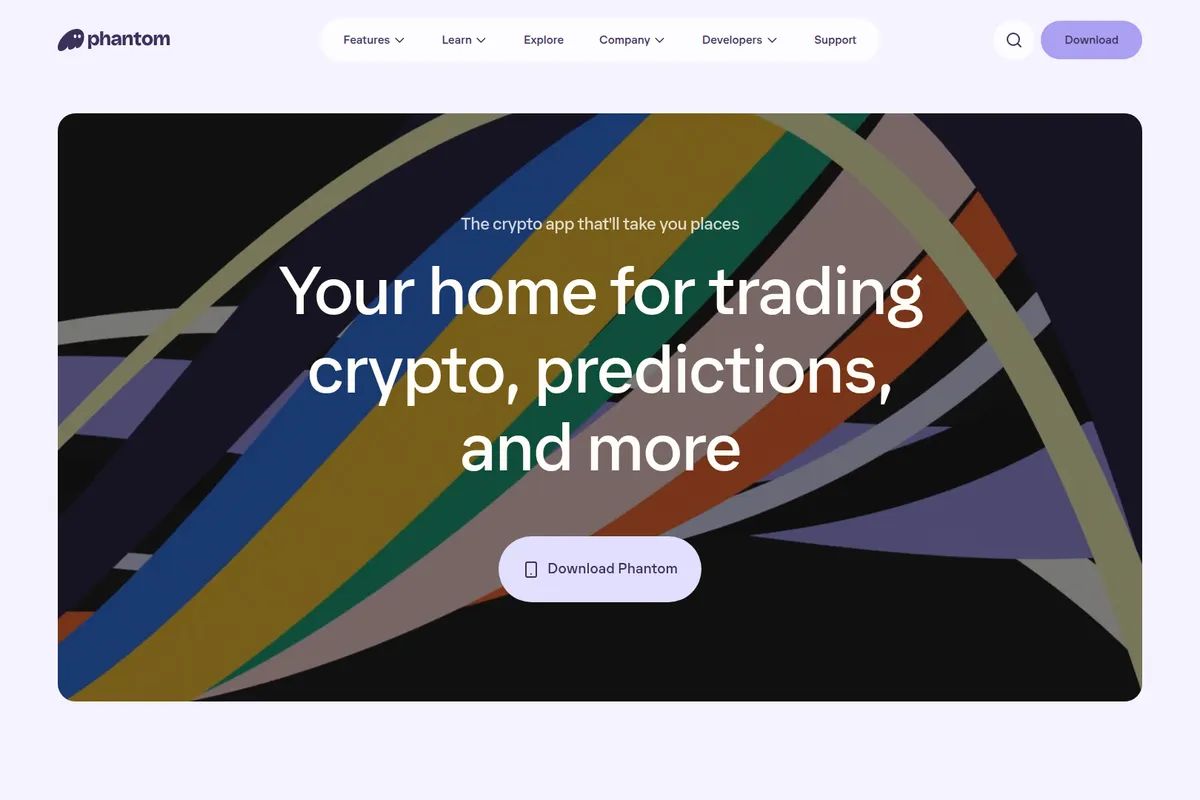
Phantom’s homepage shows the product suite broadening into trader-facing tools, including “Prediction Markets,” “Perps,” and a desktop “Terminal” experience accessible via trade.phantom.com.[1] This is an important evolution: Phantom is competing not only with wallets, but also with lightweight trading apps and on-chain power tools.
Phantom Cash: payments-style positioning
Security and trust
Security features Phantom advertises
These are meaningful, but users should interpret them correctly:
- Scam detection can reduce, not eliminate, risk. New scams and lookalike contracts evolve quickly.
- Ledger support helps protect the private key, but it does not automatically protect you from signing malicious approvals if you confirm them.
- Audits are positive, but the app-store listing does not name the firms or the scope in the captured text. Users who want deeper assurance typically look for detailed audit reports and clear vulnerability disclosure practices.
Privacy claims vs app-store disclosures
Phantom’s Google Play marketing copy says “Your privacy is 100% respected,” but Google’s Data safety panel indicates the app may collect and may share certain categories of data, including Location and App activity, and states that data is encrypted in transit. It also indicates users can request deletion.[2]
This is not necessarily unusual for a modern finance app, but it is a reminder to treat marketing language as aspirational. If privacy is a top priority, review the linked privacy policy and consider compartmentalizing wallets for different activities.
Reputation: app-store praise vs Trustpilot complaints
On app stores, Phantom’s ratings are strong at scale, 4.7 on Google Play and 4.8 on the Apple App Store, suggesting many users have a smooth experience.[2][3]
Two important nuances for readers:
- Trustpilot content can include spam and “recovery scam” patterns. The captured excerpts include suspicious “fund recovery” references and unrelated promotional language, which can reduce signal quality.[4]
- Even with noise, a consistent theme of user distress is still a risk indicator. In crypto, users often blame the wallet for losses that originate from phishing, spoof tokens, or malicious approvals, but wallets also control the clarity of warnings and the accessibility of support.
User experience
Phantom’s UX is widely described as approachable, and the high app-store ratings support that it succeeds for many mainstream users. Still, the same review ecosystems surface recurring pain points that matter if you plan to use Phantom as a daily driver.
What users like
In Apple App Store excerpts, users describe Phantom as user-friendly and as a way to move “off of the big exchanges,” implying that Phantom can serve as an on-ramp into self-custody for non-technical users.[3] On Google Play, at least one reviewer highlights that it works well and is easy to search and buy or sell.[2]
Common complaints and friction points
Across the captured reviews, several recurring issues appear:
-
Scam token exposure and “fake deposit” style tricks. An iOS reviewer warns about a fake deposit showing a large balance and suggests that interacting with the fake asset can lead to compromise.[3] While the precise mechanics can vary, the underlying risk is real: attackers can airdrop tokens or NFTs with malicious links or deceptive metadata.
-
Allegations of theft and dissatisfaction with investigative support. Another iOS excerpt claims funds were stolen despite cautious behavior and criticizes support’s ability to help identify what happened.[3]
-
Performance degradation. One iOS reviewer reports the app becoming slower over time, including delays in startup, balance refresh, wallet switching, and browser connections.[3]
-
Support accessibility confusion. A Google Play reviewer alleges there was “no way to contact support” and describes being routed to an unhelpful AI, while Phantom’s developer responses direct users to in-app support and help.phantom.com, stating they service every inquiry.[2]
-
Feature gaps vs exchange expectations. A Google Play review calls out missing total profit and loss reporting (only 24-hour P/L) and the inability to “sell and withdraw to your bank/debit card,” suggesting some users expect a brokerage-like off-ramp inside the wallet.[2]
Collectively, these point to a consistent theme: Phantom is easy to start with, but the edge cases, scams, and support interactions can be the deciding factors for power users and for anyone moving significant value.
Pricing and fees
Phantom is free to download on iOS and Android.[3][2] In practice, users should plan for three broad categories of cost:
- Network fees (gas) when transacting on supported chains.
- Swap-related price impact and routing costs.
- Wallet-level service fees for built-in swaps or “gasless” convenience modes, if applicable.
A third-party 2026 comparison focused on Phantom alternatives claims Phantom’s built-in swap can charge an “0.85% aggregator fee on select pairs,” and that “gasless swaps on Solana” can reach a “1.5% total fee” under some conditions, citing Phantom’s swapper FAQ as the origin.[5]
Comparison with alternatives
Because Phantom sits at the intersection of Solana-native usage and broader multi-chain ambitions, the “best alternative” depends on where you transact and what you value most: maximum dApp compatibility, lowest swap fees, advanced security UX, or specific ecosystem depth.
MetaMask, Rainbow, and Rabby (EVM-first)
If most of your activity is on Ethereum and EVM Layer 2s, EVM-first wallets can offer broader compatibility with EVM dApps and tooling.
- MetaMask is widely listed as a leading EVM-compatible wallet, and a third-party comparison cites a 0.875% swap fee.[6][5]
- Rainbow is positioned as a user-friendly Ethereum wallet with bridging and cross-chain swaps to L2s.[6]
- Rabby is described as a wallet for Ethereum and all EVM chains, often preferred by power users for richer transaction context.[6]
These can complement Phantom if you split activity between Solana and EVM, or replace it if you no longer need Solana-native UX.
Solana-centric options: Solflare and Backpack
Multi-chain consumer wallets: Coinbase Wallet, Kraken Wallet, Zerion
OneKey and Zengo (security model and fee positioning)
Final verdict
Phantom Wallet remains one of the strongest mainstream entry points into self-custody, especially for users interacting with Solana and for users who want a polished mobile app that combines NFTs, swaps, staking, and dApp browsing in a single place. App-store metrics are compelling, including 10M+ Android downloads and ratings near 4.8 across major stores, and Phantom continues to evolve into a broader trading and finance app with products like prediction markets, perps, and a desktop trading terminal.[2][3][1]
The main caution is that self-custody is unforgiving, and the environment is saturated with spoof tokens, malicious links, and approval-based drainers. Phantom advertises scam detection and Ledger support, but user reports still include scam encounters, theft allegations, performance complaints, and support friction. Trustpilot’s snapshot is particularly negative, although it also contains signals of unreliable content and Trustpilot explicitly states reviews are not fact-checked.[1][4]
For most users, Phantom is a solid choice if you follow best practices: use a hardware wallet for larger balances, treat unknown tokens as hostile, verify URLs, and keep a separate “hot” wallet for experimental dApps. If you are an EVM-only user, or if you prioritize ultra-low swap fees and highly defensive signing UX, it is worth comparing EVM-first wallets like MetaMask or Rabby, or fee- and hardware-oriented ecosystems highlighted in alternative guides.[6][5]