
Background and history
Operationally, Nansen appears to be run by NANSEN PTE. LTD., with Singapore listed in both its app store developer details and its Trustpilot profile. These pages list contact emails and addresses, but they do not, on their own, confirm corporate structure beyond the disclosed entity and location. [3] [4]
Key features and services
Wallet and entity labeling
Nansen’s own marketing and third-party profile text emphasize scale, commonly citing “500M+ labeled addresses.” This figure is presented as a product claim in marketing contexts rather than as an independently audited metric in the provided sources. [4] [3]
Smart Money dashboards and token research
Nansen also highlights token discovery and due diligence in its mobile app narrative. The Android listing emphasizes fast, conversational research, wallet and token analysis, and transaction decoding intended to make on-chain activity more interpretable for non-specialists. [3]
Smart Alerts and real-time monitoring
Alerts are a core part of Nansen’s value proposition because they reduce the need to constantly monitor dashboards. The 2026 review calls Smart Alerts central to real-time monitoring and references testimonials that describe “early warning” use cases. Nansen’s own site similarly highlights Smart Alerts alongside wallet labeling as essential tools for tracking real-time flows. [1] [2]
One prominently displayed testimonial claims Smart Alerts helped detect UST Curve pools being drained and “saved tens of millions of dollars” by exiting early. This figure is a marketing testimonial, not independently verified in the sources provided, so it should be interpreted as anecdotal rather than as a guaranteed outcome. [2]
Integrated trading and the “agentic” experience
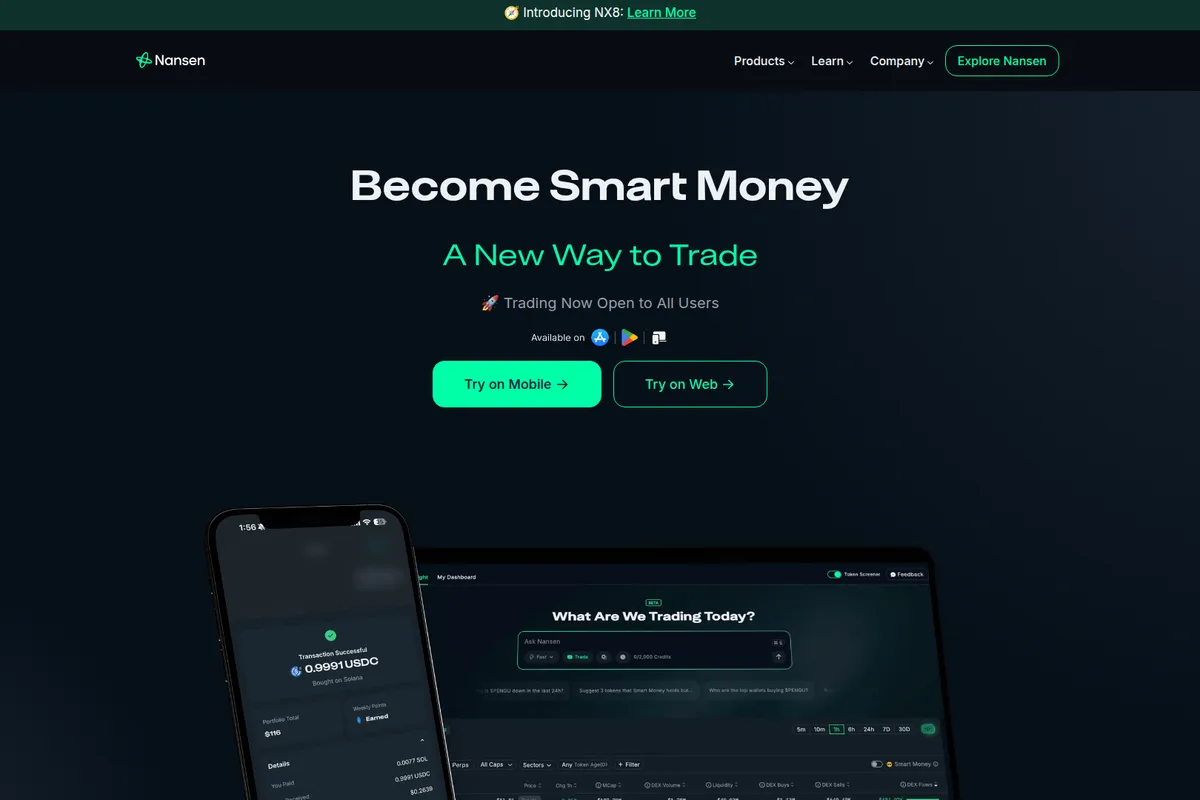
Nansen’s newer direction is combining insight and execution. On web, it markets a “Terminal Trading” experience, and on mobile it promotes “Agentic Trading,” where users ask natural-language questions and execute trades within the same app. [2]
Security and trust
What Nansen can and cannot guarantee
Data handling disclosures (mobile)
The Android app listing includes a developer-provided “Data safety” disclosure: it states some data types may be collected (including personal info), some data types may be shared (including messages and app activity, among others), data is encrypted in transit, and users can request deletion. These disclosures are useful for setting expectations, but they are not equivalent to an independent privacy audit. [3]
Customer sentiment signals
Trustpilot provides a limited but important window into user sentiment. As captured, Nansen shows a low TrustScore graphic around 2.5 out of 5, with a displayed numeric rating around 2.7 and only 8 reviews, plus a platform warning that the company “may be associated with high-risk investments.” Trustpilot also indicates the company has not replied to negative reviews. Because the sample is small, it should not be treated as statistically representative, but the recurring themes matter. [4]
On the positive side, Trustpilot also includes strong endorsements calling Nansen a go-to analytics product and praising the agentic experience and trading, as well as a long-term user stating they have used it for years. The overall picture is polarized. [4]
User experience
Nansen’s UX story is essentially a tradeoff between power and complexity.
The mobile direction is clearly aimed at reducing this friction. Nansen AI on Android is marketed as a conversational, “under 30 seconds” flow that blends answers with execution, plus portfolio review and transaction decoding. If it works as intended, this approach can make on-chain analytics more accessible to traders who do not want to live inside complex dashboards. [3]
Pricing and fees
Subscription plans
A 2026 review reports that Nansen simplified its structure into a Free plan and a single paid Pro plan. It cites Nansen Academy materials stating Pro starts at $49 per month when billed annually, or $69 per month when billed monthly. The review frames Free as suitable for learning and light research, with Pro intended for active traders, analysts, and teams that need fuller access to labels, alerts, and premium analytics. [1]
Trading fees
Nansen publishes a trading fee schedule of 0.25% for Free users and 0.10% for Pro users. A 2026 review also cites Nansen Academy as stating trading opened to all users on Jan 21, 2026, with fees differentiated by plan. [2] [1]
Comparison with alternatives
Nansen sits at the intersection of on-chain analytics, wallet intelligence, and now trading. Many “alternatives” only cover one slice of that.
Dune Analytics (custom dashboards)
DeBank (portfolio and DeFi positions)
For users whose primary need is tracking DeFi holdings across lending protocols, stablecoins, margin platforms, and DEXes, DeFiPrime positions DeBank as a DeFi portfolio dashboard alternative. This is a materially different job than Smart Money flow tracking. If you mainly want “what do I hold and where,” portfolio-first tools can be more direct. [5]
Token Terminal (fundamentals)
If your workflow is more equity-analyst-like, focused on protocol financial metrics rather than wallet flows, DeFiPrime lists Token Terminal as an analytics dashboard with traditional financial metrics on cryptoassets and DeFi products. This is often complementary to Nansen rather than a strict replacement. [5]
APY.Vision and Bloxy (specialized analytics)
Free tools comparisons and “value” debates
Some Trustpilot reviewers claim Nansen’s functionality overlaps with free tools like Arkham and Dune. This is an opinion, and feature parity depends heavily on the exact workflow, chain coverage, and labeling depth you need. Still, it highlights a real buyer consideration: on-chain analytics is a fast-moving category, and the decision to pay often comes down to the quality of labeling, the time saved, and the reliability of alerts. [4]
Final verdict
Nansen remains one of the more distinctive on-chain analytics platforms because of its labels-first thesis: turning noisy public blockchain data into faster, more contextual intelligence. For active traders and analysts who make decisions based on flows, entity behavior, and early monitoring, Nansen’s combination of wallet labeling, Smart Money dashboards, and Smart Alerts can be genuinely time-saving and can support a repeatable due diligence workflow. [1]
Its 2026-era push toward embedded execution is strategically coherent. Nansen markets a unified research-and-trade experience, including mobile agentic prompts and in-app swaps, with published trading fees of 0.25% for Free and 0.10% for Pro. If you value speed and fewer tool handoffs, that integration can be a differentiator. [2] [3]
The main caveats are also clear. First, the platform is not “set and forget.” Users can overwhelm themselves with dashboards, and labels are not guaranteed to be perfect, so disciplined interpretation and cross-checking remain necessary. Second, prospective customers should not ignore the Trustpilot signal, even if the sample is small: repeated complaints about cancellation, billing, and support responsiveness are risk factors for any subscription product, particularly one adding trading. [4]