Background and history
Mintify (mintify.xyz) presents itself as a “
digital asset trading
platform” built to consolidate onchain markets into a single consumer and developer experience, spanning
cryptocurrency trading, NFT trading,
minting workflows, and
cross-chain activity. While many products in this category began as single-chain NFT dashboards or marketplace front ends, Mintify’s messaging has broadened into a unified “onchain trading terminal,” with a web app that emphasizes discovery, analytics, and execution in one place.
[1] [2]A key point for users researching the brand is that Mintify exists alongside a recurring
scam pattern in the broader NFT space: scammers sometimes use “Mintify” in page names or URLs on unrelated domains to create credibility through name similarity. One community warning explicitly notes that there is a legitimate site with “mintify” in the name, and that scammers may exploit this confusion when targeting artists.
[3]From a corporate and ecosystem narrative standpoint, Mintify’s public communications also highlight expansion beyond NFTs into a broader onchain economy. In a March 25, 2025 press release announcing the launch of the $MINT
token, Mintify reported “over $100M in NFT
volume” and “350k unique wallets,” and described growth tied to the emergence of Bitcoin Ordinals and an
acquisition of competitor Magically.
[4]Key features and services
Mintify’s feature set, as described across its marketing site and web app, is best understood as four layers: (1) discovery and
market data, (2) execution and routing, (3) minting and creator distribution, and (4) developer and institutional infrastructure.
1) Discovery, analytics, and “trading terminal” UI
On the consumer side, Mintify highlights “discover and trade millions of
digital assets,” and the app experience surfaces market overview tables, trending lists, and category navigation that spans multiple
asset types and onchain themes. This positions Mintify not only as an execution venue, but also as an aggregation layer for market visibility across ecosystems.
[1] [2]A differentiator in the messaging is the breadth of coverage. Mintify states it supports “69+” blockchains, and it names major ecosystems including Bitcoin, Ethereum, Solana, and Hyperliquid. For users, this matters because many NFT tools are still primarily Ethereum focused, and many crypto swap interfaces remain EVM centric. If Mintify’s coverage is as extensive as claimed, it is aiming at the “one terminal for everything” market segment rather than a single-chain niche. [1]
2) Trading, swapping, and bridging
Mintify’s consumer feature claims include the ability to buy crypto, trade NFTs, swap, and bridge between networks. The product framing implies that it routes or aggregates across third-party venues to deliver “deep
liquidity,” rather than operating purely as a standalone marketplace. This kind of aggregation can be valuable, but it also means execution quality, fees, and final outcomes can depend on the downstream marketplaces,
bridges, and liquidity sources used behind the scenes.
[1]Mintify also advertises email-based onboarding and “1 click” buying. That language typically indicates a more streamlined consumer flow than traditional self-custody trading, but the provided sources do not specify
custody model details (for example, whether trades are always executed from a connected
wallet, or whether some onboarding path introduces a
custodial or embedded wallet). Users should treat “1 click” as a UX goal rather than a guarantee of simplicity in every jurisdiction, chain, or asset type.
[1]3) Portfolio tracking
Mintify markets a
portfolio feature that tracks cryptocurrencies and NFTs with real-time asset prices. For
multi-chain users, portfolio support is often the “glue” that keeps a trading terminal relevant, because it reduces the need to jump between wallet explorers, marketplaces, and token trackers. Still, portfolio accuracy depends on reliable price discovery and metadata for long-tail tokens and NFT collections, especially across many chains.
[1]4) Mintify Launchpad for minting and creators
Mintify includes a “Launchpad” module, promoted as a place to mint NFT collections and discover new drops. The marketing site also provides examples of launchpad projects and fundraising figures, such as Fugz raising $500,000 and Dreamilio raising $200,000 (with launch months shown, but not the year in the excerpted material). For creators, a launchpad can be a distribution channel and a tooling layer, but the practical value depends on curation quality, audience fit, and how primary sales are handled. [1]
5) Developer APIs and “built for agents” infrastructure
Mintify’s developer pitch is unusually prominent for a consumer trading app. It markets a “Powerful
API” spanning analytics to programmatic trading, with language geared toward automation and agents. Claimed capabilities include real-time and historical data, wallet analytics, cached metadata, and “deep liquidity from multiple markets” through a single endpoint. In the 2025 $MINT announcement, Mintify further discussed making parts of its infrastructure public, including trading APIs, digital asset orderbooks, and a developer SDK.
[1] [4]For teams evaluating Mintify as infrastructure, the key questions are not only feature breadth but also uptime, rate limits, data quality on long-tail assets, and the true depth of execution access. Those specifics are not detailed in the provided sources, so prospective integrators should validate with
documentation, SLAs (if available), and a trial.
6) Institutional positioning
Mintify also markets “Institutional Solutions,” including infrastructure for RWAs (tokenized real-world assets), trading APIs, and asset issuance. That is an ambitious scope, and it suggests Mintify is attempting to sit at the intersection of consumer trading UX and backend rails for tokenized markets. In practice, institutional adoption tends to require strong compliance posture, clear legal entities, robust custody and
settlement options, and audited controls, none of which are described in detail in the materials provided here.
[1]Security and trust
Security and
trust for Mintify should be evaluated on two tracks: (1) the legitimacy and safety signals of Mintify’s actual web properties, and (2) the broader ecosystem risk of impersonation scams using similar names.
Automated safety signals for Mintify subdomains
One of the few structured, third-party safety snapshots in the provided research is ScamAdviser’s automated review of beta.mintify.xyz. ScamAdviser assigned a Trustscore of 54/100 (labeled “fair”) and stated the site is “probably not a scam but legit,” while also emphasizing that this is an automated assessment and not a guarantee. It flagged positives such as a valid SSL certificate and DNSFilter labeling, and it also flagged negatives such as low Tranco
rank and iframe detection, plus a general warning that crypto services carry higher scam risk.
[5]Automated trust tools are best used as a starting point. For a trading terminal that may involve wallet connections and transaction signing, the more practical security checks include verifying the exact domain, avoiding links from unsolicited messages, reviewing wallet permissions, and confirming that you are interacting with official social accounts and documentation.
Impersonation risk and “Mintify” branded scams
Separately, there is documented evidence of scams that use Mintify-like branding to target creators. A DeviantArt scam warning describes a common scheme: a
scammer offers to buy art for an unusually high price, then insists the artist mint NFTs on a specific site that charges a high fee. The author explicitly warns that the scammer may rely on confusion with a legitimate Mintify-named site. This warning is about a different domain (brand.site/mintify), but the pattern is directly relevant to anyone searching “Mintify minting” and clicking unfamiliar links.
[3]In other words, the biggest user risk is not necessarily that Mintify itself is illegitimate, but that scammers exploit the name category and the urgency around mints, drops, and “buyers.” The safest approach is to navigate directly to known official domains (mintify.com, mintify.xyz, app.mintify.com) and to treat any third-party “mintify” URL as suspect until verified.
Ecosystem governance and token considerations
Mintify’s $MINT token launch adds both an ecosystem growth lever and a complexity layer. The March 25, 2025 announcement states the token initially launched on Solana and is tied to access, settlement benefits, and launchpad participation. The same release describes the Mintify Foundation as a non-profit organization and is datelined Grand Cayman, Cayman Islands. For users, that raises standard token risks:
volatility, evolving utility, and the need to understand token economics before participating in claims or incentives.
[4]User experience
Mintify’s UX goal is
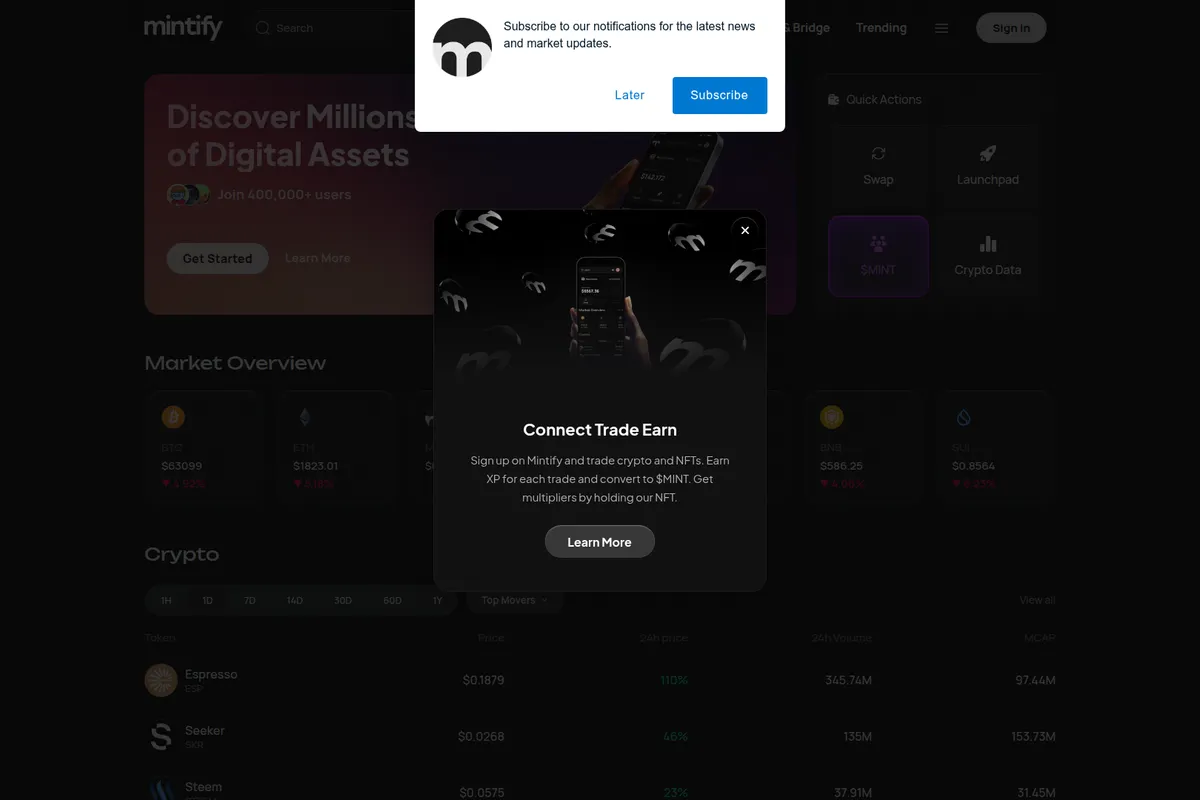
consolidation. The app front page highlights discovery and quick navigation into modules such as Swap, Launchpad, $MINT, and crypto data, reinforcing that the platform is not only for NFT traders or only for token swaps, but for users who want one dashboard for both. That “unified terminal” approach can reduce fragmentation for multi-chain users, but it also makes product clarity harder. A single interface that tries to cover mints, secondary NFTs, token swaps, bridging, portfolio, and incentives can feel busy, especially for users who only want one task done quickly.
[2]Mintify also markets “1 click” buying after email-based
account creation. This is generally positive for onboarding, but users should still expect that onchain trading involves transaction signing,
slippage, bridge
confirmation steps, and
network fees depending on chain and asset type. Mintify’s actual ease of use will therefore depend on how well it abstracts these complexities, and on which networks and wallets a user relies on.
[1]Pricing and fees
The provided sources do not offer a complete, user-facing fee schedule for Mintify. That is an important gap for a trading platform, because total cost often includes multiple layers:
- Network gas fees (vary by chain)
- Bridge fees and bridge spread (if bridging)
- DEX aggregator or marketplace routing fees (if routing externally)
- Marketplace fees and creator royalties (for NFTs, depending on venue and collection settings)
- Any Mintify platform fee or spread (if applicable)
Mintify does claim “deep liquidity” via third-party marketplaces, which suggests some trades may be routed outward. In such designs, the user experience can be smooth while costs are influenced by the underlying execution path. Prospective users who care about fees should test with small transactions first, compare quotes against known alternatives, and carefully review transaction previews before signing. [1]
One fee-related point that is relevant for safety, even though it is not about Mintify’s official site, is the scam pattern described in creator communities: high “minting fees” demanded by scam sites that claim to be part of an NFT buyer flow. Any platform asking for unusually large upfront fees to “receive” a buyer should be treated as a red flag. [3]
Comparison with alternatives
Because Mintify spans multiple functions, “alternatives” depend on what you actually use it for.
If you mainly want NFT analytics and tracking
Alchemy’s dapp directory lists many Mintify alternatives in the NFT analytics category. Examples include icy.tools (NFT tracking and analytics), NFTGo (NFT data aggregator), CryptoSlam (NFT aggregator), NonFungible (NFT data resource), and specialized rarity tools like rarity.tools and Rarity Sniper. Alerts-focused tools such as Ninjalerts and RoverX are also listed, which can be useful if your workflow is more about real-time monitoring than dashboard analytics. [6]
These tools are often narrower than Mintify’s “terminal” concept, but that can be a strength. If you only need rarity ranking or sales aggregation, a dedicated product can be faster and clearer.
If you want execution plus aggregation
Mintify’s closest conceptual peers are other “unified trading” experiences that combine discovery with execution. The provided sources do not list direct terminal-style competitors, so the best comparison you can do from this dataset is functional: compare Mintify’s swap quotes and NFT purchase flows against whichever DEX aggregators and NFT marketplaces you already use, then decide whether Mintify’s consolidation is worth any incremental costs or added trust surface.
Beware of mismatched competitor lists and name confusion
Not all “Mintify competitor” search results are reliable. One competitor list in the research set appears mismatched, naming large DeFi protocols and
centralized exchanges as Mintify “competitors,” which likely reflects a taxonomy or data mapping error rather than real substitutability.
[7]Similarly, there is frequent confusion between Mintify and Mintlify (an API documentation product). Mintlify alternatives listed on G2 are relevant to documentation tooling, not onchain trading. This matters because users can end up reading the wrong “alternatives” article and making incorrect assumptions about what mintify.xyz is. [8]
Final verdict
Mintify is best viewed as an ambitious attempt to build a unified onchain trading terminal that spans crypto and NFTs, backed by a multi-product strategy that includes launchpad minting, developer APIs, and institutional messaging. Its public narrative includes meaningful traction claims, including 400,000+ users on its site and app, and a 2025 press release citing over $100M in NFT volume and 350k unique wallets. It also expanded its ecosystem story through the $MINT token launch on March 25, 2025 and the formation or promotion of the Mintify Foundation, described as a Cayman Islands datelined non-profit. [1] [2] [4]
Where Mintify is weaker, based on the provided research set, is in publicly verifiable transparency around fees and the practical execution path for “deep liquidity” routing, as well as the unavoidable trust challenge created by widespread NFT scam patterns that reuse similar branding. ScamAdviser’s automated review of a Mintify subdomain is mildly positive but not decisive, and it underscores that users still need to apply careful operational security when connecting wallets and signing transactions. [5]
For experienced onchain users who value consolidation and cross-chain discovery, Mintify is a credible platform to evaluate, especially if you verify domains and test with small amounts first. For creators approached by unsolicited “NFT buyers,” the safest stance is skepticism: do not mint on unfamiliar sites, and treat name similarity to known platforms as a common scam tactic rather than reassurance. [3]