Background and history
Key features and services
Metaplex’s feature set can be grouped into two broad buckets: (1) digital-asset standards and tooling (historically NFT-centric), and (2) token launch mechanics aimed at fairer, more transparent distribution.
Token launches on Solana and the SVM
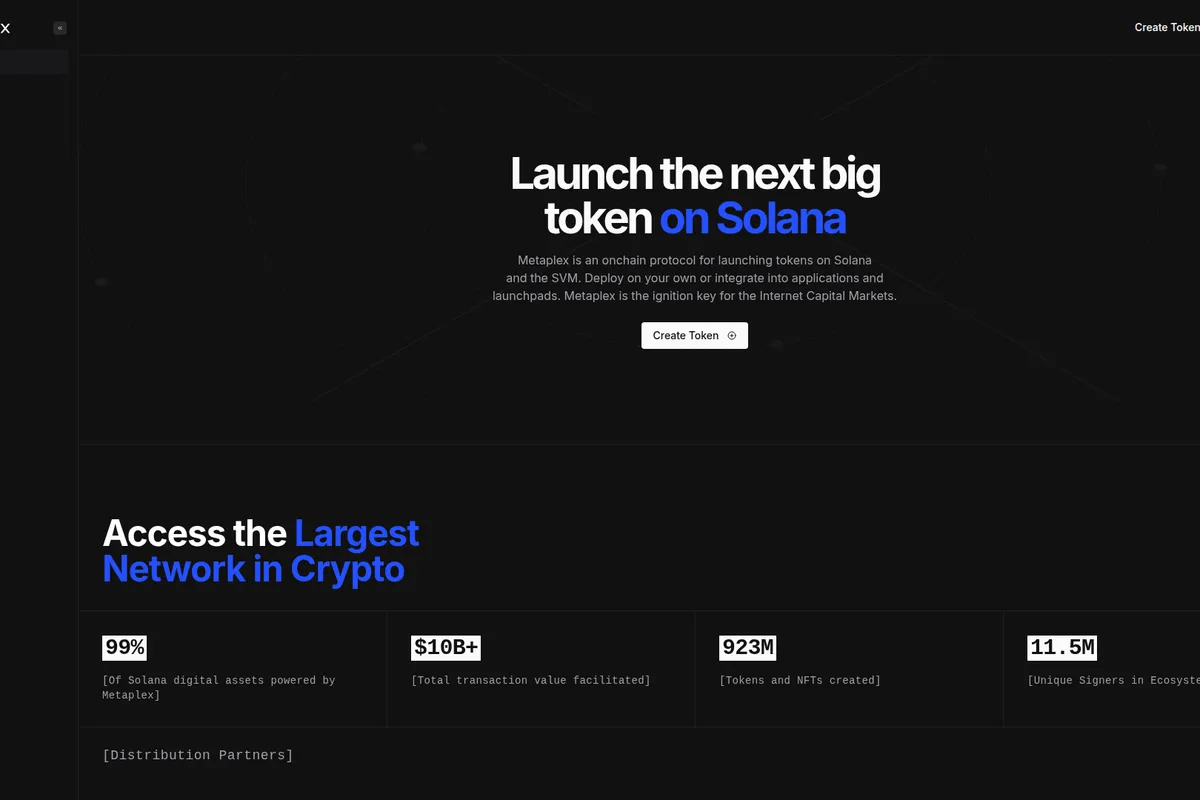
Metaplex’s homepage emphasizes launch infrastructure that can be embedded into third-party apps or used directly by teams. It explicitly calls out common failure modes in launches, including bot sniping, insider advantages (for example bundling and front-running), and confusing “handrolled smart contracts” that lead to unclear sale mechanics. [1]
Metaplex highlights three launch mechanisms:
- Launch Pool: Described as an uncapped sale method with organic price discovery and pro-rata allocations based on deposits, and it claims “no front running and sniping because everyone gets the same price.” [1]
- Auction: A time-based auction with sealed bids, a single clearing price, and tokens distributed at the clearing price once the supply is filled. [1]
- Presale: A fixed-price, first-come-first-serve option with optional caps and wallet gates, positioned as a simpler approach that can reduce speculation. [1]
NFT creation, storefront tooling, and creator primitives
These listings also highlight:
- Self-hosted storefronts: Marketed as being as easy as building a website, which signals a focus on brand ownership and direct distribution rather than relying on a centralized marketplace. [4]
- Drag-and-drop NFT creation tools: Positioned for ease of use and Solana connectivity. [5]
- On-chain creator splits and royalties: Described as a way to tag collaborators and set percentage splits, reducing administrative overhead in multi-contributor drops. [4]
- Media storage via Arweave: The listings describe NFT media being stored “permanently” with Arweave. In practice, users should verify the specific data layout for their implementation, because “permanent” storage can involve a combination of on-chain metadata and external decentralized storage. [5]
Ecosystem scale and integrations (as reported by Metaplex)
Metaplex publishes headline metrics that aim to demonstrate broad adoption:
- “99% of Solana digital assets powered by Metaplex”
- “$10B+ total transaction value facilitated”
- “923M tokens and NFTs created”
- “11.5M unique signers in ecosystem”
These figures appear on the official site and should be interpreted as protocol ecosystem metrics rather than a single app’s user count. [1]
In its 1H 2025 recap, Metaplex also lists examples of integrations and use cases, including claims that Pump.fun token launches use Metaplex standards, and that various launch and NFT platforms have added or expanded support for newer Metaplex standards. [2]
Security and trust
Audits and “battle-tested” claims
Gate Learn adds a specific audit mention, stating that Metaplex Core was audited by Mad Shield. This is helpful context, but it is still best practice to locate the underlying audit report and confirm scope, version, and remediation status before relying on any smart-contract system in production. [3]
Reputation and public review signals
A separate “trust” nuance appears in directory pages, which include “claim this page” prompts, and Trustpilot also labels the profile unclaimed. That does not imply wrongdoing, but it can mean fewer official responses and less complete support information on those platforms. [4] [6]
User experience
Metaplex’s user experience depends heavily on who you are.
For creators and brands
That said, Metaplex is not one monolithic product experience. Many creators interact with Metaplex indirectly, through marketplaces, mint sites, launchpads, or creator tools built on top of Metaplex standards. This can improve reach but also makes support and troubleshooting more complex, because issues may be caused by the integrating application rather than Metaplex itself.
For developers and launchpads
The tradeoff is that “protocol infrastructure” generally requires engineering and operational maturity. Launch designs still need careful parameterization, vesting choices, distribution strategy, and bot-resistance measures that fit the specific community. Metaplex can provide primitives, but it does not eliminate execution risk.
Pricing and fees
Metaplex does not present itself like a typical SaaS subscription with a clear monthly price in the provided sources. Instead, costs are implied to be usage-based and chain-dependent.
NFT minting costs and “no platform fee” messaging
Protocol fees and DAO buybacks
Metaplex’s 1H 2025 recap provides more concrete information about protocol economics. It states that Metaplex earns a protocol fee with almost every new token and NFT created on Solana and the SVM, and that 50% of those fees are used to buy back MPLX for the Metaplex DAO. The recap reports $13.7 million in revenue or protocol fees in Jan to Jun 2025, alongside $2.9 billion in transaction value across 121 million signed transactions. [2]
Comparison with alternatives
Because Metaplex spans multiple categories, alternatives depend on what you are trying to do.
If you want a creator marketplace or storefront suite
SourceForge and Slashdot list several creator-focused NFT platforms and marketplaces as Metaplex alternatives:
- Blockparty is framed as a Web3 tool suite for creators and brands to sell or auction items, run drops, and accept payments in USD and crypto, with flexible minting options on Ethereum and Flow. [7]
- Rarible is presented as a creator-centric NFT marketplace with community governance and a native token (RARI). [8]
- Verisart emphasizes minting plus Certificates of Authenticity, supports Ethereum and Polygon, and shows a starting price of $9.99 in the directory listings, with a noted constraint around Shopify’s NFT beta program for minting. [7]
- SolSea is described as a Solana NFT marketplace that allows creators to embed licenses at mint time and highlights low-fee transactions. [7]
Compared with these, Metaplex is often the underlying standard rather than the destination marketplace. If you want an out-of-the-box marketplace with built-in discovery and consumer UX, marketplaces like Rarible or SolSea are more direct “end-user products.” If you want deeper control and Solana-native infrastructure, Metaplex can be the base layer on which you build that storefront or integrate with others.
If you want auctions on Solana
If you are comparing “infrastructure projects” broadly
Final verdict
Where Metaplex is weaker is in easily verifiable consumer support sentiment within the provided research set. The only direct review content shown is a single 2021 Trustpilot post with a serious scam allegation, and the profile is unclaimed. That does not outweigh the protocol’s apparent ecosystem traction, but it is a reminder that users should evaluate the specific application they interact with, confirm official channels, and perform due diligence on any token launch or NFT drop, regardless of the underlying standard. [6]
For builders and serious creators operating on Solana, Metaplex is best evaluated as core infrastructure: a set of standards and launch primitives that can reduce bespoke smart contract risk and accelerate launches, with costs that are generally aligned with Solana’s low-fee environment but still influenced by protocol fees and implementation choices. For users who primarily want a simple place to buy and sell NFTs, a dedicated marketplace alternative may be the more straightforward route, even if Metaplex remains part of the underlying stack.