Background and history
That dual identity matters for users evaluating Farcaster: there is the underlying network and protocol, and then there are apps that sit on top of it. Farcaster’s strategy discussions in late 2025 added another layer to this story, suggesting the team was reconsidering how to balance the “social network” experience with wallet-led growth. [4]
Key features and services
Protocol-level portability and multi-client ecosystem
Coinbase’s educational overview reinforces this concept by describing Farcaster as “a protocol that facilitates the creation and connection of social media apps,” where users can switch between apps without losing their data or audience. [5]
In practice, this creates a split between:
- The network and its rules (identity, storage, signing, and hub synchronization).
- A set of competing or complementary apps and clients that offer different user experiences.
CoinLaunch highlights Warpcast as a major client, with an interface resembling X (Twitter), where posts are called “casts” and reshares are “recasts.” [2]
Hybrid architecture: on-chain registries plus off-chain Hubs
- Id Registry, for registering, transferring, and recovering accounts.
- Storage Registry, for tracking storage rents paid at account creation and used for interactions.
- Key Registry, for tracking keys registered to apps and controlling what an app can do on a user’s behalf. [6]
The off-chain side of the system is the Hub network. QuickNode describes Hubs as open-source, decentralized, distributed peer-to-peer nodes that store and serve Farcaster data, sync state across nodes, and can be run by any user to read and write data via APIs. It points to “Hubble” as an example Hub implementation. [6]
Frames: interactive mini apps inside posts
One of Farcaster’s most distinctive product innovations is Frames. Frames are described as embedded, interactive mini apps inside posts, making it possible to create app-like flows directly in the feed.
CoinLaunch states Frames were unveiled on January 26, 2024, and describes them as interactive mini applications for individuals and developers. It also attributes a major usage increase to Frames, citing Dune data and claiming a 1,722% surge in daily users from 2,932 (Jan 26, 2024) to 50,504 (June 2, 2024). [2]
QuickNode adds helpful specificity: a frame is essentially a web app embedded into a cast, with examples like a mint NFT button or a one-click DAO vote, and notes Frames must comply with OpenGraph standards to render properly. [6]
For the ecosystem, Frames can be a meaningful differentiator because they blur the line between social posting and onchain actions, turning the feed into a distribution layer for crypto-native interactions.
Wallet integration and the “Discover. Trade. Create.” positioning
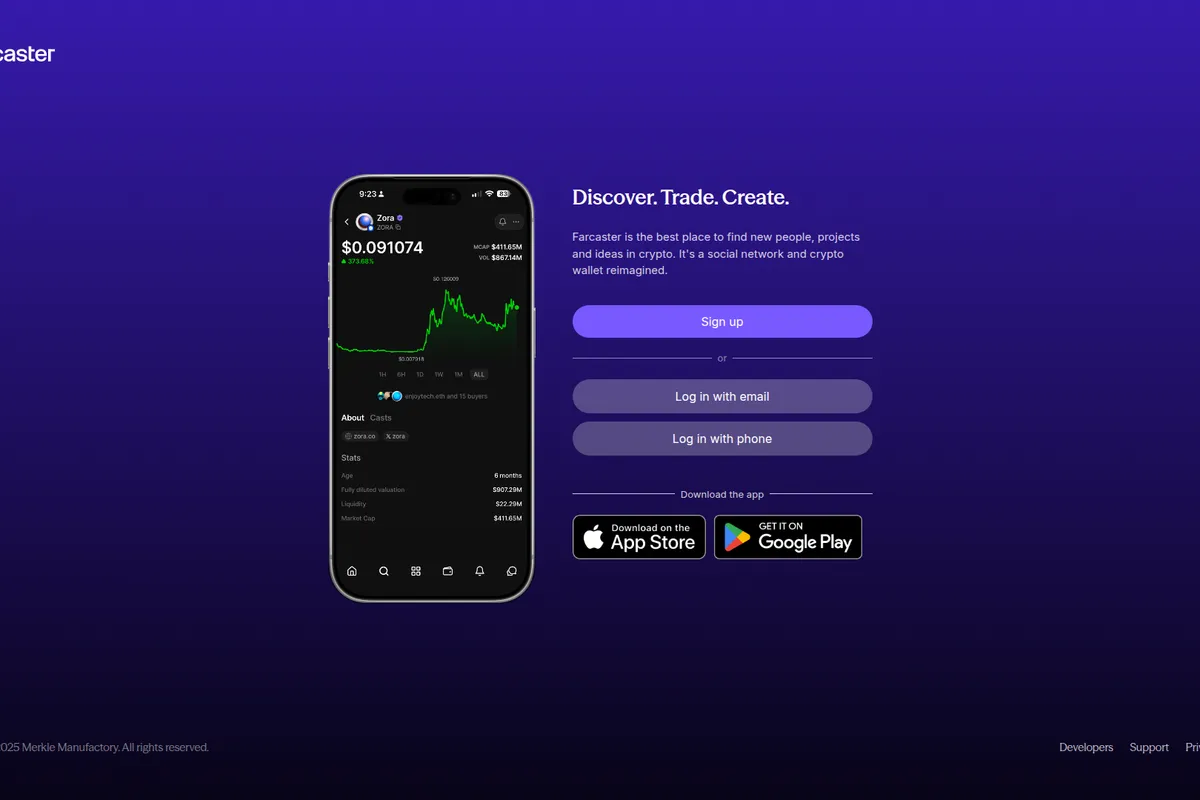
Farcaster’s own website emphasizes discovery, trading, and creation, explicitly describing the product as a social network and crypto wallet reimagined. It also shows login via email or phone alongside app download calls to action. [3]
This wallet-first direction could strengthen Farcaster’s “crypto home base” narrative, but it also creates community tension if users perceive the network drifting from social discourse toward trader tooling. ForkLog described mixed reactions, with supporters viewing it as pragmatic, and critics worrying about cultural shifts and a tool “solely for traders.” [4]
Security and trust
“Sufficient decentralization” and censorship resistance
QuickNode’s explanation provides the practical basis for these claims: accounts and permissions are anchored to on-chain registries, while state and content distribution run through a peer-to-peer network of Hubs that anyone can operate. [6]
Smart contract audits and onchain components
Network and scaling context
On-chain components are described as deployed on Optimism mainnet in QuickNode’s overview, while ForkLog notes the protocol operates on Ethereum L2 networks, including Base. [6] [4]
User experience
Onboarding: app-first, but protocol-native under the hood
Farcaster’s own site is clearly optimized for mainstream onboarding, featuring iOS and Android download links and login options using email or phone. [3]
For everyday users, the important question is how well the consumer app abstracts away crypto complexity without undermining self-custody and portability. Farcaster’s “social network plus wallet” framing suggests the product wants to be that bridge.
Social primitives: casts, channels, and app extensibility
Terminology and primitives are straightforward once learned: casts are posts, channels are groups, and frames are embedded web apps. [6]
Pricing and fees
Farcaster is not described as “free forever” in the way many mainstream social networks are. Instead, sources emphasize economic friction as a deliberate anti-spam and sustainability mechanism.
CoinLaunch echoes the same concept and adds a practical note that while the fee is cited as $5, it can be closer to $6 when paid via Apple Pay or Google Pay, while also referencing restricted posting for new accounts. [2]
For users, this model has two implications:
- Bot resistance can improve because mass account creation is not free.
- Adoption can be slower at the margin because there is a paywall, even if small.
Funding, traction signals, and token status
This is neither inherently good nor bad, but it does affect expectations. Users looking for a token-driven social economy should treat Farcaster as a product and protocol first, not as a guaranteed token thesis.
Finally, ForkLog introduces a more cautionary business signal: it reports Q4 revenue of $1.84 million, down 85% year over year, and references earlier reporting that monthly revenue declined 96% from a February peak to October 2024, citing DefiLlama for the metrics. [4]
Comparison with alternatives
Because Farcaster is both a protocol and an app ecosystem, “alternatives” can mean very different things. The most useful comparisons are at the protocol level.
Lens Protocol (closest crypto social graph peer)
How to choose between them (based on the cited framing): if you primarily want a crypto-native social graph protocol with an emerging multi-app ecosystem, Lens is the most direct alternative to evaluate alongside Farcaster. [7]
Bluesky and the AT Protocol (open social, different stack)
Slashdot’s alternatives list includes Bluesky and the AT Protocol, emphasizing free access, customizable feeds, moderation lists and content filters, and portability across hosts while retaining identity and connections. [8]
These alternatives are less about onchain identity and more about open networking and algorithmic choice. They can be a better fit for users who want open social mechanics without crypto wallet integration as the organizing principle.
ActivityPub, nostr, and Hive-based social (Ecency)
These ecosystems can be compelling for users who prioritize federation (ActivityPub), relay-based social (nostr), or built-in token reward economies (Hive). They are not drop-in replacements for Farcaster’s specific blend of EVM identity, hubs, and Frames.
Final verdict
Farcaster stands out as one of the most ambitious attempts to make social media portable. The consistent thread across sources is that it is meant to be a protocol, not just an app, enabling identity and audience portability across clients and offering developers a foundation to build on. [1] [5]
Product-wise, Frames are the clearest differentiator, turning posts into interactive surfaces that can trigger crypto-native actions and experiences, and they are credited in third-party coverage with significant user growth during 2024. [2] [6]
For crypto-native users who want a social layer tightly integrated with onchain identity, interactive content, and an app ecosystem that can evolve beyond a single client, Farcaster remains a leading contender. For users who want an open protocol without crypto-first design constraints, AT Protocol or ActivityPub ecosystems may feel simpler. And for those specifically choosing between crypto social graphs, Lens is the most direct peer to compare head-to-head. [7] [8]