Naming Service

Ethereum Name Service (ENS) Review

ens.domains8.4/10February 24, 2026

Objective 2026 review of ENS (ens.domains), covering features, ENSv2 roadmap, security risks, fees, integrations, and top decentralized naming alternatives.

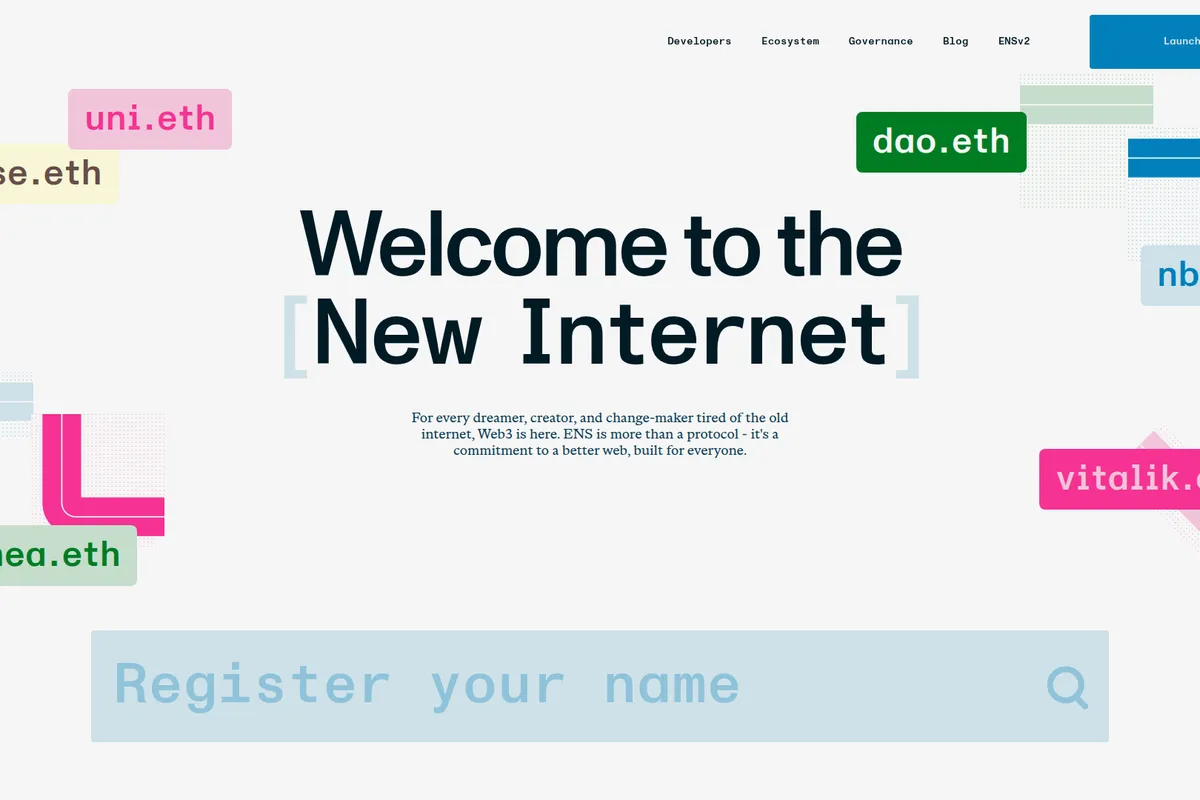
Ethereum Name Service (ENS) screenshot

Background and history

Ethereum Name Service (ENS) is a decentralized naming system built around the idea that most people should not need to copy and paste long hexadecimal addresses to use crypto. Instead, ENS lets you register and use a human-readable name like name.eth, then map that name to wallet addresses and other records that supporting apps can resolve automatically. The official site frames this as identity infrastructure that is “anchored in Web3, but works across the internet,” emphasizing personal ownership and portability across services. [1]
In 2026-oriented coverage, ENS is increasingly positioned as more than a payment convenience. Review-style analysis describes it as a core Web3 identity primitive used across logins, profiles, governance participation, and reputation signaling, with usability improvements like reverse resolution making identities visible throughout wallets and social or community apps. [2]
A useful way to think about ENS is the analogy to the internet’s Domain Name System (DNS). Coinbase’s educational glossary describes ENS as a decentralized, open, expandable naming system on Ethereum that maps human-readable names to machine-readable identifiers. It also highlights that ENS is organized hierarchically, domains have owners, ownership can be transferred, and a registry coordinates the system. [3]

Key features and services

Name resolution for payments and transfers

The flagship feature is address resolution. Once you configure an ENS name, compatible wallets and apps can resolve yourname.eth into a destination address at the moment you send funds. This is the most direct usability win, and it is also one of the simplest to explain: it reduces errors caused by copying and pasting addresses, and it makes receiving funds more shareable in chats, social profiles, and invoices. [1]

In 2026 review coverage, ENS is described as supporting multi-address records, where a single name can map to an Ethereum address and also store addresses on other networks, plus additional records like text metadata. That matters because many users treat ENS as a cross-app identity handle, but still need to receive assets on different chains depending on counterparties and applications. [2]

Reverse resolution (displaying your primary name)

Reverse resolution is an underrated part of the ENS user experience. Instead of only resolving a name to an address, reverse resolution links an address back to a chosen ENS name so apps can display name.eth in interfaces by default. Review coverage emphasizes how this improves usability in wallets, social feeds, and token-gated community tools, and how it increases the identity value of ENS because the name becomes the visible layer. [2]

Text records, content pointers, and profile-like identity

Beyond address records, ENS can store additional records that applications can interpret as profile metadata, avatars, or content pointers. The official website markets ENS as a way to keep identity consistent across services and platforms, rather than juggling multiple usernames. [1]

This matters in practice because ENS becomes less like a “payment alias” and more like a portable profile backbone. The tradeoff is that profile utility is heavily dependent on integration quality across the apps you actually use, which leads to a recurring theme in ENS reviews: ENS UX is partly an integration problem. [2]

Ecosystem adoption signals and partners

The ENS homepage displays headline ecosystem metrics, including 638,435 owners, 1,345,030 names, and 600 integrations. The site does not provide a timestamp or methodology on the homepage itself, so treat these as directional signals rather than audited reporting, but they still indicate substantial adoption. [1]

ENS also highlights “Key Partners” such as Coinbase Wallet and Rainbow (wallets), Brave (browser), GoDaddy and Etherscan (services), and Uniswap (dApp). These are important because name resolution and reverse resolution only feel seamless when they are supported by the tools you already rely on. [1]

ENSv2 roadmap and the 2026 deployment pivot

ENSv2 is widely framed as the major inflection point for ENS in a multi-chain environment. The stated directional goal is often summarized as “one name, any chain,” aiming for more coherent cross-chain resolution and more flexible ownership patterns while keeping the naming anchor in Ethereum. [2]
A notable 2026 strategic decision reported in review coverage is that in February 2026 ENS chose to deploy ENSv2 on Ethereum mainnet (L1) and stop development of its planned Namechain L2. The rationale described includes Ethereum scaling progress and a sharp drop in ENS-related gas costs over the prior year, which changed the cost-benefit picture for a dedicated rollup. The argument also emphasizes legibility and predictability, since reducing chain fragmentation can improve reliability and reduce UX confusion for a naming system that is meant to be a stable identifier layer. [2]
From a user perspective, review expectations for ENSv2 include fewer steps to register, more flexible payment and renewal flows, and clearer role-based controls for teams and companies. If those changes land cleanly, they could reduce two of today’s biggest sources of friction: operational overhead and organizational account management. [2]

Security and trust

ENS reduces one class of errors, but adds new ones

ENS helps reduce address copy and paste mistakes, but it also introduces new risk surfaces because names are easier to misread and easier to impersonate than raw addresses. A balanced security view is that ENS improves day-to-day usability, but the “last mile” of trust still depends on careful verification and wallet hygiene.

Look-alike phishing and impersonation

One of the most cited risks is look-alike phishing. Attackers may register visually similar names, use confusing punctuation, or mimic brands and public figures. Review guidance typically focuses on user discipline: verify names carefully before sending, treat unexpected record changes as suspicious, and use trusted address books for large transfers. [2]

Wallet compromise, approvals, and record tampering

An ENS name is ultimately controlled by keys. If a wallet is compromised, an attacker can transfer the name, change records, or redirect payments. This is why experienced users often summarize ENS security as wallet security, with hardware wallets and conservative approval practices as the primary mitigations. [2]

Namespace management and subname abuse

ENS also enables namespaces and subnames (subdomains), which can be powerful for communities and organizations. The tradeoff is reputational: if a team issues subnames without clear policies, spam and low-quality issuance can degrade trust in the namespace. Review coverage recommends that namespaces define issuance rules, revocation policies, and dispute handling to prevent abuse. [2]

Trust model and governance framing

The ENS homepage frames the project as “a public good” and “community-driven non-profit,” pointing users toward the ENS DAO and documentation for governance. [1]
Separately, third-party market coverage characterizes the ENS token as primarily a governance token for the protocol. That framing is useful for understanding how changes such as fee structures or upgrade decisions can be influenced, but governance tokens also introduce their own participation and voter-distribution dynamics that users should not confuse with consumer protections. [4]

User experience

Onboarding and daily use

ENS onboarding generally follows a predictable flow: connect a wallet, search for a name, register it via an Ethereum transaction, then configure records like your primary address and optionally reverse resolution. Coinbase’s glossary description summarizes the key point for newcomers: acquiring an ENS name requires registering through ENS and completing an Ethereum transaction using Ether. [3]

Once configured, the day-to-day experience depends on integration. In apps with strong support, you type a name and the app resolves it reliably. In weaker integrations, the same name might not resolve at all, might resolve only on certain networks, or might prioritize records differently. The 2026 review coverage is explicit that ENS UX is partly an integration problem, shaped by resolver patterns and how each app implements resolution logic. [2]

Who ENS is a strong fit for

Review-style guidance is fairly consistent on fit:

ENS tends to be a strong fit for people who frequently send and receive crypto, creators who want a consistent handle across apps, teams and DAOs coordinating across roles and wallets, and developers building identity-aware dApps. [2]

ENS is less ideal for users operating primarily in ecosystems where ENS resolution is not well supported, and for organizations that require reversible, centrally arbitrated naming disputes or legal-identity guarantees. In other words, the limitations are often about compatibility and governance expectations, not just the underlying technology. [2]

Pricing and fees

ENS costs are best understood as lifecycle costs rather than a one-time purchase. Review coverage notes that ENS names typically involve registration and renewal cycles, with costs varying by name length and demand. It also emphasizes that the biggest losses are often operational failures, such as missed renewals or key compromise, rather than the fee schedule itself. [2]

For newcomers, Coinbase’s description adds an important practical detail: registering requires an Ethereum transaction paid in ETH, which means gas fees are part of the total cost. [3]

In 2026, gas costs are also a strategic variable. The reported cancellation of the Namechain L2 plan is explicitly tied to Ethereum scaling progress and lower ENS-related gas costs, implying that the cost environment is an active design input for ENS’s roadmap. [2]

ENS token context (non-custodial platform, governance-focused)

ENS also has a governance token, ENS. Market sites and exchange-hosted commentary often mix protocol analysis with investment narratives, so it is worth separating platform utility from token price speculation.
For example, Cryptopolitan’s February 2026 update listed a snapshot including a price of $6.73, market cap of $257.44M, 24-hour trading volume of $21.01M, circulating supply of 100 million ENS, and an all-time high of $85.69 on Nov 11, 2021. It characterizes ENS token utility primarily as governance. [4]
Separately, a MEXC-hosted article frames ENS as a “digital identity layer of Web3” and highlights governance over fee structures, treasury management, and upgrades. It also makes additional claims about registrations growth and competitive positioning, which are best treated as contextual commentary rather than protocol documentation. [5]

Comparison with alternatives

ENS is the default naming layer for many Ethereum-native users, but “alternatives” can mean very different things: other naming protocols, cross-chain identity systems, or tooling that competes with parts of the ENS workflow.

Unstoppable Domains

Directory-style comparisons often emphasize that Unstoppable Domains markets a one-time purchase model with no renewals, and supports sending multiple cryptocurrencies with a single domain. For users who strongly dislike renewals, this ownership and pricing narrative can be compelling. [6]

The tradeoff is ecosystem alignment: ENS has deep roots in Ethereum culture and Ethereum-native integrations, while other domain systems may have different resolution standards, TLD options, and browser or wallet support patterns.

Handshake (HNS)

Handshake is positioned as a decentralized, peer-to-peer naming protocol and an experimental root naming system, often discussed as an alternative approach to internet naming and certificate authority models. It is presented in directories as permissionless and decentralized, but it is not a drop-in replacement for ENS’s Ethereum identity and record system inside dApps. [6]

Solana Name Service (Bonfida)

If your primary activity is on Solana, Solana Name Service tooling, including offerings associated with Bonfida, may provide a more native identity experience in that ecosystem. In other words, chain alignment can be more important than abstract feature checklists. [6]

Cross-name-service aggregation and ENS-adjacent tooling

Some “alternatives” are really layers on top of naming systems. Alchemy’s directory lists Everyname as a protocol that fetches wallet addresses and names from any blockchain name service, and it also lists ENS subdomain tools such as ESF Tools and Namespace that focus on subname management and adoption rather than replacing ENS. [7]

These are worth considering if your goal is discovery, onboarding, or managing many identities at once, but they do not eliminate the need to evaluate the underlying naming standard and its trust model.

Final verdict

ENS remains one of the most important pieces of Ethereum user experience infrastructure, and in 2026 it is increasingly accurate to describe it as an identity layer rather than only a payment alias. The official site’s reported scale, 638,435 owners, 1,345,030 names, and 600 integrations, plus highlighted partners like Coinbase Wallet, Rainbow, Brave, GoDaddy, Etherscan, and Uniswap, all point to meaningful ecosystem penetration. [1]

The platform’s strengths are clearest when you live in the Ethereum-first world: readable names reduce errors, reverse resolution improves interface trust, and profile and content records enable portable identity. The main weaknesses are also predictable: phishing via look-alike names, reliance on wallet security, and inconsistent integration behavior across apps and exchanges. Those are not minor issues, but they are manageable with good operational practices and conservative verification for high-value transactions. [2]

ENSv2 is the roadmap item to watch, particularly given the reported February 2026 decision to stay on Ethereum L1 and cancel the planned Namechain L2. If ENSv2 delivers smoother multi-chain resolution and better organizational controls without fragmenting the naming layer, ENS’s “one name, any chain” ambition could strengthen its position as a durable Web3 identity primitive. [2]

Frequently Asked Questions