Background and history
Key features and services
Market overview, rankings, and coin pages
Global average pricing and data aggregation
Exchange quality signals and Trust Score
DeFi analytics via GeckoTerminal
This matters because many DeFi risks are market-structure risks. A token can display a price and even a market cap estimate, yet be effectively illiquid or dependent on a single fragile pool. Pool and liquidity context does not eliminate risk, but it helps users validate that the market is real.
Portfolio tracking, watchlists, alerts, and multi-portfolio workflows
CoinGecko includes consumer utility features that go beyond browsing.
A separate 2026 portfolio-focused review characterizes CoinGecko Portfolio as a free monitoring layer with broad coverage, including coins and NFTs, real-time pricing, per-asset profit and loss, and multiple portfolios. It also highlights organizational flexibility such as “unlimited lists” and mobile features like syncing, alerts, and widgets tied to holdings. [6]
Learn content, reports, and engagement features (Candy)
CoinGecko invests in education through its Learn section, tutorials, glossary content, and periodic publications. Its official beginner guide, updated June 9, 2025, also promotes CoinGecko ebooks such as “How To DeFi” and “How To NFT.” [4]
CoinGecko also runs a daily engagement mechanic called Candy. According to CoinGecko’s guide, users can collect free Candy daily and redeem rewards like ebooks, NFTs, discounts, and other perks. [4] Community reviews echo this, describing “daily candy rewards” redeemable for learning materials and occasional perks. [5]
API and data services
CoinGecko is also a developer platform, in the sense that many apps use CoinGecko data programmatically. CoinGecko reports 10 billion+ monthly API calls and 8+ years of historical data. [1] CoinBureau notes the API has a free tier plus paid tiers and is widely used as a data source across wallets and apps. [2]
On Product Hunt, reviewers repeatedly praise the API as reliable and comprehensive, including one claim of “99.9% uptime.” While such claims are not the same as a formal SLA, they are a useful signal of developer satisfaction in the available dataset. [5]
Security and trust
The main trust questions are therefore about data quality, transparency, and methodology.
CoinGecko’s approach combines aggregation (to produce global average prices), metadata surfacing (such as contract addresses and venue context), and exchange quality signals like Trust Score. [2] It also emphasizes its identity as an independent and neutral aggregator. [1]
At the same time, CoinGecko and third-party reviews underscore an important limitation: much information is sourced from third parties, and users should still verify key details, especially for DeFi assets where contract addresses, liquidity, and venue selection can determine whether a trade is safe or even feasible. [2] In practice, the safest workflow is to use CoinGecko as a starting point, then cross-check with official project channels and on-chain explorers.
Reputationally, community sentiment is mixed but generally positive in the sources provided. Product Hunt shows a 4.2 rating based on 6 reviews, with praise for reliable data depth and criticism around occasional sluggishness and requests for clearer listing policies. [5] The same page contains an embedded, unverified excerpt that appears to reference Trustpilot metrics; since it is not a primary Trustpilot source in the dataset, it should be treated cautiously. [5]
User experience
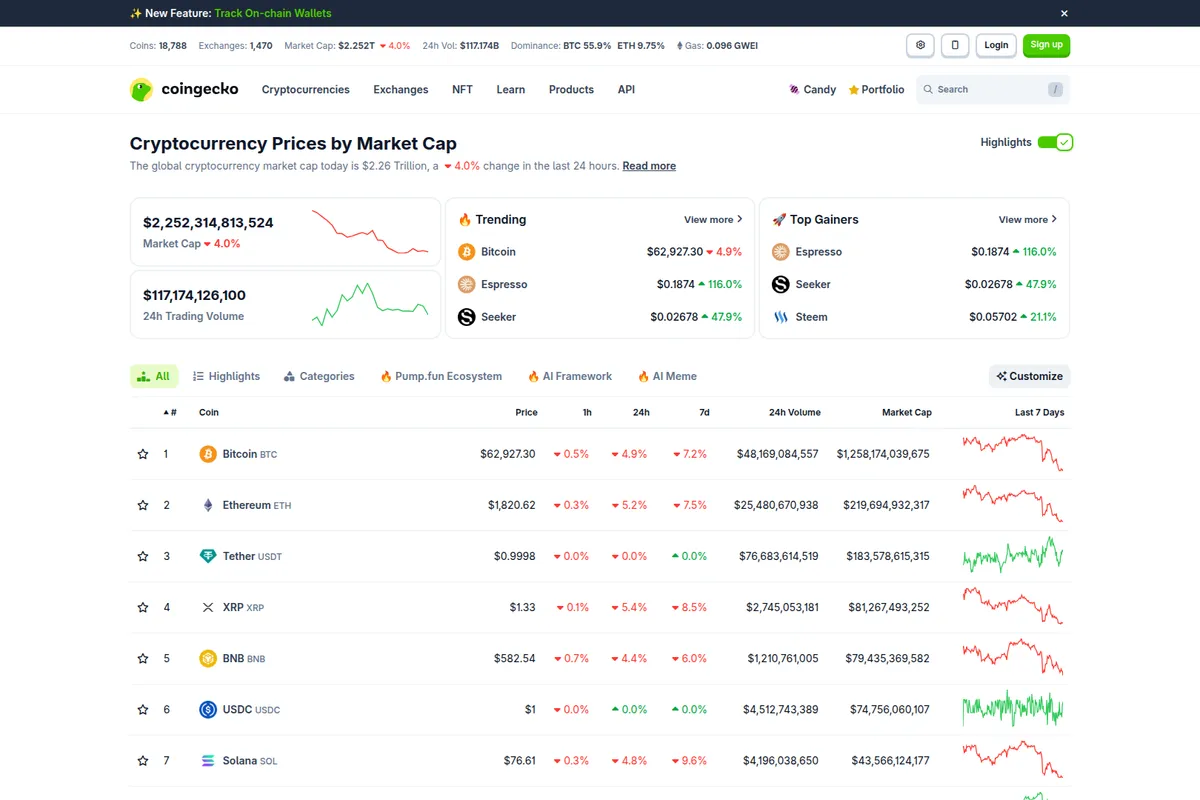
CoinGecko’s user experience is built around fast navigation between the market overview, coin pages, categories, and research tools.
On the plus side, CoinGecko’s breadth makes it a practical daily dashboard. CoinBureau describes it as a “must-use” tool for daily research, especially for verification and DeFi checks. [2] The presence of watchlists, alerts, compare tools, and educational content supports a range of user journeys from beginner to advanced.
Mobile is a significant part of the product. CoinGecko promotes iOS and Android apps with push notifications for real-time updates. [3] On its About page, it reports 1 million+ downloads and a 4.8 average app rating. [1]
The most consistent UX critiques in the dataset are about performance and density. Product Hunt commentary mentions occasional app sluggishness and requests for a lighter UI. [5] Another practical friction point is the portfolio workflow. CoinBureau notes portfolio tracking can feel manual, and CryptoAdventure stresses that performance accuracy depends on consistent entries and that DeFi complexity can outgrow simple tracking. [2] [6]
Pricing and fees
For most users, CoinGecko is effectively free. The consumer website, coin pages, discovery tools, and many portfolio features are accessible without a paid subscription, and CoinGecko even includes free daily rewards (Candy) that can be redeemed for content and perks. [4]
The main paid component in the available sources is the API. CoinBureau notes CoinGecko offers a free API tier and paid tiers. [2] Specific pricing is not included in the provided research set, so any evaluation here should focus on what is known: there is a free entry point for developers, and CoinGecko operates at very large API call volumes, suggesting mature infrastructure. [1]
Comparison with alternatives
CoinGecko competes in a crowded landscape that includes other aggregators, exchanges with their own market dashboards, and specialized on-chain analytics tools.
CoinMarketCap (closest like-for-like aggregator competitor)
If you want the closest “same job to be done” alternative, CoinMarketCap is typically the first comparison. Semrush’s January 2026 competitor report states CoinMarketCap is CoinGecko’s closest competitor and shows materially higher traffic in that month: CoinMarketCap at 81.69M visits versus CoinGecko at 21.99M visits. [7]
CoinGecko’s counter-positioning, according to CoinBureau and Product Hunt sentiment, is not necessarily “bigger,” but “more verification-first,” including quality signals like Trust Score and strong DeFi checks through GeckoTerminal. [2] [5]
Exchange dashboards (Binance, Coinbase, Crypto.com, Bitget)
DEX analytics tools (Dexscreener, GeckoTerminal)
For users whose primary need is early token discovery and on-chain market monitoring, dedicated DEX analytics tools can be stronger than general market aggregators. In the provided dataset, GeckoTerminal is highlighted by CoinBureau as a major strength for CoinGecko specifically, because it brings pool and liquidity context into the research workflow. [2]
API alternatives for developers
If your main relationship with CoinGecko is via API, there are multiple alternatives. Alchemy lists five CoinGecko API alternatives: Alchemy Prices API, CoinAPI, CoinMarketCap API, Coincap, and Coinlayer. Coinlayer’s card description includes a concrete coverage claim of “more than 25 exchanges and 385 coins.” [8]
The tradeoff typically comes down to breadth versus specialization, rate limits and reliability expectations, and whether you want a pure pricing feed or a richer dataset (metadata, categories, exchange signals) that mirrors CoinGecko’s product depth.
Final verdict
CoinGecko’s strongest identity in 2026 is as a research-first, verification-oriented crypto market data platform. Its value is highest when you are trying to sanity-check an asset, compare cross-venue prices, evaluate exchange quality using signals like Trust Score, and validate DeFi tradability via GeckoTerminal’s liquidity and pool views. [2]
It is less compelling if your priority is automated portfolio syncing, tax-grade accounting, or being the first to see every new listing the moment it appears. Both CoinBureau and portfolio-focused reviewers describe the portfolio experience as more manual, and community comments point to occasional sluggishness and requests for clearer listing policy transparency. [2] [6] [5]