Background and history
Third-party coverage pegs the exchange’s launch to 2022. FXEmpire’s “Backpack Exchange” review states it was launched in 2022 and frames it as a Singapore-based exchange, while also showing “Headquarters: Dubai, UAE” in the same page’s feature table, a reminder that Backpack’s corporate footprint can look multi-jurisdictional depending on the source and context. [2]
Key features and services
1) A combined exchange and wallet experience
The exchange itself presents three main modules, Spot, Futures, and Lend, as first-class navigation items. [5]
FXEmpire’s review, which is framed as a “Review 2026” and updated Nov 24, 2025, characterizes the exchange as streamlined and geared toward speed and simplicity, with spot and futures as the main markets. [2]
2) Spot and futures trading (plus a margin discrepancy)
There are several plausible explanations, including timing (product updates after the review), regional gating (feature availability by jurisdiction), or terminology differences (for example, cross-collateralized derivatives risk models being described as “margin”). The sources provided do not resolve this inconsistency, so prospective users should confirm in-app, for their region, what “margin” functionality actually exists before funding an account.
3) Lending, yield, and collateral utility
4) Wallet and Web3 features
5) Trading tooling: charts and API
6) Asset coverage
Security and trust
1) Exchange security signals
PoR coverage limited to a subset of assets can still be meaningful, but users should understand what is and is not included, how frequently it is updated, and whether liabilities are accounted for. The provided sources confirm PoR exists for six cryptos, but they do not detail methodology.
2) Wallet security claims: scam detection, hardware wallets, and NFT locking
3) Regulation and compliance clarity
Regulatory framing is mixed in the provided sources. FXEmpire’s narrative says Backpack operates under VARA (Dubai’s Virtual Assets Regulatory Authority) while the same page’s “Main Features” table lists regulation as “N/A.” This internal inconsistency makes it hard to treat the regulatory posture as settled based on that single page. [2]
From a user perspective, the practical implication is that you should verify the exact entity you are contracting with, what jurisdiction it is in, and what product features are permitted where you live. This is especially important for derivatives.
4) Data privacy disclosures (Android)
Google Play’s Data Safety section indicates the app may collect location, personal info, and financial info, and may share app activity and app info and performance with third parties. It also states data is encrypted in transit and that users can request data deletion. [3]
These disclosures are common for apps that provide trading and wallet services, but privacy-conscious users should still review the linked privacy notice and consider what permissions they grant.
User experience
1) Platform availability
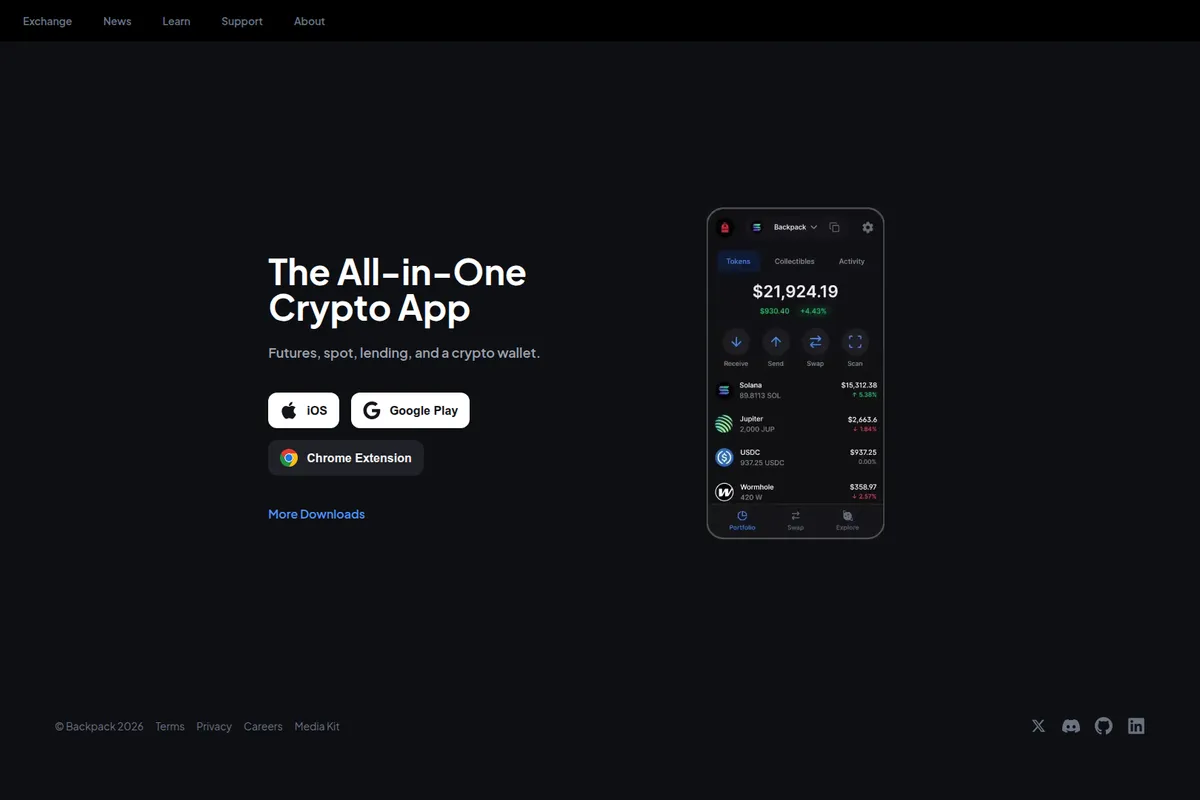
Backpack is distributed on iOS and Android, and it also offers a Chrome extension from the main website. [1]
2) App store reputation signals
As of early 2026 snapshots in the provided sources, the Android app shows a 4.2 rating with 100K+ downloads and around 1.77K reviews, and the iOS app shows a 4.4 rating based on 213 ratings. [3] [4]
3) Reported pain points: crashes, portfolio glitches, and accessibility
These issues matter more for an all-in-one app than for a single-purpose wallet. If your wallet is also your trading entry point, stability and accessibility problems can turn into time-sensitive financial risk during volatile markets.
4) On-chain transaction finality and address validation expectations
A critical iOS review alleges an address-handling glitch that dropped the last character of a Solana address, resulting in funds being sent to an unrecoverable address. Backpack’s developer response denies truncating addresses, notes that Solana transactions are irreversible, and says the address was incomplete, while also stating the team is improving validation and safeguards. [4]
Regardless of which interpretation is correct for that specific incident, it illustrates a broader truth: self-custody wallet UX must strike a balance between user freedom and safety rails. Strong preflight checks, clear warnings, and robust address validation can prevent irreversible mistakes.
Pricing and fees
Trading fees
FXEmpire reports low trading fees relative to many centralized exchanges:
- Spot: 0.08% maker, 0.10% taker (with discounted spot fees shown as 0.07% maker, 0.09% taker)
- Futures: 0.02% maker, 0.05% taker
In FXEmpire’s category scoring, “Fees” is one of Backpack’s strongest areas. [2]
Deposits, withdrawals, minimums, and USD messaging
FXEmpire describes “limited deposit and withdrawal methods” and lists deposit methods as credit or debit card, crypto, and SWIFT transfer, with withdrawals via crypto and SWIFT. It also reports a $100 minimum fiat deposit. [2]
Meanwhile, Backpack.exchange markets “Wire Transfers are Live” and claims users can deposit and withdraw USD with no fees. It also promotes converting USDT to USD with 0 fees. [5]
The most reasonable interpretation from the provided information is that fiat capabilities may be evolving, region-dependent, or subject to eligibility checks. Users should verify availability, fees charged by intermediaries (for example, bank wire fees), and the exact supported currencies in their account interface.
Comparison with alternatives
Because Backpack combines a wallet and a centralized exchange, it competes across two landscapes.
On the exchange side, established centralized exchanges often differentiate with broader asset listings, mature derivatives suites, and deeper educational and support infrastructure. Backpack’s advantages, based on the sources provided, are its low reported fees, TradingView integration, and API support, paired with a simpler product surface area. Its disadvantages include limited asset breadth and weaker support scores in FXEmpire’s review. [2]
On the wallet side, Backpack competes with dedicated self-custody wallets that are optimized for specific ecosystems. Backpack’s pitch is not just multi-chain coverage, but also wallet safety tooling like scam detection and NFT locking, plus the convenience of an integrated trading and lending stack. [4]
A practical way to decide is to consider your primary workflow:
- If you mainly trade spot and perps and care about fees and API access, Backpack’s exchange profile can be appealing, assuming features are available in your region.
- If you mainly use Web3 and self-custody, Backpack’s security-oriented wallet tooling is a plus, but app stability, accessibility, and validation safeguards become critical.
- If you want both, Backpack’s all-in-one approach can reduce friction, but it also concentrates risk in one app and one ecosystem.
One more note: some search results for “backpack app alternatives” refer to hiking and trail-navigation apps, not crypto. Those are unrelated to Backpack.app as a crypto wallet and exchange, and should not be treated as direct alternatives for trading or Web3 usage. [6] [7]
Final verdict
Backpack is an ambitious attempt to merge a multi-chain self-custody wallet with a low-fee centralized exchange and a lending layer that markets collateralized yield. The official properties emphasize futures, spot, lending, and a wallet as one cohesive app, and FXEmpire’s review supports parts of that story by highlighting low fees, TradingView integration, and API strength. [1] [2]
The main reservations are not about a single feature gap, but about consistency and operational maturity. Provided sources disagree on whether margin trading exists, and even the regulatory framing is inconsistent on a single third-party review page. Funding rails also look mixed, with FXEmpire describing limited methods while Backpack.exchange markets fee-free USD wire deposits and withdrawals. [2] [5]