Background and history
Key features and services
Permanent storage and the “pay once” model
Arweave’s central value proposition is permanence. Rather than paying recurring subscription fees to keep data hosted, Arweave is widely described as using an upfront payment model, where users pay in AR to store data indefinitely. A 2026 third-party review describes this as an endowment-style approach, where part of the fee supports long-run storage obligations, while also warning that the model’s strength depends on incentive alignment and future cost dynamics. [3]
Software directories echo this positioning in more product-oriented language. SourceForge describes Arweave as a new type of storage that backs data with “sustainable and perpetual endowments,” claiming users and developers can store data forever and describing it as a “collectively owned hard drive that never forgets.” [4]
The Permaweb, websites, and decentralized publishing
The Permaweb is the user-facing layer of Arweave. SourceForge describes it as a global, community-owned web whose content, from images to full web apps, is permanent, decentralized, and retrievable quickly, with messaging like “No more 404s” and “No more stealth edits.” [4]
Messari highlights that Arweave is built on top of HTTP, making Permaweb content accessible using modern browsers such as Brave and Google Chrome. In other words, the project’s ambition is not only backend archival, but web-native publishing and hosting for content meant to persist. [2]
Gateways and web access
Upload tooling, bundling, and the Bundlr to Irys shift
From a developer’s perspective, uploading content directly to base-layer storage can be slower or less convenient than using specialized tooling. The 2026 review describes bundling layers and SDKs as practical infrastructure that many applications depend on, and it notes the rebranding of Bundlr into Irys as part of the ecosystem’s evolution. [3]
This tooling can be a net positive, it reduces friction and makes Arweave easier to integrate. The tradeoff is that relying on intermediaries can introduce dependencies, changing workflows, and potential ecosystem fragmentation.
AO compute expansion
A major part of the newer Arweave narrative is expansion beyond storage into decentralized compute via AO. A 2026 review describes AO as a hyper-parallel computer built on top of Arweave’s permanent data layer. [3]
99Bitcoins states AO launched in 2025 and offers a simple mental model: Arweave is a permanent database, AO is a global computer for running programs. It also claims that anyone with CPU or GPU capacity can provide compute on AO, with potential use cases including AI model training, data analysis, app hosting, and automated tasks. [5]
Security and trust
Architecture: blockweave and Proof of Access
The same explainer also describes Wildfire as a self-organizing topology and reputation system meant to incentivize fast sharing and availability, summarized as “if you share with me, I will share with you.” [6]
The permanence tradeoff: integrity vs privacy and compliance
Permanent publishing has clear integrity advantages, it can reduce silent edits and make public records more auditable. However, permanence also creates risk. A 2026 review cautions that Arweave is a poor fit for transient data, frequent edits, or deletion requirements because permanence becomes a liability. [3]
Access-layer centralization risk
User experience
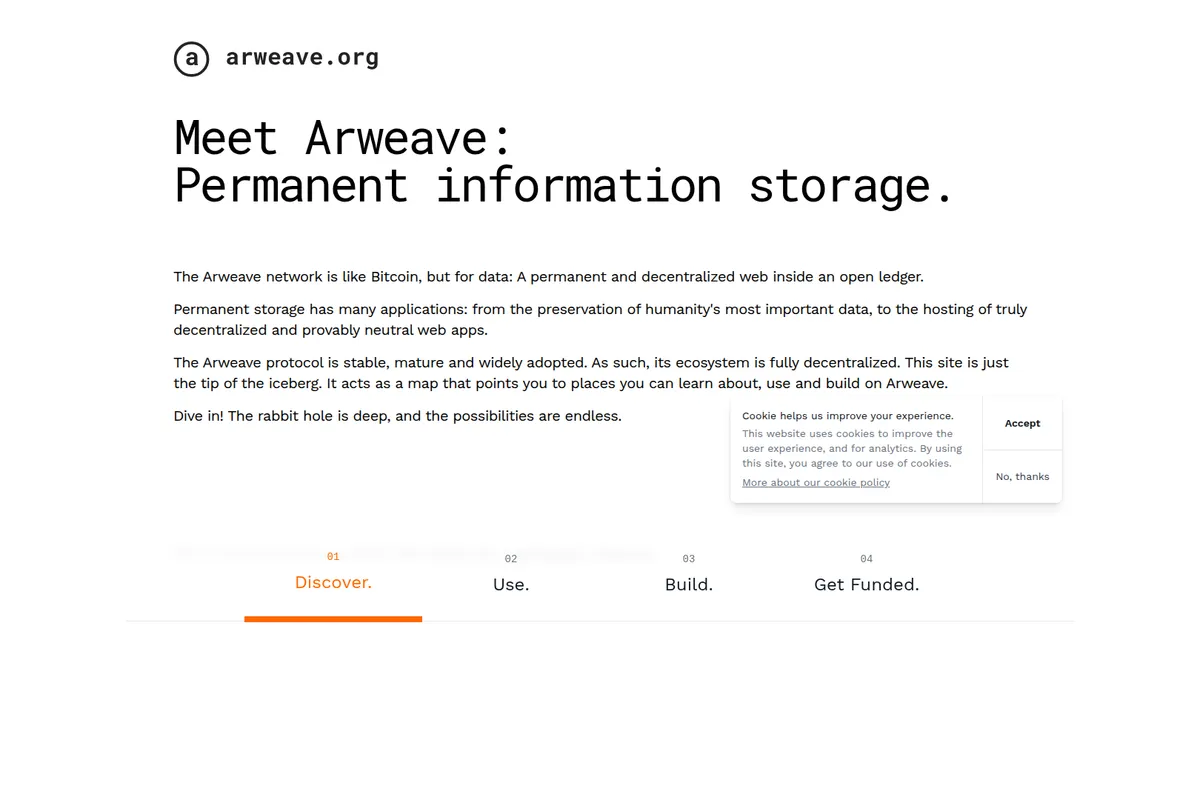
Arweave’s user experience is best understood as an ecosystem experience rather than a single app. The official site explicitly positions itself as “a map” into a decentralized ecosystem, organized around Discover, Use, Build, and Get Funded. [1]
For end users
For everyday consumption, the Permaweb aims to “look like the normal web,” according to SourceForge, with content that remains accessible over time. [4]
The caveat is that most users will depend on gateways and ecosystem applications. This typically works well when gateways are reliable, but can be confusing when users expect “pure decentralization” and encounter real-world chokepoints like gateway performance, caching, or rate limits.
For developers
Developers typically care about upload workflows, SDK maturity, and operational guarantees. The 2026 review notes that uploading directly can be less convenient and that bundling layers and tooling are common, with ecosystem evolution such as Bundlr’s rebrand to Irys. [3]
This is a familiar pattern in Web3 infrastructure: base layers provide strong primitives, while most production teams rely on higher-level tooling to meet usability and performance needs.
Pricing and fees
Arweave’s pricing is not presented as a traditional subscription schedule in the provided sources. Instead, the dominant pricing narrative is the one-time payment model.
Adoption and ecosystem signals (as stated in the sources)
Arweave’s official site claims the protocol is “stable, mature and widely adopted,” and emphasizes a community-driven ecosystem. [1]
A third-party review from 99Bitcoins presents several adoption and positioning claims, including that Arweave launched in 2018 and crossed 10 billion stored data items in late 2024. It also frames Arweave as a home for many NFT collections and as a storage layer for other chains’ data. These are useful directional signals, but they should be treated as claims from that publication within the confines of this source set. [5]
On performance, different sources provide different TPS figures. The 2018 Medium explainer claims up to 5,000 TPS. [6] 99Bitcoins claims up to 50,000 TPS, referencing scaling via Bundlr, and compares this to Solana’s 65,000 TPS maximum. These figures are presented as claims in the respective sources, not as independently validated benchmarks in the provided materials. [5]
Comparison with alternatives
Arweave’s most meaningful differentiator is permanence. Many alternatives focus on decentralized storage without the same “store forever with an upfront payment” positioning, or they emphasize storage markets, pinning services, or cloud-like object storage.
Arweave vs Filecoin
If your workload benefits from market-driven pricing, flexible retention periods, or retrieval-focused economics, Filecoin may be a closer fit. If permanence and immutable publishing are the core requirements, Arweave’s positioning is more directly aligned.
Arweave vs IPFS and pinning and media management services
IPFS is listed by Alchemy as a free distributed file storage protocol alternative. [8] In practice, many IPFS-based deployments rely on pinning or managed services to keep data available.
Pinata appears in CB Insights and Alchemy as an Arweave alternative, framed as decentralized file storage and management, and as a media management platform for Web3 builders. [9] [8]
The practical distinction is that IPFS plus pinning can be excellent for content addressing and distribution, but “permanent by default” is not always guaranteed unless additional economic or operational commitments are maintained.
Arweave vs Storj
Storj is repeatedly listed as a top alternative across CB Insights, Alchemy, and Slashdot. Slashdot shows a concrete price point of $4/TB stored per month and markets it as decentralized cloud object storage with claims of lower costs and carbon reduction. [7]
This contrast is straightforward: Storj is positioned closer to a cloud storage replacement with recurring pricing, while Arweave targets permanent retention with an upfront payment model.
Arweave vs Swarm and other decentralized storage tools
A useful way to choose is to start with requirements:
- If you need permanence and tamper resistance for public artifacts, Arweave is purpose-built for that.
- If you need flexible retention, deletion, private access controls, or conventional service-level guarantees, you may prefer cloud-like decentralized object storage or managed tooling.
- If you need compute marketplaces, CB Insights lists projects such as Akash Network in the broader competitor set, highlighting that “storage plus compute” is an adjacent competitive axis. [9]
Final verdict
Arweave is best understood as specialized infrastructure for permanent publishing and long-lived public data. Its strongest appeal is clarity of purpose: it is designed to keep information accessible and tamper-resistant for the long run, with a widely repeated “pay once” model and an ecosystem layer, the Permaweb, that aims to make permanent hosting feel web-native. [1] [4]