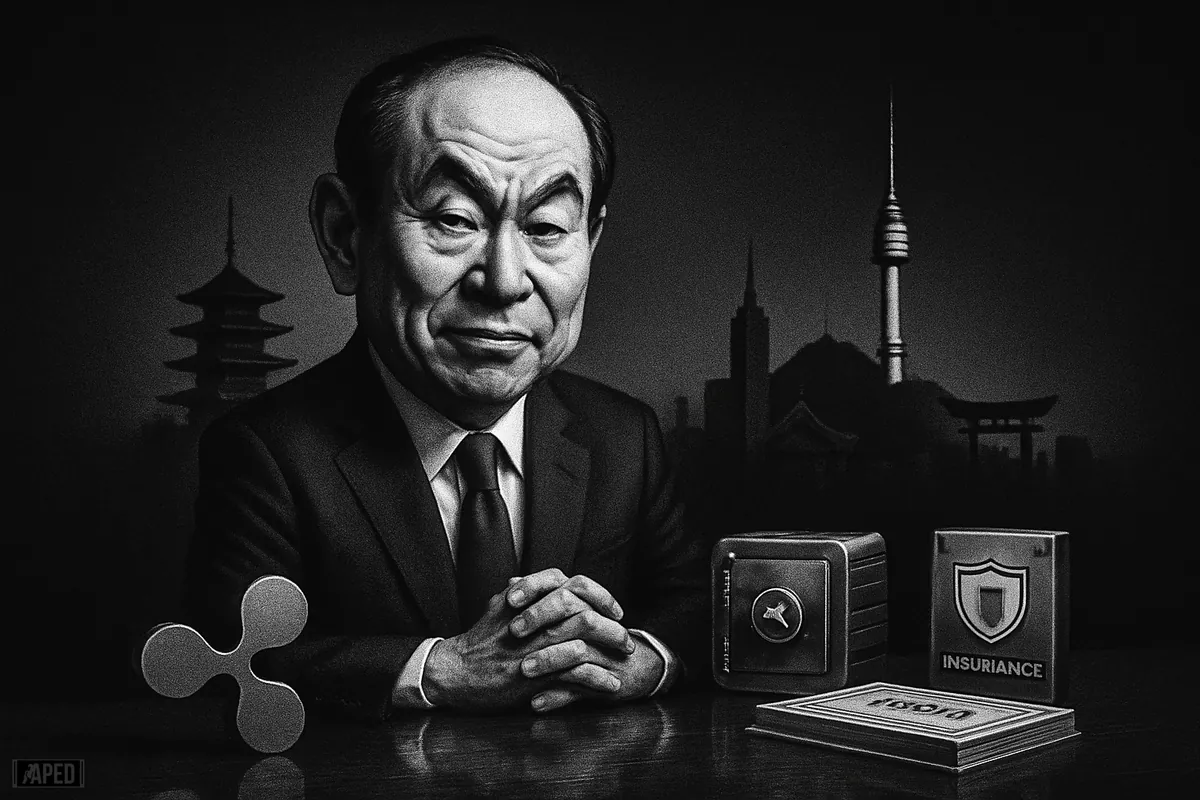
The "surprise" in Ripple's latest South Korea insurance deal looks less surprising once you follow the ownership trail. The Kyobo Life partnership is being pitched as a blockchain first for Korea's insurance sector, but the more interesting story is old-fashioned corporate choreography. At the center of it is SBI Holdings CEO Yoshitaka Kitao, who appears to have spent the past year arranging the boardroom furniture long before Ripple's tech entered the room. [1]
Ripple and Kyobo Life are working on settlement infrastructure tied to tokenized government bonds, using Ripple Custody. That is the headline. The subheadline, and arguably the real one, is that this partnership sits inside a broader SBI push to connect Japanese finance, Korean banking, and digital asset rails across Asia Pacific. Blockchains get the branding. Conglomerates do the plumbing. [2]
Enjoy articles without ads?
Register for free and get unlimited access to all articles.
The deal behind the deal
Fresh reporting around the partnership points to a multistep sequence rather than a one-off collaboration. Kitao had previously acquired a 4.99% stake in Kyobo Life for 18 billion yen. SBI Holdings then moved to officially acquire Kyobo Life on April 17, 2025, according to the source material cited around the deal. [3]
That alone would make Ripple's appearance in Kyobo's stack look more strategic than accidental. But the timeline gets more specific. By the first half of 2026, Kyobo Life is expected to complete the purchase of a controlling stake, 50% plus one share, in Korea's SBI Savings Bank for 900 billion won. On April 10, SBI and Kyobo also launched a $50 million Digital Innovation Fund II aimed at fintech startups in Southeast Asia. [4]
Put plainly, Ripple is not parachuting into a random insurance pilot. It is being inserted into an ecosystem that SBI and Kyobo have been knitting together through equity, banking control, and venture capital. Funny how these "sudden" partnerships keep arriving after the cap table is already sorted.
Kitao's importance is not just that he runs SBI. He has also been one of Ripple's highest-profile institutional backers in Asia for years. That matters because it frames the Kyobo arrangement less as a narrow product deployment and more as another node in SBI's regional digital finance buildout. [5]
SBI has long treated blockchain infrastructure as a distribution problem, not just a technology problem. Control the bank, hold the strategic stake, seed the startup pipeline, then layer in custody and settlement rails where they fit. It is not glamorous, but it is how actual financial infrastructure gets adopted. White papers rarely buy banks.
For Ripple, this is useful for obvious reasons. Insurance and bond settlement are not flashy retail use cases, but they are precisely the kind of institutional workflow the company wants to own: regulated assets, known counterparties, repeat transactions, and custodial oversight. If tokenized government bonds gain traction in Korea, being embedded early via Kyobo could give Ripple a stronger foothold than another generic enterprise proof of concept ever would.
What the Kyobo pilot is actually targeting
The key operational detail is the use of Ripple Custody for settlements involving tokenized government bonds. That suggests the project is focused on safekeeping and transfer infrastructure for digitized fixed income instruments, rather than on public crypto trading. The distinction matters. Tokenization pitches often get inflated into broad claims about reinventing capital markets overnight. Usually, the real work is much narrower: settlement, recordkeeping, collateral movement, and compliance. [6]
Kyobo's role also makes sense in that narrower frame. Insurance firms manage large pools of long-dated assets and have direct interest in efficient settlement for high-grade instruments like government bonds. If blockchain rails can reduce reconciliation overhead or improve transfer speed without upsetting regulators, that is a practical use case. Not sexy, but finance does run on boring systems for a reason.
South Korea's relevance here is also specific. A successful institutional tokenization framework in one of Asia's most digitally sophisticated financial markets would be a meaningful reference point for the rest of the region. It would not prove that every tokenization pitch is suddenly real, because of course not, but it would show that regulated incumbents are willing to test the model at production depth.
The Kyobo arrangement looks most coherent when viewed alongside SBI's cross-border ambitions. The acquisition activity, the Korean banking tie-up, and the Southeast Asia fintech fund all point to the same thesis: build an interoperable financial network across APAC, then plug digital asset infrastructure into that network where it can generate transaction flow.
That makes Ripple one layer in SBI's strategy, not the strategy itself. This is important because crypto coverage often reverses the hierarchy, treating the blockchain vendor as the prime mover and the financial institutions as passengers. Here, the institutions appear to be driving. Ripple supplies tools. SBI supplies the map.
There is also a competitive angle. Tokenized bond settlement is attracting attention from banks, custodians, and fintech platforms globally. If SBI can help establish early working relationships between insurers, banks, and digital asset providers in Korea and Southeast Asia, it may secure an advantage in the kind of regional financial stack that gets sticky over time. Once settlement and custody workflows are embedded, switching costs rise.
What this means for Ripple and XRP narratives
Investors will inevitably try to translate this into a direct XRP$1.518 price story. That is usually where nuance goes to die. The available details point to Ripple Custody and enterprise settlement infrastructure, not necessarily to immediate token demand for XRP$1.518 itself. Ripple's corporate expansion can be strategically important even when the linkage to XRP is indirect or delayed.
That does not make the development trivial. Institutional partnerships often matter because they validate distribution and compliance capability, not because they instantly move on-chain volumes in public view. If Ripple can show that its custody stack is being used in regulated bond workflows, that strengthens its pitch to other financial institutions. Markets love to skip that middle step, but it is usually the one that pays.
The Ripple-Kyobo partnership is best understood as a case study in how crypto infrastructure gets adopted when real money is involved. Not through sudden inspiration, but through ownership ties, boardroom alignment, and careful regional expansion. Kitao's fingerprints are all over that process.
What to watch next is straightforward: whether the Kyobo pilot moves beyond announcement-stage language into measurable implementation, whether South Korean regulators support broader tokenized bond settlement frameworks, and whether SBI uses this corridor to extend Ripple-linked infrastructure into more APAC institutions. If that happens, this will look less like an isolated insurance headline and more like a template. Sure, a very corporate template, but those are usually the ones that stick.
Your reviews help us improve the quality of both current and future articles. All reviews are public and visible to other readers. We use both ratings and comments to improve future articles and to revise any articles that do not meet our standards.
 See more like this on Google