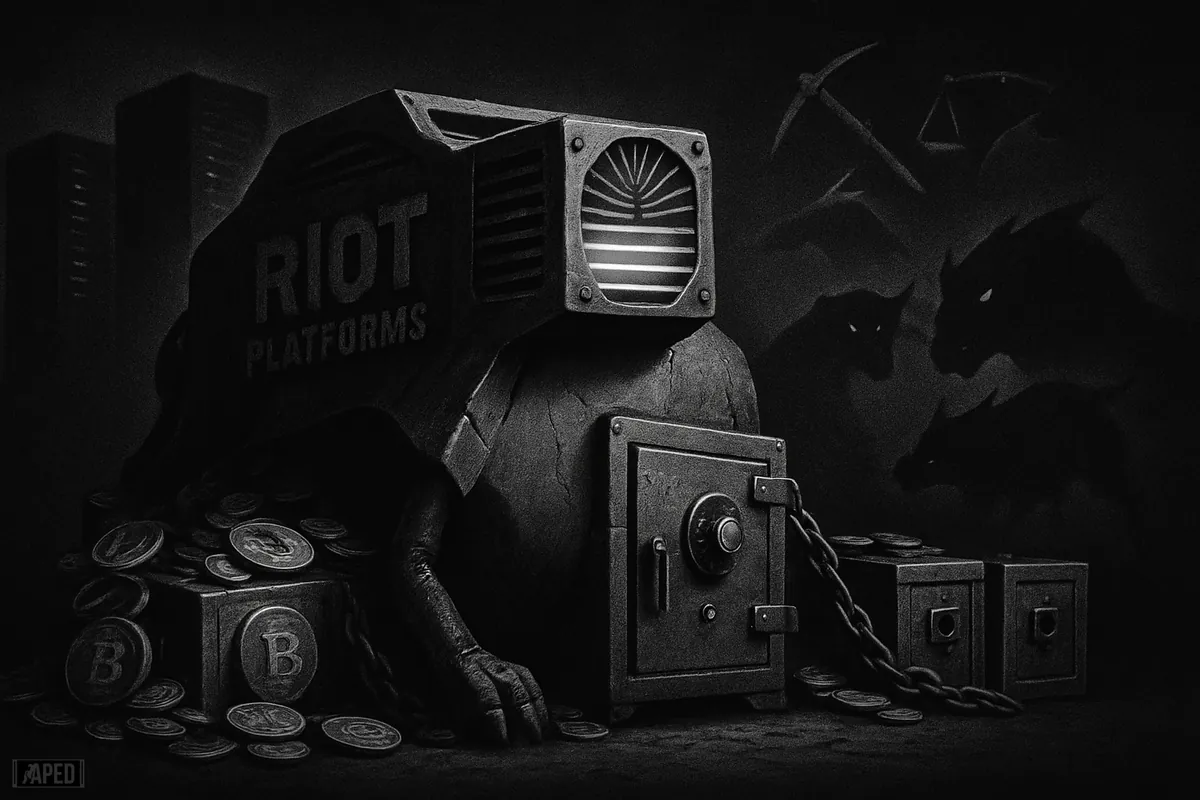
Miners are supposed to print BTC, not speedrun treasury sales. But post-halving math has been ugly, and Riot just showed the bill.
Riot Platforms said it sold 3,778 Bitcoin$81,758.74 during the first quarter of 2026, raising about $289.5 million at an average sale price of $76,626 per coin. The update landed Thursday and adds Riot to a growing list of public crypto firms tapping their Bitcoin$81,758.74 stacks as mining economics stay under pressure. [1]
That number matters because Riot only produced 1,473 BTC in the quarter. In plain English, it sold far more Bitcoin than it mined. This was not routine treasury housekeeping. It was a deliberate liquidity move.
Register for free and get unlimited access to all articles.
Riot's Q1 sales show the squeeze
Riot's production update makes the imbalance pretty clear. Selling 3,778 BTC against quarterly production of 1,473 BTC means the company offloaded roughly 2.6 times what it mined over the same period. Even for a miner with a large balance sheet, that is a strong signal that holding every newly minted coin is no longer the easy play.
The company said the sales generated net proceeds of $289.5 million. Using Riot's disclosed average sale price, those disposals happened well above spot levels seen at the end of the week, with Bitcoin$81,758.74 changing hands around $66,800 on Friday. That gap suggests Riot sold into stronger prices earlier in the quarter rather than waiting for the latest dip. [2]
Riot still held a sizable Bitcoin treasury after the sales, with about 15,000 BTC on hand, based on the company's quarter-end disclosure. So this is not a full retreat from the "HODL miner" playbook. It is more like a listed miner admitting that cash flow beats vibes when margins get pinched. [3]
The easy explanation is profitability. The better explanation is a stack of pressure points hitting at once.
Post-halving rewards are still biting
Bitcoin's halving cut block rewards in half, but electricity bills, hosting costs, and debt service did not magically do the same. That has left miners more exposed to hashprice compression, especially when networkdifficulty stays high and Bitcoin price momentum cools off.
For operators with large fleets, the game is now about efficiency and treasury management, not just raw hashrate growth. If coin production drops while operating costs remain sticky, selling BTC becomes the fastest way to fund expansion, cover fixed expenses, or avoid more expensive financing. [4]
Public miners have different constraints
Private miners can go dark. Public miners cannot. Listed companies have quarterly expectations, capex plans, and shareholders who care about liquidity. Riot's sale fits that reality. A treasury full of Bitcoin looks great in a bull market, but public markets punish balance sheet stress fast.
That is why these sales tend to cluster. Once one or two firms start monetizing holdings, it becomes easier for others to do the same without pretending it is some galaxy-brain strategy. Sometimes a sale is just a sale.
Riot is not alone
The broader signal here is that Riot's move came alongside fresh selling elsewhere in the sector. Arkham flagged a 500 BTC outflow from a Riot-linked wallet on Thursday, suggesting the treasury activity was still active around the time of the company update. [5]
Other firms have also been in distribution mode. According to the source reporting, MARA Holdings, Genius Group, and Nakamoto Holdings sold a combined 15,501 BTC over the last week. That does not automatically mean forced selling across the board, but it does point to a clear trend: miners and crypto-linked firms are increasingly willing to monetize reserves instead of treating Bitcoin treasuries as sacred. [5]
That matters because public miners have become a quasi-corporate bid for BTC over the last few cycles. When that bid softens, or flips into net selling, it changes one small but real piece of market structure.
The optimistic take is disciplined treasury management. Sell into stronger prices, lock in cash, preserve optionality, and keep enough Bitcoin on the balance sheet to benefit if the market turns higher later in the year. With 15,000 BTC still held, Riot has not exactly gone risk-off.
The less flattering take is that mining margins are weak enough that Riot had to lean harder on its reserves than bulls would like. Selling more than double quarterly output is not the kind of stat miners brag about unless they need the proceeds.
Both readings can be true at the same time. The company may be acting prudently precisely because the environment is tougher.
Why the market cares
For Bitcoin itself, miner selling is not a doom signal on its own. Riot's $289.5 million raise is meaningful for the company, but it is still small relative to overall BTC market liquidity. This is more sentiment and sector-health data than existential market structure damage.
For mining equities, though, it is a sharper tell. Investors want exposure to Bitcoin upside with operational leverage. What they do not want is a recurring pattern where that leverage gets eaten by power costs, rising difficulty, and treasury drawdowns.
That is the real story under the headline. Riot sold BTC, yes. More importantly, it showed that even large, established miners are still managing through a post-halving environment where scale alone does not guarantee fat margins.
The Bottom Line
Riot's Q1 sale was big, intentional, and hard to spin as business as usual. The company raised nearly $290 million, sold far more Bitcoin than it mined, and joined a wider wave of miner treasury sales.
If Bitcoin recovers and hashprice stabilizes, this could look smart, sell high, reload later. If margins stay weak and more miners keep hitting the bid, expect treasury sales to remain part of the 2026 mining playbook. Not bullish, not catastrophic, just the kind of math that reks narratives first.
Your reviews help us improve the quality of both current and future articles. All reviews are public and visible to other readers. We use both ratings and comments to improve future articles and to revise any articles that do not meet our standards.
 See more like this on Google