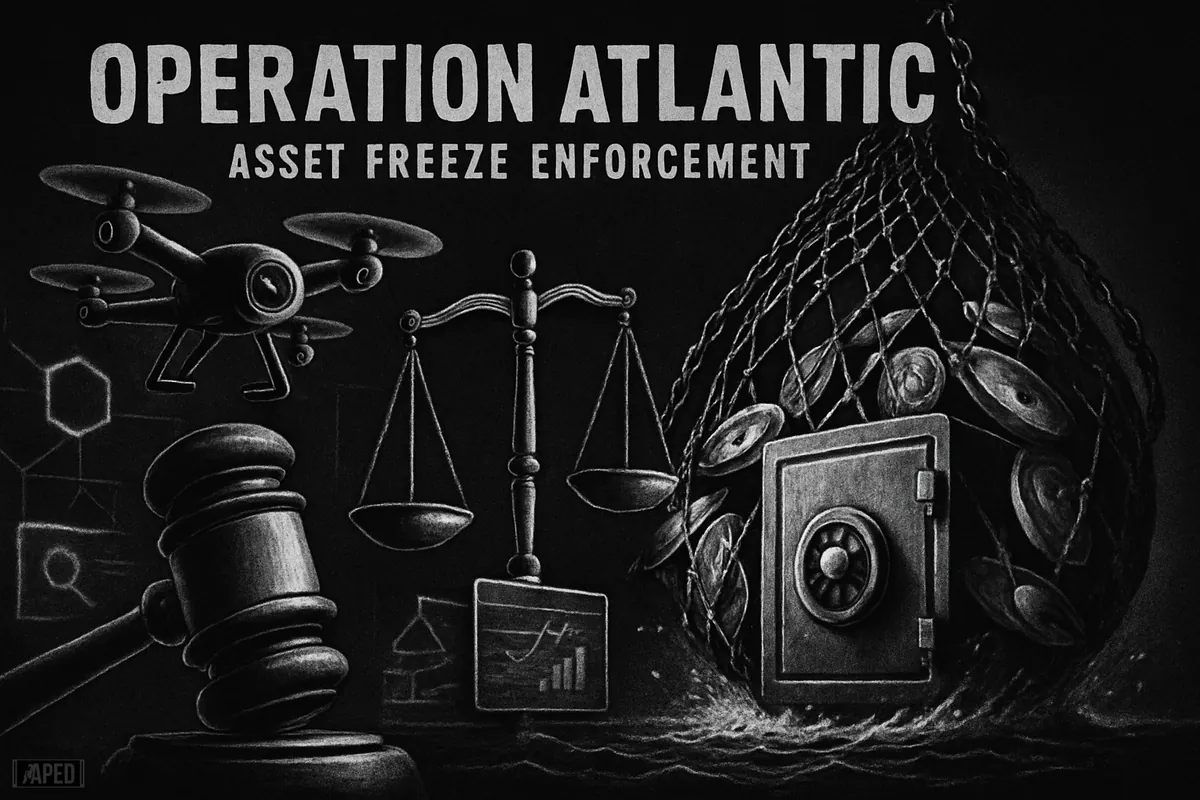
The trade here is not a token pump, it is enforcement finally getting faster. Operation Atlantic, a joint push involving U.S. and U.K. authorities plus crypto firms, has already helped trace and freeze tens of millions in stolen digital assets. The number that matters is more than $45 million disrupted, with some reports placing the broader impact closer to $62 million. For a market still fighting the "crypto is irreversible crime money" headline, that is a meaningful shift. [1][2]
Enjoy articles without ads?
Register for free and get unlimited access to all articles.
A cross-border freeze on stolen funds
Operation Atlantic is a coordinated effort between law enforcement agencies in the United States and United Kingdom, working alongside blockchain intelligence and industry partners to identify scam proceeds and lock them down before they fully disappear through the usual maze of wallets, bridges, and exchanges. [3]
The campaign appears focused less on splashy single-wallet seizures and more on process. Trace flows quickly, flag counterparties, notify platforms, and freeze funds before victims are permanently rekt. That matters because crypto theft recovery is usually a race against laundering speed, not a courtroom debate.
Authorities and private-sector participants said the operation targeted funds linked to fraud and theft schemes, with the stolen assets often moved across jurisdictions. That is where the public-private setup earns its keep. Law enforcement can compel and coordinate, but chain analytics firms and exchanges often spot the trail first. [4]
Why this operation stands out
Speed is the product
The basic problem in crypto crime recovery has never been visibility alone. Most major chains are transparent. The bottleneck is action. If investigators can identify wallets but cannot get centralized venues, issuers, or counterparties to respond quickly, the money keeps moving.
Operation Atlantic seems designed to compress that timeline. Instead of waiting for a fully built criminal case, participants move to disruption as soon as enough evidence ties wallets to illicit proceeds. Freezing first, litigating later, is often the only way to preserve value. [5]
It is bigger than one seizure number
The headline figures vary across reports, which is common in active investigations. One widely cited total says the operation disrupted more than $45 million. Other coverage points to around $62 million in fraud-related crypto being frozen or interrupted across participating jurisdictions. [1][2]
That gap does not necessarily mean contradiction. One figure may refer to directly frozen assets, while the higher number may include broader disrupted flows, linked recoveries, or later additions. The practical takeaway is straightforward: this was not a token pilot. It hit real size.
How the money gets caught
Blockchain trails still matter
Even when thieves cycle assets through multiple wallets, swaps, or bridges, they leave a pattern. Investigators map those flows, cluster addresses, and identify likely cash-out points. Once stolen funds touch a centralized exchange, stablecoin issuer, or compliant service provider, the odds of intervention rise sharply. That can include issuers of Tether$0.999021 or USDC$1.0005 when those assets move through venues able to respond to freeze requests.
That makes "crypto is untraceable" one of the market's lazier myths. Privacy tools and obfuscation methods still create friction, and some assets are harder to follow than others. But large-scale laundering often breaks down at the off-ramp.
Firms are now part of the enforcement stack
This case underscores how exchanges, analytics providers, and compliance teams have become part of the infrastructure layer for asset recovery. They are no longer just passive venues waiting for subpoenas. In many investigations, they are the first line of pattern recognition.
That evolution has strategic consequences for criminals and legit users alike. Scammers now face a narrower window to move funds. At the same time, exchanges and custodians will likely face more pressure to prove they can freeze, trace, and coordinate without overblocking lawful activity. In practice, that can extend to stablecoin ecosystems built around Binance USD (Linea)$0.99977, Tether$0.999021, or USDC$1.0005 where counterparties and issuers play a role in compliance response.
What it means for the crypto market
Operation Atlantic lands at a moment when the industry wants institutional credibility without inviting heavier-handed regulation. Successful asset recovery operations help the good-faith case for crypto by showing that stolen funds are not automatically gone forever.
There is also a market structure angle. More recoveries mean more confidence from payment firms, banks, and regulated financial institutions considering blockchain rails. Nobody expects fraud to disappear, but a stronger recovery toolkit lowers one of the biggest operational objections.
For retail users, the lesson is less comforting but more useful: recovery odds improve when stolen assets hit compliant venues, not when they vanish into opaque ecosystems. The practical defense remains boring and undefeated, hardware wallets, withdrawal allowlists, two-factor authentication, and healthy suspicion toward social engineering.
Risks and limits
This is not a magic wand. Plenty of stolen crypto will still move through mixers, peer-to-peer channels, mule accounts, or jurisdictions with weak cooperation. Some chains, tools, and asset types remain much harder to police in real time.
There is also a civil-liberties edge here. Faster freezing powers can save victims, but they raise the usual questions about due process, false positives, and who gets to decide which wallets are tainted. The stronger the enforcement stack gets, the more important transparency and auditability become.
The Bigger Picture
Operation Atlantic looks like a preview of where crypto enforcement is heading: multinational, data-heavy, and deeply integrated with private companies that control key chokepoints. That is bad news for scam operators who still think a few hops and a bridge are enough to shake the trail.
The watchlist from here is simple. First, whether authorities publish a clearer breakdown of the $45 million to $62 million range. Second, whether more exchanges and stablecoin issuers formalize rapid-freeze partnerships. Third, whether this model scales beyond scams into bigger thefts and state-linked laundering. If it does, the market may be entering a new phase where stolen crypto moves fast, but recovery moves faster.
Your reviews help us improve the quality of both current and future articles. All reviews are public and visible to other readers. We use both ratings and comments to improve future articles and to revise any articles that do not meet our standards.
 See more like this on Google