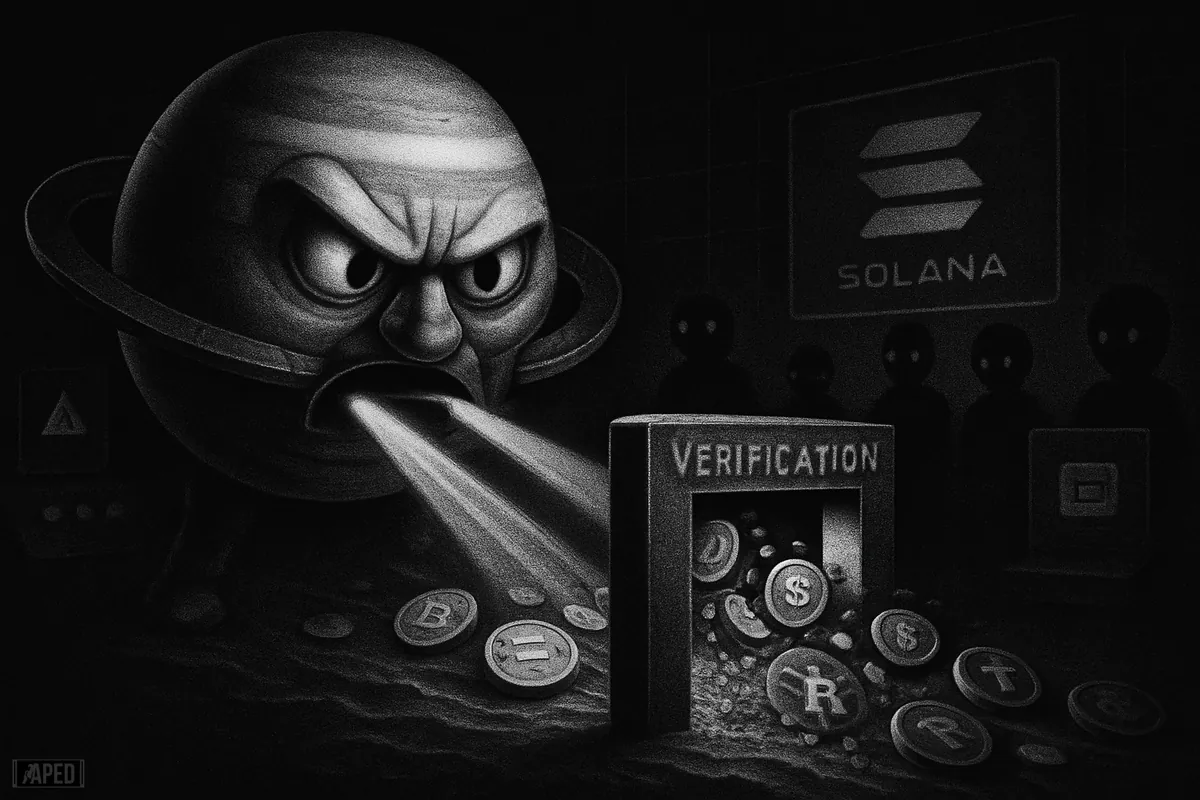
Jupiter$0.2076 has rolled out a Token Verification API aimed squarely at one of Solana$76.56's messiest problem sets: figuring out which newly created tokens are legit before users, launchpads, or bots ape in. The immediate catalyst is simple enough, Jupiter wants verification baked directly into token creation and trading flows, not bolted on after the damage is done. [1]
That matters because Solana's launchpad economy moves at absurd speed. New mints appear by the minute, copycat tickers are common, and AI agents now route trades fast enough to turn a bad token list into a proper liability.
Register for free and get unlimited access to all articles.
What Jupiter actually launched
The new API gives external platforms a way to query Jupiter's token verification data and use it inside their own products. That includes decentralised exchanges, launchpads, wallet interfaces, and increasingly, autonomous trading agents. [2]
Rather than forcing users to leave an app and manually cross-check a mint address, the tool lets builders surface token status during onboarding, listing, and execution. If it works as intended, a launchpad can screen a token before it goes live, a DEX can flag suspicious assets, and an agent can avoid routing flow into obvious spoof contracts. [3]
This is less flashy than a new trading engine, but arguably more useful. Solana has not lacked token creation tools. What it has lacked is a widely embedded standard for deciding whether a token is genuine, impersonating another asset, or carrying obvious metadata issues.
Why this is landing now
Jupiter is leaning into a role it has increasingly claimed on Solana: infrastructure provider, not just swap venue. The aggregator already sits in the middle of a huge amount of retail and application order flow, which gives it a natural vantage point on what people are actually trading and where dodgy assets tend to appear. [4]
The timing also reflects how token discovery has changed. Launchpads used to be the main gatekeepers. Now wallet feeds, bots, and AI agents are all part of the funnel. Once machine-driven traders start scanning newly issued tokens, bad metadata and fake branding become a much bigger operational risk. A human might hesitate at a suspicious ticker. An agent will just execute if the input data looks clean.
That makes verification an API problem, not just a UI problem.
Jupiter has framed the product as a public-good style layer for the ecosystem, and the logic checks out. Solana's token layer is open by design, but that openness has produced a lot of low-quality issuance, ticker squatting, and fake "official" assets. [5]
A verification API does not eliminate scams. It can, however, reduce the dumbest failure modes:
What builders can do with it
Check whether a token is recognised and verified
Pull standardised token information
Add verification checks to launch flows
Filter assets for trading interfaces or agents
Reduce impersonation risk from duplicate names and symbols
That is especially relevant for launchpads trying to avoid reputational damage. If a platform lets users create and market tokens in a few clicks, it also inherits some responsibility when traders get rugged, or at least hopelessly confused.
Why AI agents are in the headline
The mention of "agents" is not marketing fluff. It is a clue about where order flow is heading.
Crypto apps are increasingly experimenting with automated agents that can search, evaluate, and execute trades with minimal user input. On paper, that sounds efficient. In practice, it introduces a new attack surface. If an agent sees two tokens with the same symbol and no strong verification layer, it may buy the wrong one faster than a human can blink. [6]
Jupiter's API is basically trying to become a trusted data source for those systems. That would give the firm a stronger position in the stack. Not just where trades are routed, but where tokens are classified before trades even happen.
That strategic move is worth watching. Data standards tend to look boring until everyone depends on them.
For launchpads, the biggest upside is pre-trade hygiene. Verification can be integrated at the point of token creation, before an asset is shown to users as if it were battle-tested. That should help reduce accidental listings of misleading or incomplete projects.
For DEX front ends, the benefit is more defensive. A venue can still remain permissionless while adding clearer warnings and trust signals around assets. That is often the practical middle ground in crypto: keep the rails open, but stop pretending every token deserves the same presentation.
For wallets and portfolio apps, there is also a discovery angle. Verified token information improves search, asset display, and routing. That sounds mundane, but UX failures are often where scams get their edge.
The limits of verification
No one should confuse "verified" with "safe." Verification typically means a token's identity, metadata, or association has been checked against some standard. It does not guarantee healthy liquidity, sane tokenomics, honest insiders, or a future that is not a bit of a mess.
Bad actors can still launch compliant-looking assets. Mercenary rotations can still pump and dump verified tokens. Thin pools can still create violent slippage. None of that disappears because an API label says a token is real.
There is also the centralisation question. If Jupiter becomes the de facto verification layer for Solana apps, its standards and review processes start carrying outsized influence. That may be acceptable if the system stays transparent and useful, but ecosystems should be wary of invisible gatekeepers, even competent ones.
Why it matters
This launch is not about a new token or a quick price catalyst. It is about trust plumbing, which tends to matter more over time than whatever CT is shouting about today.
Jupiter is trying to turn token verification into default middleware for Solana's launchpads, DEXs, and trading agents. If adoption follows, fewer users will get caught by obvious impersonation plays, and more apps will treat token legitimacy as a machine-readable input rather than an afterthought.
The invalidation is straightforward: if builders do not integrate it, or if verification quality slips, this becomes another nice-sounding safety layer that traders ignore. But if the API becomes standard kit across Solana, Jupiter will have tightened its grip on one of the ecosystem's most valuable choke points, trusted token data.
Your reviews help us improve the quality of both current and future articles. All reviews are public and visible to other readers. We use both ratings and comments to improve future articles and to revise any articles that do not meet our standards.
 See more like this on Google